
The rhythmic foundation is what separates genres from each other the fastest. Hip-hop has its beat, house has its own, rock'n'roll has its own. Italo Disco also has a recognizable rhythmic pattern assembled from a few base structures. Here's how the signature rhythms of the genre were programmed on the Roland TR-808 and other drum machines of the era.
The Main Pattern
The classic Italo Disco rhythm in its simplest form:
- Kick: on every quarter - 1, 2, 3, 4. This is "four on the floor," the common denominator of all dance music.
- Clap: on beats 2 and 4. The "and-two-and-four" accent.
- Hi-hat: in eighths or sixteenths, for drive.
- Snare: sometimes on 2 and 4 instead of the clap or together with it.
This base formula is the foundation of 90% of Italo Disco tracks. Variations come through accents, filters, percussion, and pauses.
Why the TR-808 Is So Important
The signature Italo Disco rhythm sound is inseparable from the Roland TR-808. Its sounds had specific qualities:
- A "plump" bass kick with a signature low-frequency rumble.
- A sharp clap with a signature synthetic color.
- A "ticking" hi-hat - metallic, easy to recognize.
- Specific toms with a humming tail.
- A resonating snare.
No other drum machine gave the same signature "flavored" sound. The TR-808 became synonymous with the genre's rhythm.
Kick Patterns
Variations on the base kick:
- Classic "four on the floor." Kick on every quarter, even delivery.
- With a skip on beat three. 1-2-_-4, builds a feeling of tension.
- With a double hit. An extra kick on the "and" before the main beat.
- With syncopation. An accent shift that builds "rocking."
Most classic Italo Disco tracks use the first, simplest option. But variations add variety to more complex works.
The Clap as the Main Accent
The clap is one of the most recognizable elements of Italo Disco. It usually sounds on beats 2 and 4 of the bar, building the signature rhythmic frame. That's the same backbeat as in rock'n'roll, but performed with the synthetic TR-808 sound.
Many Italo Disco producers reinforced the clap with additional effects:
- Reverb. A signature "bathtub" of space around the clap.
- Layers. Several claps with small time offsets.
- EQ. Emphasizing midrange for "punchiness."
All of that made the clap one of the most noticeable elements in the mix.
Hi-hat Patterns
The hi-hat in Italo Disco usually works continuously, building the "drive" of the whole rhythm. Typical options:
- Closed eighths. "Tsk-tsk-tsk-tsk" eight times per bar.
- Sixteenths. An even denser pattern, 16 hits per bar.
- Closed plus open combination. An open hat on the "and" of each beat gives a syncopated effect.
- Accents. Periodic emphasis on specific hits.
The choice depends on the tempo and mood of the track. Fast compositions use sixteenths, calmer ones - eighths.
The Open Hat as a Signal
The open hi-hat in Italo Disco is often used as a structural element. It marks transitions, emphasizes important moments, builds a "shining" layer in the high frequencies.
A classic device - the open hat on the "and" of beat four of the last bar before the chorus. That works as a "here comes the main thing" signal, preparing the listener for the emotional peak.
Toms and Percussion
Toms are used rarely in Italo Disco but effectively. Typical applications:
- Transitions. Short tom fills between sections of a track.
- Accents. Emphasis on especially important moments.
- Melodic lines. Sometimes toms play simple melodies.
- "Jungle" textures. For exotic tracks like "Tarzan Boy".
The specific TR-808 tom sound - with a humming tail - made them a recognizable calling card of the era.
Programming Patterns
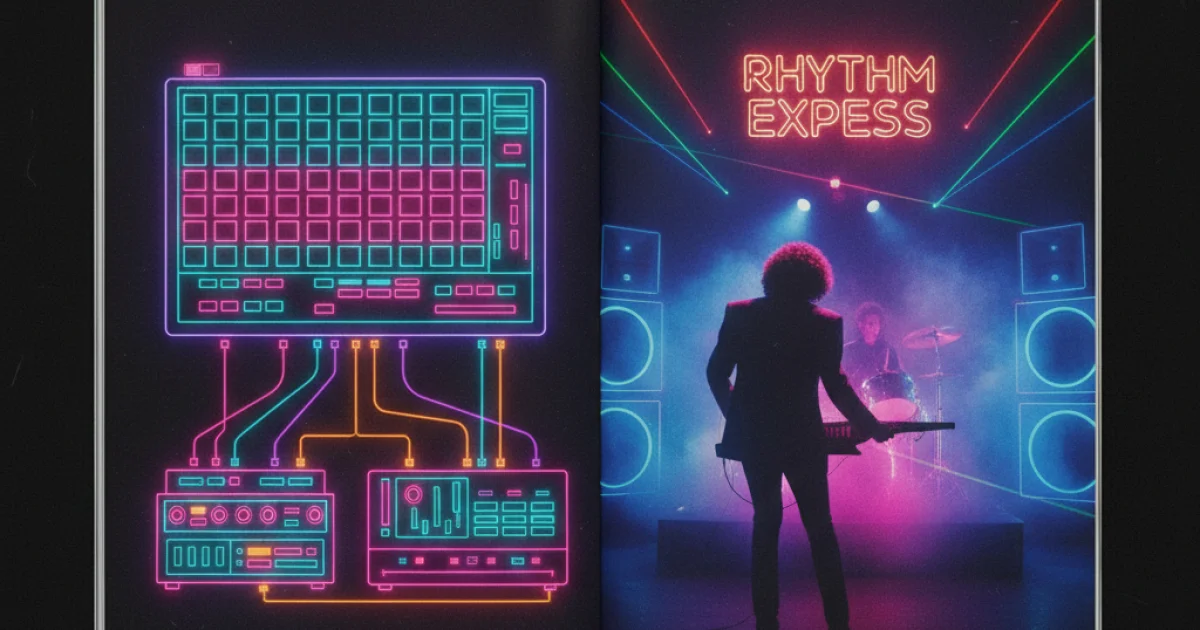
Programming rhythm on the TR-808 required specific skills. The machine had sixteen steps per bar, and the producer "placed" hits on these steps via buttons. It was a process requiring rhythmic sense and experience.
A typical Italo Disco pattern was programmed in roughly 10-15 minutes by an experienced producer. For fast conveyor-line production that was critical - the faster the rhythm foundation is built, the faster the whole track is recorded.
LinnDrum and Alternatives
Besides the TR-808, Italo Disco sometimes used LinnDrum - a more "live" drum machine with samples of real drums. The LinnDrum sound is more "premium" - that's how the work of leading American producers of the time sounded.
Some Italian producers with big budgets used LinnDrum for "solid" projects. But mass Italo Disco was built on the TR-808 - a budget but recognizable machine.
Tempo as a Criterion
Italo Disco tempo is usually in the 118-130 BPM range. That's the optimal rhythm for the dancefloor:
- Slow ballads: 110-118 BPM.
- Classic dance: 120-125 BPM.
- Energetic numbers: 126-130 BPM.
- Late transitional (close to Eurodance): 130-138 BPM.
Most classic hits are in the central zone of 120-125 BPM. It's a comfortable tempo you can dance to for hours.
Comparison with Neighboring Genres
The rhythmic structure of Italo Disco differs from close genres:
- vs American disco. American disco has more "live" rhythms with accents, Italo Disco - more electronic and even.
- vs house. House has a tighter beat, fewer melodic accents in the rhythm section.
- vs synth-pop. Synth-pop (Depeche Mode, Pet Shop Boys) uses more complex, non-standard patterns.
- vs Eurodance. Eurodance speeds tempo to 130-140 BPM, uses a more aggressive kick.
In this comparison Italo Disco takes a "middle" position - electronic enough, but not harsh; dance-oriented, but melodically rich.
Eastern European Specifics
Soviet Italo Disco clones often used simplified rhythmic patterns. The technical base was weaker (TR-808s were rare), so producers worked with more primitive drum machines or even live drummers imitating electronic rhythms.
That gave Soviet tracks a slightly different rhythmic character - less "sterile," a bit more "live." But the base principle - kick on every beat, clap on 2 and 4 - stayed.
Rhythm in the Present
Signature Italo Disco rhythms are actively used in modern music. Synthwave artists practically inherit these patterns wholesale. Modern retro producers recreate TR-808-like sounds through plugins.
The Weeknd's "Blinding Lights," many Dua Lipa tracks, Bruno Mars work on rhythmic foundations laid by Italo Disco in the '80s. That's direct proof that the genre's rhythmic discoveries keep working forty years later. Four hits on every quarter plus a clap on 2 and 4 - the simplest formula, which turned out to be one of the most durable in the history of pop music.
Tempo, half-time and manual calculation are covered in the guide to what BPM means in music.
A first sixteen-step beat is built from scratch in the guide to using a drum machine.