
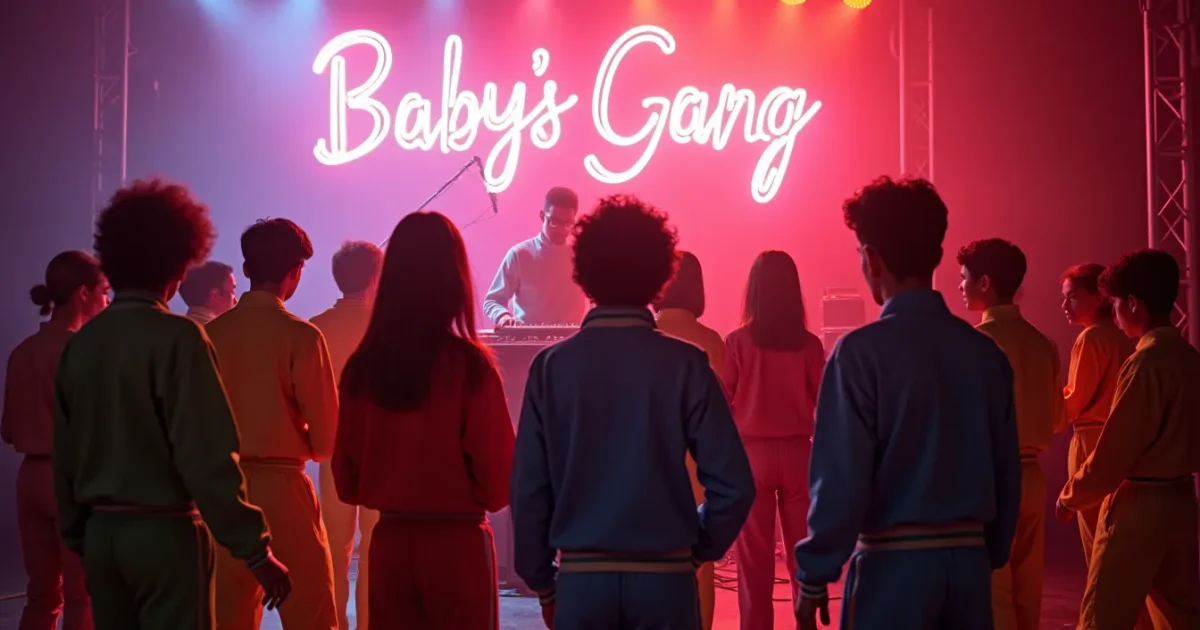
1983. Italian producer Alfredo Pignagnoli gathers thirteen teenagers in a studio and gives them a simple brief: sing easy English phrases over an electronic beat. The result is the single "Happy Song," which two years later reaches European charts thanks to a cover by Boney M. The project is called Baby's Gang, and it is one of the strangest cases of a children's choir turning into an Italo Disco act.
Baby's Gang entered genre history not as a solo artist, but as a studio construction: children at the front, adult producers behind the desk, Memory Records as the label, and a sound that felt childlike and club-ready at the same time. This case shows how, in Italo Disco, sound and image could matter more than the identity of the performer.
Why a children's choir?
By 1983 Italo Disco already had established vocal models: melancholic male vocals in the style of Savage, theatrical intonations from Gazebo, robotic parts from Den Harrow. Pignagnoli chose a different path - a children's choir that sounded innocent and danceable at the same time. This made Baby's Gang stand out: at the time almost no one in Italo Disco used children's voices as the lead element.
The idea was not unique in global pop music - think of children's choirs in 1970s disco or later eurodance projects. But in the context of Italian electronic dance music it was a novelty. A children's choir provided instant recognizability and opened the door to an audience younger than Italo Disco's core target segment.
How a children's Italo project was born
Alfredo Pignagnoli worked in the Italian music industry as an arranger and producer. In the early 1980s he realized that European dance music was looking for new images. After the success of children's choirs in pop music and the spread of synthesizers, an idea emerged: build a group where the vocals would sound high and almost childlike, while the arrangement would be full-scale Italo Disco.
In 1983 Pignagnoli brought Ivana Spagna into the project - a young singer who later became a solo star with "Easy Lady." She became the face and lead voice of Baby's Gang, although the studio recordings featured a choir of thirteen teenage girls. Various sources list names such as Caterina, Cristina, Debora, Denise, Federica, Ilaria, Laura B., Laura M., Lisa, Maria Grazia, Mary, Patrizia, Sara and Vittoriana. They were not professional singers, but ordinary teenagers chosen for a specific sound.

"Happy Song": from single to European hit
Baby's Gang's debut single, "Happy Song," was released in 1983 on Memory Records. The track followed a simple formula: a repeating chorus, a light synth riff, a children's choir and a dance tempo around 120 BPM. The song was written by Pignagnoli, Spagna and Otto Bacciocci. The release on Memory Records was produced by Alessandro Zanni and Stefano Cundari, the label's founders. The 12-inch maxi-single came out as MEMIX 011, the German license as ZYX 5076 and the Spanish as Blanco y Negro BNS-104, with "Ice Cream" on the B-side.
In Italy the single received a modest response, but the real breakthrough came in 1985 when German group Boney M. recorded a cover of "Happy Song." The Boney M. version made the song recognizable across Europe and redirected attention to the original Baby's Gang recording. From that point the project was no longer a one-off experiment. The original Baby's Gang version, however, had a drier synthesizer sound and less dramatic vocals.
The Boney M. cover landed at a time when the group was experiencing a second wave of popularity after their run of 1970s hits. For Baby's Gang it meant instant international exposure without the need for their own touring schedule.
After "Happy Song" came further singles:
- "Challenger" (1984)
- "America" (1985)
- "Jamin" (1985)
- "Step by Step" (1985)
- "My Little Japanese Boy" (1986)
- "Disco Maniac" (1988)
Many of these tracks were arranged by the same writers who worked on other Memory Records projects. Composers behind K.B. Caps and Koto often crossed paths in the label's studios.
Albums and the end of the group
Baby's Gang's debut album, Challenger, appeared in 1985. It included the already-released singles and several new tracks in the same style. A second album, Child Disco, came out in 1989, by which time mainstream interest in classic Italo Disco was fading across Europe.
By the late 1980s the project had effectively ended. Ivana Spagna left for a solo career and released "Easy Lady" in 1986 - a hit that overshadowed Baby's Gang's entire catalogue. One of the choir members, Denise Bonfanti, later tried a solo singing career without significant success.
Sleeves and visual image
The visual side of Baby's Gang was part of the marketing strategy. The sleeves of the singles and the Challenger album showed teenagers in bright clothing against geometric shapes and neon colors - typical design for Italian dance releases of the mid-1980s. This imagery told the buyer that the music was fun, carefree and danceable. At the same time the full names of the members rarely appeared on the covers, underlining the anonymity of the studio project.
Memory Records' internal policy assumed that the artist's face mattered less than a memorable hook. Baby's Gang fit this model perfectly: they had a strong visual code and instantly recognizable sound, but no need for a personal story for each member.
Detail: despite the name, Baby's Gang were never a "band" in the usual sense. They had no fixed line-up, no rehearsals and no conventional tours. They were a studio project where sound and image mattered more than individual personalities.
Baby's Gang's sound in the Italo Disco context
Baby's Gang combined several elements typical of Italo Disco:
- eighth-note synth bass
- simple major-key harmonies
- a drum-machine beat
- melodic female/childlike vocals
- minimal lyrics, maximum hook
At the same time the project differed from classic Italo Disco by avoiding the melancholic vocal style of Savage or Gazebo. Baby's Gang sounded brighter and more playful, placing them closer to European synth-pop and teen pop than to the nocturnal Milan disco sound. Most tracks stayed in the 116-124 BPM range, slightly slower than the classic 128 BPM Italo hits, making the songs more accessible to a younger audience.
Instruments and arrangement
The arrangements used instruments standard in Italian studios of the mid-1980s: Roland Jupiter-8 and Prophet-5 for melodic lines, LinnDrum or Roland TR-808 for drums, Minimoog or equivalent synthesizers for bass. Vocals were recorded by layering several children's voices to create a choir effect. This was cheaper than working with professional session singers and produced the characteristic "schoolyard" timbre.
The mix of children's voices with a hard electronic beat became Baby's Gang's trademark. The listener heard innocence and dance energy simultaneously - a combination that worked on radio, in clubs and at children's parties.

Connections to other Memory Records projects
The Memory Records studio ecosystem in the mid-1980s operated like a factory: the same musicians, arrangers and engineers moved between projects. Baby's Gang recorded in the same studios as K.B. Caps, Koto and early Ivana Spagna releases. This explains the sonic similarity across many label releases - they drew from the same pool of instruments and arranging techniques.
Songs such as "Happy Song" and "Challenger" later served as references for other label projects. The melodic riff of "Disco Maniac" became the basis for Koto's 1992 track "Mind Machine" - an indirect acknowledgment of Baby's Gang's influence on the Italian electronic scene.
Reissues and modern life of the catalogue
During the 1990s and 2000s the Baby's Gang catalogue was reissued on Italo Disco compilations, especially in Germany and Japan where interest in the genre remained steady. Compilations often included "Happy Song" and "Challenger" as examples of unconventional Italo Disco. In digital catalogs these tracks still appear on retro-disco playlists, although the group never achieved the cult status of Ken Laszlo or Ryan Paris.
Today Baby's Gang are remembered more as a curiosity of Italian dance industry than as an influential project. Their contribution to the genre lies in demonstrating the flexibility of the Italo Disco formula: under an electronic beat and a repeating hook you could place not only an adult melancholic vocal, but also a children's choir.
Why Baby's Gang still matter
Baby's Gang proved that Italo Disco could be not only nocturnal and adult, but also childlike and almost playful. The project never reached the cult status of Den Harrow or Savage, but its formula - children's choir + electronic arrangement + club tempo - proved viable and influenced later European children's and teen pop projects.
The main lesson for today's listener is that Italo Disco relied on image as much as sound. Baby's Gang lasted only as long as their sound felt fresh. Once the children's choir ceased to be a novelty and Ivana Spagna moved on, the project dissolved into the broader stream of Italian dance music - leaving behind a handful of bright singles and one of the genre's most unusual stories.
Listening to Baby's Gang today, "Happy Song" sounds like a typical example of how Italian producers of the 1980s could turn any vocal image - even a children's choir - into a dance product. It is not profound music, but its lightness carries part of Italo Disco's DNA: efficiency, memorability and the ability to work with limited resources. For collectors of vinyl singles Baby's Gang remain interesting precisely because their releases are rare and capture the aesthetic of mid-1980s Memory Records.