

1992. Sony introduces the MiniDisc format - 74 minutes of digital audio on a magneto-optical disc the size of a floppy. That same year in Russia, a DJ in a provincial House of Culture mixes music on two Soviet-made Mayak 240-S cassette decks, with no crossfader and no beatmatching. "1990s DJ" is a query with a steady stream in Wordstat: people are looking for what 1990s DJs worked with and how, in an era of transition from Soviet equipment to vinyl, from cassettes to CD, and from CD to MP3. Let's break it down by sources - formats, mixing technique, where records came from, and when new formats arrived in Russia.
Vinyl: Technics, Chinese turntables and "the barrel"
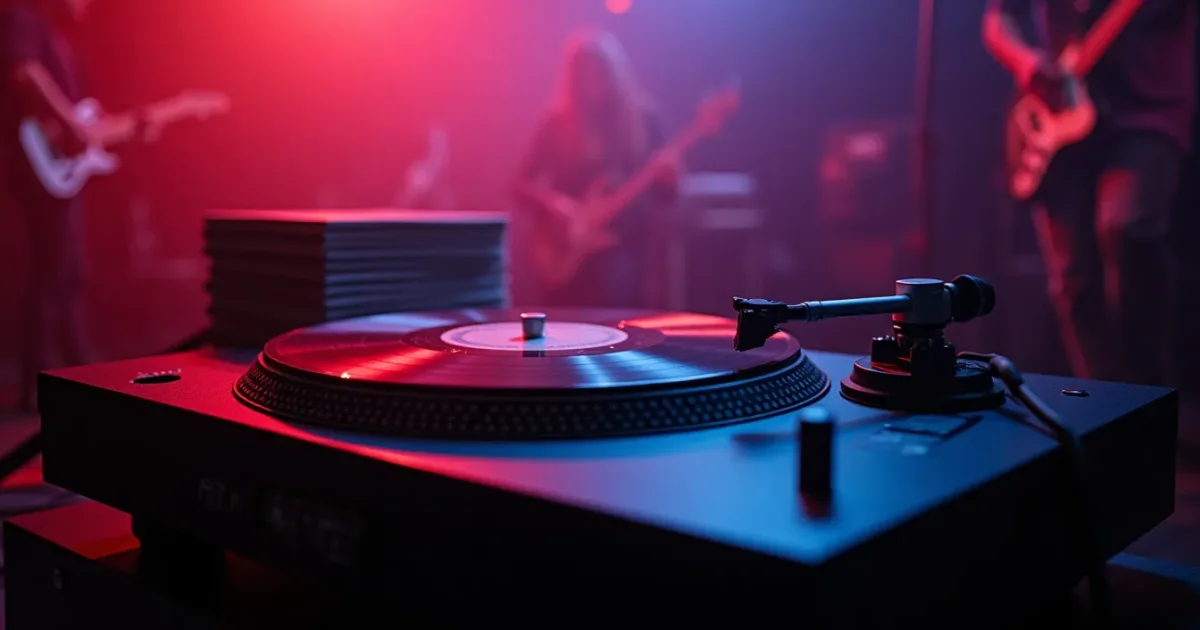
The Technics SL-1200MK2 - direct drive, quartz stabilisation, pitch-control slider. Released in the summer of 1979, it became the global standard for DJ turntables. In Russia in the early 90s it is unobtainable: the price of a single SL-1200MK2 exceeds a provincial DJ's annual income. "Of course, nobody had the money for Technics," recalls DJ Madman, who worked in Ulyanovsk. In 1998 the venue "Khudozhka" bought its first vinyl turntables - Chinese ones. Technics arrives later - the SL-1200M3D, released in 1997: recessed power button, reset button, no click at the zero pitch position.
A DJ who decides to work on vinyl faces the problem of access to records. Vinyl as a mass medium in Russia is dying by the mid-90s: groups stop releasing albums on records, switching to CD. In 1993 the band Alisa releases a vinyl LP on Moroz Records - one of the last mass vinyl releases. For records, DJs travel to Moscow. The top regional DJ Igor Lobynin (DJ Virus) played disco-house, "travelled to Moscow for records, and had the freshest stuff". Vinyl cost money, took up space, and required needles and cartridges - all imported via an "ordered - shipped - delivered" chain that took from two weeks to several months.
For the BPM and tempos DJs chose for mixing on these turntables, see the guide on BPM for an italo-disco DJ set. For how 1990s discos were organised technically - turntables, light, acoustics in the DK - see the breakdown of the 1990s disco setup.
In the 1980s it was no better. The Pyramid disco (Kuibyshev, 1980-1982) ran on three reel-to-reel Mayak tape recorders, a mixer, a powerful amplifier, speakers, and a control panel for visual effects. Until 1985, a DJ was obliged to have the list of all songs approved by the culture department of the district party committee. By the early 90s this requirement was gone, but the habit of planning the evening in blocks - slow dances in the first set, dance in the second - remained.
Cassettes: Mayak, Elektronika and beatmatching without beatmatching
Before vinyl - cassettes. Two Mayak 240-S cassette decks, made by the Mayak factory in Kiev, are the typical early-90s setup. Between them sits an Elektronika-03 console: analog, with potentiometers, no crossfader. The transition between tracks is "pause" on one deck, "start" on the other. Beatmatching - synchronising the tempo of two records, introduced by Francis Grasso in 1969 in New York - is technically impossible on cassette decks: there is no speed control. The only way to "mix" is to choose tracks with a similar tempo and switch in the pause between verses. On direct-drive vinyl turntables beatmatching is possible: the pitch fader changes the platter speed, and the DJ synchronises the tempo of two records into a continuous flow. But vinyl in the early 90s is a privilege of the few. For most 90s DJs in Russia, beatmatching remained a theory heard on Radio Maximum.
Records for cassette decks were obtained at cassette-recording studios. In Ulyanovsk in 1993-1995, the "Avtograf" studio worked on Karl Marx Street, on the first floor of the Kontaktor factory: a person arrived with a blank cassette, chose from a list printed on a dot-matrix printer, and left with a recording. Another channel was recording from the radio. Radio Maximum in the early 90s was the main source of information about dance culture. DJ Fonar hosted a dance programme from which DJs learned "what vinyl is, what turntables are, and how this culture works".
In Moscow, meanwhile, clubs of a new format were opening. DJ Fonar recalled: "It was the era of new-format discos. First, it became possible to work at night. Second, there were full bars." Clubs like The Red Zone, "U Lissa", Jump - Jump held up to 2,000 people, "U Lissa" sprawled across half the Olimpiysky. The entertainment programme was built around two live acts, with dance blocks between their sets, and the clubs ran six days a week. In these clubs, DJs already worked on vinyl turntables - imported, not Chinese: Technics, Vestax. Moscow lived on a different schedule of access to equipment and music: here were people who travelled to Europe for records, and shops where turntables could be bought rather than ordered by mail with delivery in three months.
MiniDisc: the format that did not take hold
Sony introduced the MiniDisc in September 1992, released it in Japan in November 1992, in Europe and North America in December. MD is a magneto-optical disc in a cartridge 68×72×5 mm, with ATRAC compression, 60, 74 or 80 minutes of audio. The format was designed to replace the cassette, but did not replace it globally. Popular in Japan, moderate in Europe, MiniDisc in Russia remained a niche: players were expensive, discs were hard to find, and the music industry did not release on MD.
Some DJs used MD as an intermediate format between cassette and CD: they recorded on MD tracks that were not available on vinyl, and played them from an MD player through a mixer. The advantage of MD over cassette was random access: you could jump to the right track in seconds, not minutes. The drawback was price: a Sony MD player in the early 90s cost several months' salary. For the tempos of dance music for DJ sets, see the BPM guide for disco tracks.
When formats arrived in Russia
- 1982 - Compact Disc: Sony CDP-101, the first CD player, goes on sale on 1 October 1982 in Japan. In Russia, CD players appear in the early 90s but are expensive.
- 1992 - MiniDisc: Sony announces in September, releases in November. In Russia - a niche format, not widely available.
- 1993 - MP3: MPEG-1 Audio Layer III defined in 1991, finalised in 1992, published as standard ISO/IEC 11172-3 in 1993.
- 1994 - CD-R: recordable CD becomes affordable (a blank CD-R cost about $12 in 1994, dropping below $1 by the late 90s). In Russia - CD burners appear in the late 90s.
- 1998 - Diamond Rio PMP300: one of the first portable MP3 players, released by Diamond Multimedia in September 1998. The RIAA sued, claiming the player violated the 1992 Audio Home Recording Act. In Russia - MP3 players appear in the early 2000s.
- 2001 - Apple iPod: the mass shift to file-based music.
CDJ: when CD entered the booth
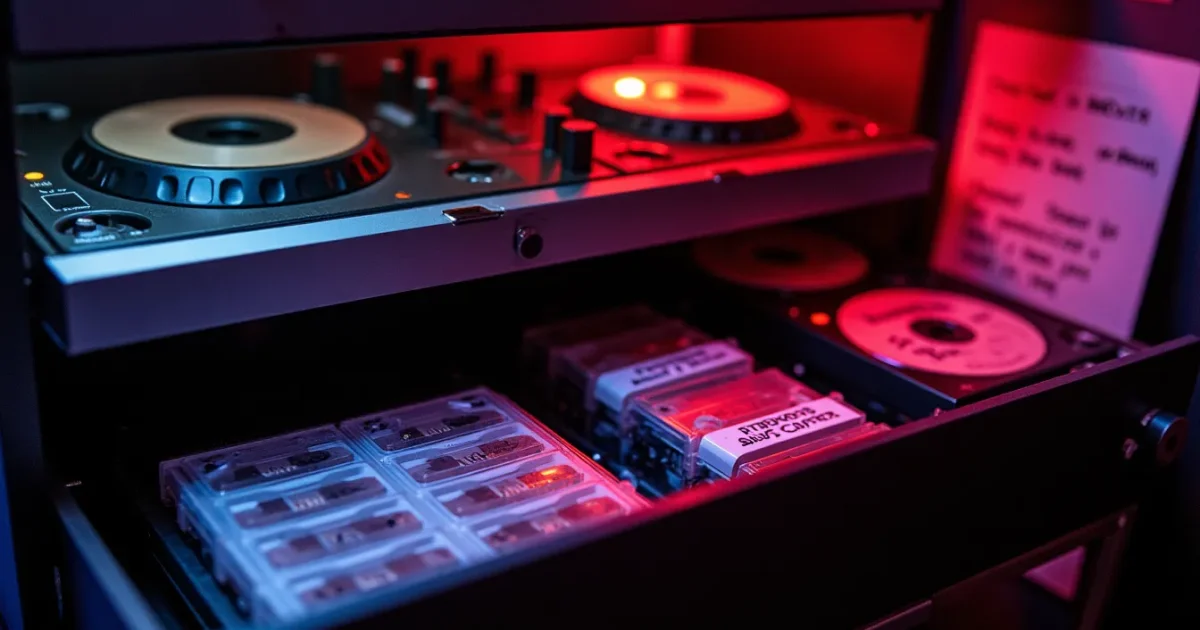
The CDJ - a CD player for DJs with a jog wheel and pitch fader. Pioneer released the first CDJ-500 in 1994. In Russia, CDJs appear in the late 90s - early 2000s, in clubs where vinyl turntables already stand. A DJ with two formats - vinyl and CD - becomes the norm: vinyl for mixing and scratching, CD for tracks not available on records. By the late 90s, a blank CD-R costs less than a dollar, and DJs record their compilations on CD, transferring the cassette practice to a digital medium.
Detail: MP3 as a format was published in 1993 (ISO/IEC 11172-3:1993), but only gained mass distribution in the late 90s - with the rise of file-sharing networks. The Diamond Rio PMP300 (September 1998) was the first commercially successful portable MP3 player. The Apple iPod came out in 2001. Between the standard and the mass-market device - 8 years.
Where records came from
Channels of access to music in 90s Russia: radio, cassette studios, trips to Moscow, orders from abroad. Radio Maximum was the only source of information about "what was happening in the club world". Cassette studios were the main channel for the provinces: you choose from a list, you get a recording. Moscow was for those with connections and money: records, CDs, MiniDiscs. Orders from abroad were for professionals: catalogues delivered by mail, records from Germany and England. The "ordered - shipped - delivered" chain took from two weeks to several months. Records were expensive, but they gave access to music that was not available on cassettes or CDs in Russia: white labels, promo releases, 12-inch singles that never reached the mass market.
Cassette culture had a downside: generation-after-generation copying degraded quality. A cassette copied from a cassette copied from a cassette lost high frequencies and added hiss and wow by the fourth or fifth generation. For a DJ, this meant that a track "everyone played" sounded different for each person - depending on how many generations of copies stood between the original and their cassette. Digital formats - CD and MD - solved this: a copy sounded the same as the original. But access to them in 90s Russia was limited by price.
By the early 2000s everything changes: MP3, the internet, file-sharing. A DJ no longer needs Mayak 240-S decks, the cassette studio at the Kontaktor factory and a trip to Moscow for records. What is needed is a computer, the internet and a CD burner. By 1998 a blank CD-R costs less than a dollar, and DJs record on CD everything they used to copy to cassette. By 2001 - the Apple iPod, by 2003 - the iTunes Store. The Technics SL-1200 remains - but no longer as the sole tool, rather as one of several. The 1990s DJ in Russia travelled from a Soviet-made cassette deck to direct drive and MP3 - in ten years and through four formats.