
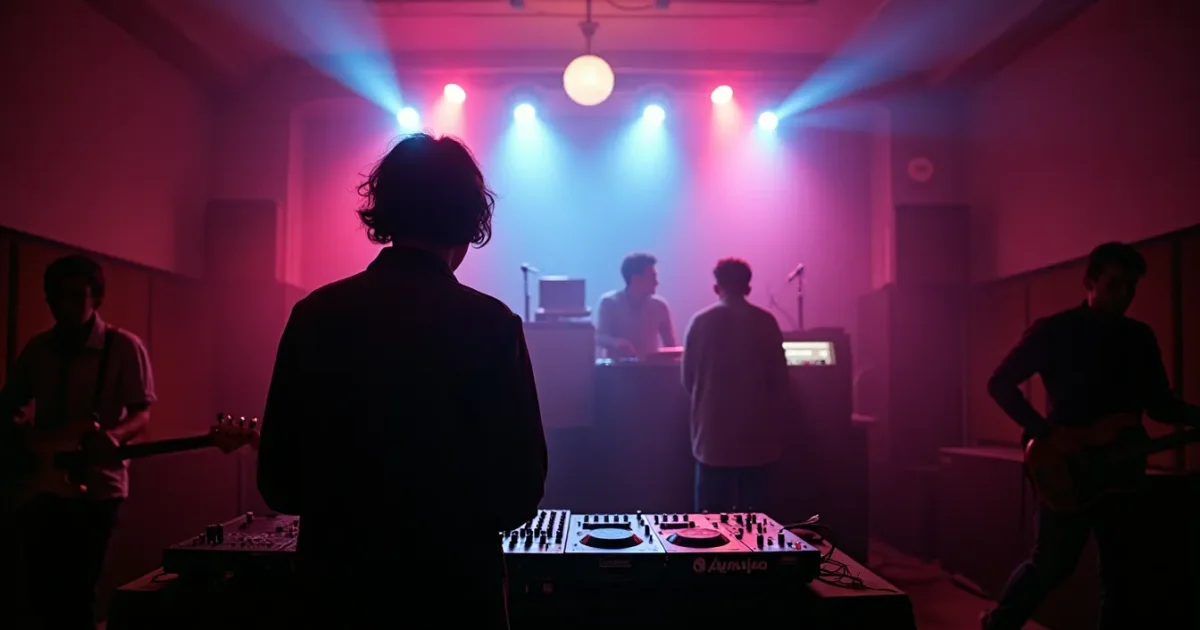
1993, Ulyanovsk. A DJ who opened a summer dance floor on the site of a former motorcycle track works on two Mayak 240-S cassette decks and a heavy Elektronika-03 mixing console from the 1980s. He does not know that specialised DJ equipment exists - and he is not alone. How 1990s discos worked in Russia: Soviet-made cassette decks, light machines from the Kazan Prometheus studio, and mirror balls spun by a motor cannibalised from a sewing machine. By the end of the decade vinyl turntables will arrive - first Chinese, then Technics. But in the early 90s disco in Russia is a different machine.
Sound: from the Mayak to Technics
In 1993, specialised DJ equipment in Russia is a rarity. The Technics SL-1200MK2, released in the summer of 1979 and the global standard for DJ turntables, costs more than a provincial club earns in a month. "Of course, nobody had the money for Technics," recalls a DJ who worked a provincial venue in 1998. That same year, the venue bought its first vinyl turntables - Chinese ones.
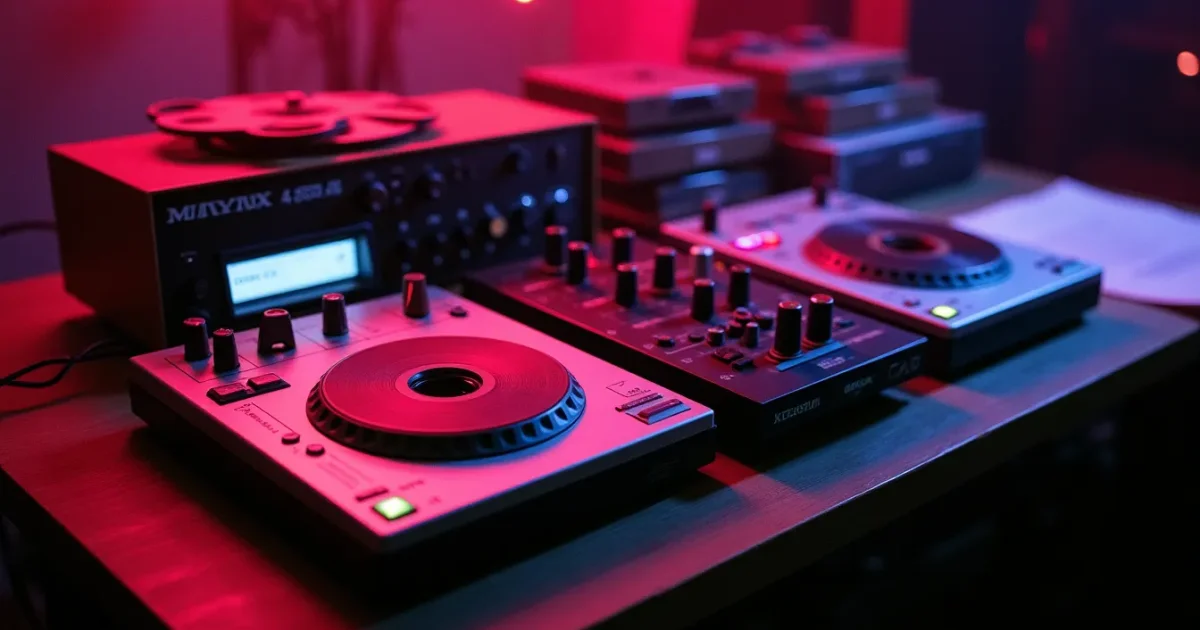
Before vinyl - cassettes. Two Mayak 240-S cassette decks, made by the Mayak factory in Kiev, are the typical early-90s setup. Mayak is a series of transistor tape recorders from the Mayak-201 to the Mayak-205, the first in the country to receive the state quality mark. Between the two decks sits a console. Not a DJ mixer with a crossfader, but a consumer or semi-professional mixing console like the Elektronika-03: heavy, with analog potentiometers and no smooth transition between channels. The transition between tracks is pressing "pause" on one deck and "start" on the other. No beatmatching.
In the 1980s it was no better. The Pyramid disco (Kuibyshev, 1980-1982) ran on three reel-to-reel Mayak tape recorders, a mixer, a powerful amplifier, speakers, and a control panel for visual effects. For more on how tracks were mixed in the mid-1980s, see the breakdown of 1985 mixing techniques.
Discos in Houses of Culture (DK) were not only in Kuibyshev. In Smolensk, on the cusp of 1975-1976, the first stationary disco, "Orpheus", appeared. Two or three years later - discoclubs "Spectrum" (DK of the hosiery workers), "Youth" (DK "Kristall"), "Phoenix" (DK of the radio-parts factory). In Gagarin - "Omega", in Desnogorsk - "Neutrino". Each discoclub ran on whatever equipment could be found: reel-to-reel tape recorders, homemade consoles, speakers from a radio shop. No professional disco equipment was manufactured in the USSR - everything was assembled from what was available.
Light: Prometheus and the mirror ball
Colour-music (svetomuzyka) in Soviet and early Russian discos is a distinct engineering culture. The Kazan Prometheus studio produced disco installations from the early 1970s. By 1992 the studio was making the "Disco" installation - an autonomous optical output device (VOU) and a four-channel control panel (PU) connected by cable. The unit operated in two modes: automatic colour-music device (ASMU) and colour-music instrument (SMI) - meaning light could be controlled manually, in sync with the music.
Projection went onto a hemispherical screen or any external surface - wall, ceiling, fabric. Light images - abstract, geometric, colourful - were formed by optical elements and projected through a system of lenses and mirrors. These are not lasers or LED panels - they are analog optics, mechanics and incandescent lamps. From the dance floor it looked like coloured spots crawling across the walls to the beat of the music.
The mirror ball is a separate story. In 1988 a "ball with mirror facets, a rotation drive and a rotation-frequency sensor" was patented in the USSR - the patent was published in 1991. In practice, the disco ball was more often spun by a motor cannibalised from a sewing machine or a fan: there was no professional drive, and the ball itself was faceted glass or acrylic prisms on a papier-mache sphere. The strobe is another standard: periodic bright flashes in a darkened room that turn the dancers' movements into a jerky animation. A strobe circuit for discos was published in radio-amateur handbooks - you could build one at home.
Besides Prometheus, disco light machines were built by enthusiasts: coloured filters on car bulbs, homemade thyristor controllers, mirror prisms on stepper motors. The result was uncontrolled flashes and rotating beams that hit dancers in the eyes and the ceiling. Professional lighting fixtures (scanners, lasers, LED panels) were absent from provincial DKs - they will appear in the late 90s, with the first European-level clubs in Moscow and St Petersburg.
Acoustics in the DK: what sounded and how
Discos took place in Houses of Culture - DK. DK of the factory, DK of the hosiery workers, DK "Kristall" - the standard venues of the 1980s-1990s. A DK hall is a rectangular parterre with a stage, ceiling 4-6 metres, walls of concrete or brick. Acoustic design - absent. Sound from the speakers reflects off every surface, creating boom and reverberation. At high volume, certain frequencies (especially bass) drone, masking the midrange.
Speakers - Soviet, from the Amfiton and Radiotekhnika factories, more rarely homemade. Amplifier - Elektronika, Amfiton, or an imported Aiwa or Sharp bought under the counter. Power - 50 to 200 watts per channel. For a DK hall of 200-300 people this is sufficient, but not enough for clean sound at high volume. For the tempos and BPM of dance music that DJs chose for these halls, see the BPM guide for disco tracks.
Organising the evening: song lists and new-format clubs
Until 1985, a DJ was obliged to have the list of all songs performed at the evening approved by the culture department. This is not a metaphor - a printed list was submitted to the district or city party committee. By the early 90s this requirement was gone, but the structure of the evening remained. A typical DK disco: 3-4 hours, two 45-minute sets with an intermission. The first set - slow dances and lyrical numbers. The second - dance, from 120 BPM and up. The finale - a slow dance for the curtain.
In Moscow, by the early 90s, clubs of a new format appeared. DJ Fonar recalled: "It was the era of new-format discos. First, it became possible to work at night. Second, there were full bars." Clubs like The Red Zone, "U Lissa", Jump - Jump held up to 2,000 people, "U Lissa" sprawled across half the Olimpiysky. The entertainment programme was built around two live acts, with dance blocks between their sets, and the clubs ran six days a week.
The transition: from cassettes to CD and vinyl
The mid-90s are a turning point. Cassettes still dominate: in 1993-1995, cassette-recording studios operate in cities, copying cassettes from giant lists printed on a dot-matrix printer. In Ulyanovsk the "Avtograf" studio worked on Karl Marx Street on the first floor of the Kontaktor factory: a person arrived with a blank cassette, chose from a list, and left with a recording. This was the main channel of access to music for those without Moscow connections with access to "barrels" (vinyl).
But the compact disc is already advancing. The Sony CDP-101 - the world's first CD player - went on sale on 1 October 1982 in Japan. In Russia, CD players appear in the early 90s but are expensive. By the mid-90s, vinyl as a mass medium in Russia is dying: groups stop releasing albums on records, switching to CD. In 1993, the band Alisa releases the vinyl LP "For Those Who Fell from the Moon" on Moroz Records - one of the last mass vinyl releases.
The paradox: exactly when vinyl leaves mass use, it enters DJ culture. DJs who learned about vinyl turntables from broadcasts of Radio Maximum (where DJ Fonar talked about dance culture) begin ordering records from Moscow and abroad. By the late 90s - the first Chinese turntables in provincial clubs. By the early 2000s - the first Technics SL-1200M3D, released in 1997: recessed power button, reset button, no click at the zero pitch position. But even in 1998, Chinese turntables were a novelty in the provinces: the top regional DJ Igor Lobynin (DJ Virus) played disco-house, travelled to Moscow for records, and had "the freshest stuff". Vinyl cost money, took up space, and required needles and cartridges - all imported via a "ordered - shipped - delivered" chain.
Parallel to vinyl, the CD enters the DJ booth. The CDJ - a CD player for DJs with a jog wheel and pitch fader, allowing manipulation of digital music like a vinyl record - was first released by Pioneer in 1994 (CDJ-500). By that time Pioneer had already released the CDJ-500II and CDJ-100S, but the provinces got mostly early models or copies. By the late 90s, DJs with two formats - vinyl and CD - became the norm: vinyl for mixing and scratching, CD for tracks not available on records.
Detail: The Technics SL-1200MK2 was produced from 1979 to 2010 - 31 years without changing the design. The SL-1200M3D came out in 1997 and differed by a recessed power button (so the DJ would not turn the deck off with an elbow) and a reset button. Both models: direct drive, quartz stabilisation, 3 million units sold. Discontinued 1 November 2010, revived in 2016 (SL-1200G).
A 300-seat DK hall, Mayak 240-S cassette decks, an Elektronika-03 console, a mirror ball with a fan motor and a Prometheus light machine - this is the technical reality of 1993. By 1999 the same hall may have vinyl turntables and CD players. But between 1993 and 1999 are six years in which DJ culture in Russia travelled from cassette decks to direct drive.