
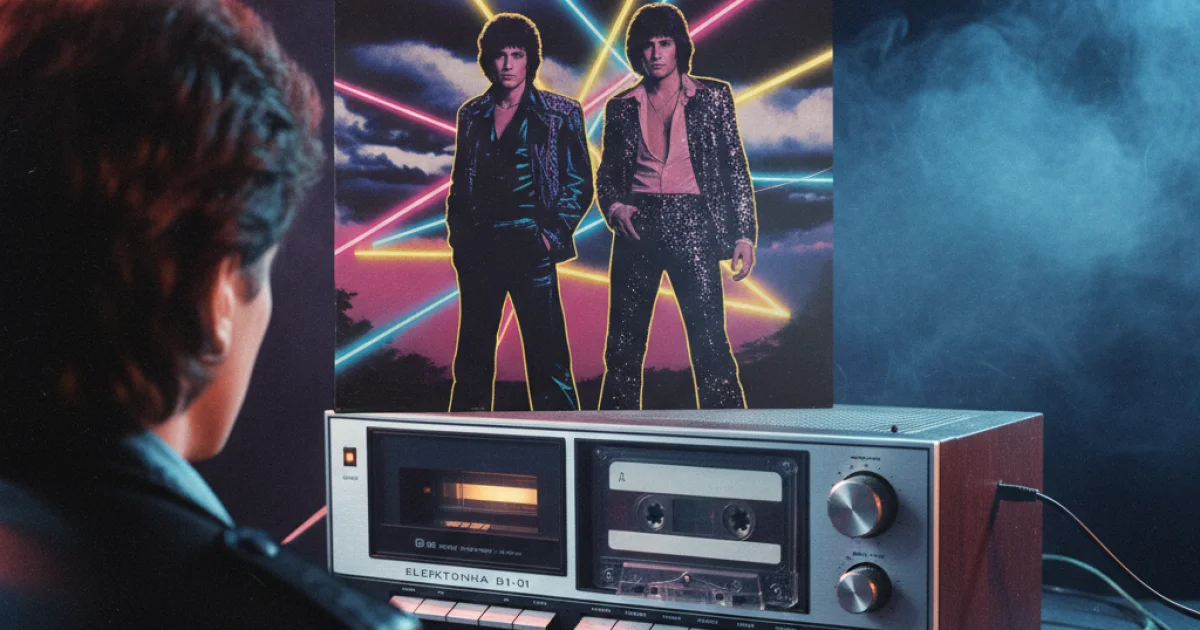
If in Italy and Germany Italo Disco was just popular dance music, in the Eastern Bloc it became something bigger. The sound of freedom, a window onto the Western world, a badge of belonging to a "real" youth culture. Here's how that worked.
Scarcity Builds a Legend
In the USSR and the rest of the Eastern Bloc, Western music was almost never officially sold. Records by Modern Talking, Savage, or Den Harrow were rare in state-run stores. The Soviet label Melodiya occasionally released compilations, but way behind schedule and in trimmed-down form.
So the main distribution channels were informal: black-market dealers at flea markets, friends who traveled abroad, tape dubs from acquaintances. One original record could exist as hundreds of copies of varying quality - from a clean recording to a muffled "third copy of a third copy."
Tape Decks and Cassettes
The main medium for Italo Disco in the USSR was the compact cassette. Vinyl players were relatively rare, but cassette decks were in almost every household. Popular tracks were taped off the radio, dubbed from friends, compiled into personal 90-minute mixtapes on TDK or BASF cassettes.
That created an interesting side effect: people knew the tracks but often had no idea who the artists were or what the songs were called. A cassette might just say "Disco-80" on the label, with a random assortment of tracks from different years and artists inside.
Standard handwriting on a BASF cassette spine: "Disco-80, Side A." No further detail.
Modern Talking: Supernova Stars
Although Modern Talking was a German duo working in the Italo Disco aesthetic, they became the genre's biggest stars for Soviet audiences. "You're My Heart, You're My Soul," "Cheri Cheri Lady," "Brother Louie" - practically the entire country knew those songs by heart.
When Dieter Bohlen and Thomas Anders came to Russia for concerts in 1998, the stadiums were packed. By that point, Modern Talking had a status in Russia comparable only to what The Beatles had for the previous generation.
Discotheques and "Disco Programs"
Every Soviet House of Culture had a discotheque, and Italo Disco was its backbone. DJs (called "disco hosts" at the time) put together sets from Western tracks taped off Finnish or Polish radio.
Another interesting phenomenon - TV "disco programs" like "Musical Ring" or later "Up to 16 and Older." These occasionally aired Western music videos, and each screening was an event - people recorded them on VCRs and talked about them at school for weeks.
East Germany: A Special Case
In East Germany, Italo Disco arrived faster - because of proximity to the West and the ability to pick up West German radio. The language was the same, and GDR youth listened to the same charts as West Germany, just illegally.
The German label ZYX Music specifically targeted the Eastern European market, and when the wall came down in the '90s they found themselves in a strong position - they already had a built-in audience.
Poland and Yugoslavia
In Poland and Yugoslavia the regimes were softer, and Western music was sold relatively freely - Italian artists were touring there as early as the '80s. The 1986 Sopot Festival in Poland hosted Ryan Paris and other stars of the genre. Both countries also developed their own scenes: Polish and Yugoslav artists worked in the Italo Disco style in their native languages, and some of them still tour today.
That's why nostalgia for Italo Disco is especially strong in Russia, Poland, Czech Republic, and other post-socialist countries. It's music tied for an entire generation to youth, first love, first discotheques, and the feeling that a "bigger world" had just cracked open.
Savage's concerts at Moscow's Crocus City Hall in 2024 sell out - the average age in the room is around 50, and half the audience knows the lyrics by heart in an English they never really learned. For them, Italo Disco was never just dance music.
The resemblance between Mirage and neighbouring projects is mapped in the comparison of Soviet groups and Italo Disco.