
In May 1985 the Swiss duo Yello - Dieter Meier (lyrics and voice) and Boris Blank (music) - released the album Stella. One track is a 3-minute piece called “Oh Yeah”. Commercially it wasn't a hit: in 1985 it peaked at only #51 Billboard Hot 100. But a year later the film Ferris Bueller's Day Off placed the song on its soundtrack, and from that point those three seconds - “Oh… yeah…” - became the most-quoted vocal sample in American pop culture. By 2024 “Oh Yeah” has appeared in more than 200 films, TV shows, and commercials.
Yello - Switzerland's electronic anomaly
Yello formed in Zurich in 1979. Boris Blank worked as a bank clerk; on the side he recorded experimental electronic music in a basement. Dieter Meier was an heir to the Meier & Cie bank and didn't hold an official job - he played golf, shot conceptual films, wrote poetry. They met at a party in 1978.
One defining fact about Yello: they never perform live. Across 46 years (1979-2025) the band has played nine shows in total - all in major cities for special occasions. The reason: Blank dislikes the stage, and Meier suffers from stage fright. Their entire career is studio work and albums.
By 1985 Yello already had a reputation as “the Swiss electronic experimentalists”. The 1983 album You Gotta Say Yes to Another Excess had broken through the New York underground club circuit. Fatboy Slim later called it one of the most important albums of his youth.
Recording “Oh Yeah”
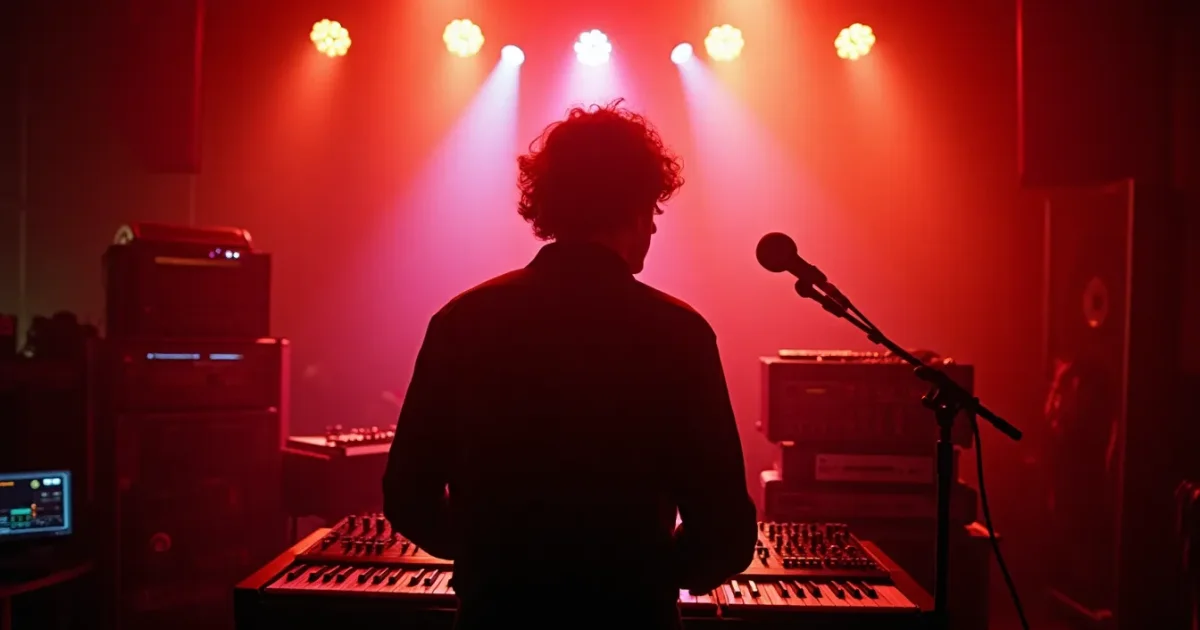
“Oh Yeah” was cut at Blank's home studio in Zurich from November 1984 to February 1985. The main instrument was a Synclavier II, a $200,000 digital sampler-synthesizer. Blank was among the first European musicians to own a Synclavier (alongside Peter Gabriel and Sting).
The song's core idea: Meier's voice through an Eventide H949 Harmonizer at -12 semitones (an octave down). Meier speaks “Oh… yeah” and “beautiful” in his normal register, but on tape they come out as a low rumble. That became the song's signature.
Structurally “Oh Yeah” is a very odd song. It has no conventional verse-chorus-bridge. It's a minimal track: an 808 rhythm frame, a Synclavier bass line, three vocal samples (“Oh yeah”, “beautiful”, “more”) repeating at long intervals. Total runtime 3:05, but the actual material would fit into 45 seconds.
“The song is about nothing. It's literally „nothing" repeated for three minutes. We were laughing in the studio: this is the laziest track we've ever recorded.”
- Boris Blank, The Quietus, 2009
Ferris Bueller and MGM
In January 1986 director John Hughes was finishing Ferris Bueller's Day Off. Editor Paul Hirsch was hunting for an “audio bookmark” for the scene where Ferris wrecks a red Ferrari 250 GT California. He slipped in a demo cassette from a stack of new albums - “Oh Yeah” was on it. Hirsch dropped the three-second “Oh yeah…” over the scene, and Hughes decided in five seconds: “This. Exactly these three seconds”.
Yello didn't know their song was in the film until the June 1986 premiere. Meier learned about it when his brother called from America: “Dieter, I was at the movies, and your voice was in it”. After that Meier and Blank received a $3,500 licensing cheque. In a 2023 Rolling Stone interview they said: “That was the best cheque of our lives. It changed our career”.
Effect: 200 films and commercials
After Ferris Bueller “Oh Yeah” became a universal “voice bookmark” of American pop culture. First in 80s comedies: The Secret of My Success (1987), Ruthless People (1986), She's Out of Control (1989). Then in countless beer ads (Bud Light, Miller Genuine Draft).
By 2024 “Oh Yeah” has featured in:
- more than 60 films (from Ferris Bueller to The LEGO Movie 2 2019)
- more than 80 TV series (from Family Guy to The Mandalorian)
- more than 60 commercials (Twix, Chevrolet, Burger King, Coca-Cola)
- more than 30 video games (Grand Theft Auto: Vice City, Saints Row)
The financial effect was enormous. Swiss newspaper Neue Zürcher Zeitung (2019) estimated Yello earn over $2 million a year from “Oh Yeah” licensing alone. Most of that is not from single sales - it's from film/TV/ad usage.
- Key: D-flat minor (a rare choice), no modulations
- BPM: 105
- Length: 3:05
- Album: Stella (May 1985, Vertigo/Mercury)
- Singles sold: 300,000 copies by 1990
- 1986-2024 licensing revenue: estimated over $40 million
Meier and Blank still live in Zurich
By the late 80s Dieter Meier became a known figure in Zurich: restaurateur (Meier Gold and Bärengasse), winemaker (Ojo de Agua in Argentina), visual artist (exhibitions at Kunsthaus Zurich). He still lives in a Zurich flat overlooking the Limmat River. In 2024 he turned 79.
Boris Blank - born 1953 - still works at the same Zurich studio. In 2022 Yello released Point - their first album in six years. It features a new “Oh Yeah” vocal (Meier cut a new version in 2022, sounding like the old one but with a slightly deeper tone - age has its effect).

What makes “Oh Yeah” so universal
The answer is emptiness. “Oh Yeah” means nothing. It's not about love, friendship, or war. “Oh yeah”, “beautiful”, “more” - these are basic English interjections that any language-aware listener grasps. You don't even need English - their meaning is obvious from intonation.
That makes the song ideal for any situation. Want to show a character is impressed? - “Oh yeah”. Want to show savouring a moment? - “beautiful”. Want to show greed? - “more”. Yello invented, perhaps without realising it, a universal emotional vocabulary for American cinema 40 years into the future.
What to listen to next
For the “minimalist” electronic aesthetic of the mid-80s: Yello “Oh Yeah” → Kraftwerk “Tour de France” (1983) → Devo “Whip It” (1980). Three different keys to one idea - electronics as ironic joke rather than serious music.
If you want to go deeper into Yello, listen to The Race (1988, their biggest hit, #7 UK), Desire (1994), and the 2020 album Point. Yello is a rare band that in 46 years has not changed lineup, sound, or philosophy. Two people, one studio, one attitude.