

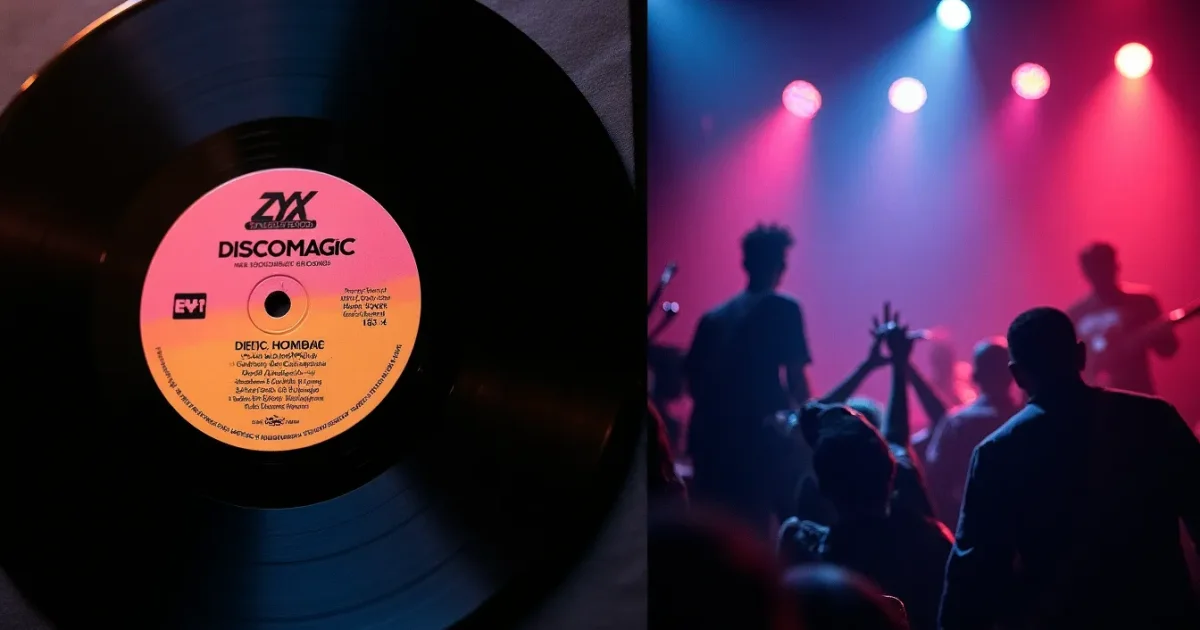
1983. The Italian label Discomagic Records presses the Savage maxi-single "Don't Cry Tonight" - 12-inch vinyl, 45 RPM, matrix number etched in the runout groove. Thirty years later, the same track appears on a 180-gram vinyl reissue with remastered audio and a new catalogue number. For the italo disco collector, the choice between an original and a reissue is not a matter of price but of sound, packaging, and authenticity. We break down what exactly distinguishes original releases from reissues and how to make a deliberate, informed choice.
What is an original and what is a reissue
Original - a vinyl release issued at the time the track was recorded, on the original label, with mastering done in the year of release. For italo disco, this means: a record pressed in Italy, Germany, or Scandinavia during 1982-1989, with the catalogue number of the original label (Discomagic Records, Time Records, Memory Records, Baby Records, ZYX, and so on).
Reissue - any subsequent release of the same track on vinyl. There are three types. First: an official reissue by the original label, often with the same catalogue number but at a different time. Second: a reissue by a different label that licensed the track - with new mastering, a new cover, a new catalogue number. Third: an unofficial (bootleg) - an illegal copy, often with a cover imitating the original. How to distinguish a bootleg from an official reissue is a separate topic, but here we discuss the first two types.
Sound: original mastering versus remastering
The main argument for the original is sound. Original italo disco pressings were made from an analog master recorded on magnetic tape. Reissues are often made from a digital copy - a CD master or a digital file. The difference is audible: the analog master gives a warm, soft sound with natural dynamics; the digital one is sharper, with boosted highs and compression.
However, not all originals sound better. Italian labels in the 80s economised on pressing: vinyl could be thin (120-140 g), mastering rushed. Some originals sound quieter and dirtier than quality reissues. Reissues on 180-gram vinyl with remastering from specialist labels sometimes sound objectively better than the original - but this is not "that" sound people listened to in 1983.
Detail: if a reissue carries the note "from the original master tapes" - it means the label found the original magnetic tape and made a new mastering from it. This is the best type of reissue: analog source, modern equipment. But if it says "remastered from digital source" - the sound will be digital, regardless of vinyl weight.
Packaging: cover, inserts, matrix
Original italo disco releases often had distinctive covers - photo sessions of the artists, graphic design by studios like P. G. Studio (Milan) or Metronome (Munich). Reissues either copy the cover (if the licence allows) or make a new one. Printing quality on reissues is usually higher: modern printers produce sharp images, without the colour misregistration that was normal in the 80s.
But originals have what reissues do not: matrix etching. In the runout groove of the vinyl, near the label, a matrix number is etched - a combination of letters and numbers indicating the pressing plant. For Italian releases this is often SONOPRESS (Italy) or PDO (Germany). The matrix is the primary identifier of an original, and italo disco collectors check it first. Reissues have a different matrix, and by it you can distinguish an original from a copy in five seconds.
Inserts - lyric sheets, posters, stickers - were part of original releases and are almost never reproduced in reissues. If you buy an "original" without an insert that should be included - it is either an incomplete set or a reissue.
Pressing plants and their identification
The matrix etching is not just a number. It is the fingerprint of the pressing plant that made the record. Sonopress (Italy) - the largest Italian plant, pressing for Discomagic, Time Records, Baby Records. PDO (Philips Du Pont Optical, Germany) - the German plant, pressing for ZYX Music and Metronome. Record Industry (Netherlands) - the Dutch plant, pressing for Scandinavian releases. From the matrix you can determine not only original versus reissue, but also the country of pressing - which is critical for collectors seeking a specific version.
For example, Savage "Don't Cry Tonight" was released on Discomagic Records in Italy (original, Sonopress), on Mikulski in Germany (original for the German market, PDO), and later on ZYX Music (reissue, different plant). Each version sounds slightly different: different vinyl, different mastering for the local market, different thickness. The Italian original is the most sought after, because that is what was played in the discos of Rimini in 1983.
Condition: the Goldmine scale and Discogs
Both originals and reissues are graded on the Goldmine scale used by Discogs: Mint (M), Near Mint (NM), Very Good Plus (VG+), Very Good (VG), Good (G), Poor (P). But between originals and reissues there is a difference in typical condition.
Italo disco originals from the 80s are records 35-40 years old. Finding an original in NM is difficult: vinyl was played at discos, stored without sleeves, handled with bare hands. Most originals on the market are VG or VG+, with surface noise and scuffs. Reissues from the 2010s-2020s are usually sold in NM - they have not been played, only bought. But NM on a reissue does not mean "better sound": it means "new condition."
Checking an original's condition is a ritual. Visual inspection under bright light: scratches, scuffs, needle marks. Tactile: fingers along the groove - smooth or rough. Auditory: playback on a good turntable with a quality stylus - surface noise, clicks, skips. VG+ allows light surface noise but no skips or jumps. VG - noticeable noise but the track plays. Below VG is not acceptable for italo disco collectors: the genre requires clean synth sound, which is drowned out by worn vinyl noise.

Decision tree: original or reissue
For the italo disco collector, the choice depends on priorities:
- Priority - authenticity. Original. Only the original gives "that" sound, "that" cover, and "that" matrix. A reissue is a copy, however well it sounds.
- Priority - sound. Depends. If the original is in VG condition with noise - a 180-gram reissue with remastering sounds better. If the original is in NM - the original sounds better.
- Priority - budget. Reissue. Italo disco originals cost 15 to 200 euros depending on rarity. Reissues - 15-30 euros consistently.
- Priority - collector value. Original. Reissues do not appreciate. Rarer originals do. The guide to italo disco record prices shows the trend.
- Priority - availability. Reissue. Many rare italo singles exist in only 50-200 copies. A reissue is the only way to get the track on vinyl.
More on building a collection in the vinyl collection guide. But there is another factor often overlooked: the emotional one. An original is an artefact of its era. A record someone bought in Milan in 1985, took home, put on the turntable, and listened to. A reissue is a product made in 2020 on order. The sound may be similar, but the story is different.
The italo disco reissue market
Italo disco reissues on vinyl are a relatively new market, and it is growing fast. Before the 2010s, most reissues came out on CD: ZYX Music, Discomagic Records, and other labels reissued their 80s catalogues on compact disc, often as compilations. Vinyl reissues began appearing in the 2010s, when the vinyl renaissance gained momentum.
Today, italo disco vinyl reissues are released by several categories of labels, and each category targets its own audience. Specialist vinyl labels produce quality reissues on 180-gram vinyl with remastering. Italian successor labels - ZYX Music, Ala Bianca Group - reissue their own catalogues. Indie labels - New Generation Disco Records, Hargent Media - release both reissues and new material. Each type has its pros and cons, but the main question remains unchanged: is the reissue made from an analog master or from a digital copy. The answer determines everything.
Specific examples: original versus reissue
Grant Miller "Colder Than Ice" (1985): original on ZYX Records - thin vinyl (about 130 g), PDO matrix, cover with the blue ZYX logo. The 1999 "Believe Mix" reissue on ZYX Music - different mastering, different mix, different cover. The 2024 EP "The Best Part Of Me" - digital source, 180-gram vinyl. For the collector, the 1985 original is the only "real" release.
Off "Electrica Salsa" (1987, Flea Records): original - Italian pressing, thin vinyl, cover with the flea logo. Reissues on digital platforms (2010, Ala Bianca Group) - not vinyl, but files. No vinyl reissue of this track has been released, which makes the original the only way to get the track on plastic.
Ryan Paris "Dolce Vita" (1983): original on Discomagic Records - Italian pressing, Sonopress matrix. Reissues: many CD versions, several vinyl reissues from different labels. The 1983 original remains the most desirable - and the most expensive - version.
Den Harrow "Bad Boy" (1985): original on Baby Records (Italy) with Sonopress matrix. German edition on Polydor - different mastering, different cover. Reissues on ZYX Music in the 2000s - digital source. The Baby Records original is the most valuable, because Baby Records was the project's primary label.
Forty years after the first release of Savage "Don't Cry Tonight" - the 1983 original and the 2020s reissue sit on the shelf side by side. One is an artefact, the other a copy. The choice is the collector's. But if the budget allows - buy both: the original for history, the reissue for sound. And if not - buy the original. The noise of 80s vinyl is also part of italo disco, part of its character, its warm, slightly dirty, but alive sound that cannot be copied.