
1984. West Berlin. The group Alphaville releases the single "Big in Japan" - and German synth-pop enters the international arena. In the same year, Propaganda records "Dr. Mabuse" in Düsseldorf with producer Trevor Horn. In Cologne, Silent Circle assembles "Touch in the Night." Germany in the 80s is not simply a consumer of British synth-pop but an independent scene with its own cities, studios, and sound. Twelve groups that defined German electronic music of the decade.
How German synth-pop differs from British
British synth-pop - Depeche Mode, Pet Shop Boys, OMD, Human League - grew out of new wave and post-punk. German synth-pop grew out of a different tradition: the krautrock of Kraftwerk, the disco production of Giorgio Moroder (the Munich school), and Italian italo disco, which in the 80s was the main imported genre in West Germany. The result: a different timbre, a different tempo, a different approach to vocals.
German synth-pop is colder, more mechanical. British - melodic, more emotional. German groups more often use drum machines (Roland TR-808, TR-909) and sequencers instead of live drums. British - more often mix electronic and live instruments. German vocals - restrained, even; British - expressive, with melodic lifts. More on the genre boundary between disco and electronic music in the Italo Disco and Eurodance guide.
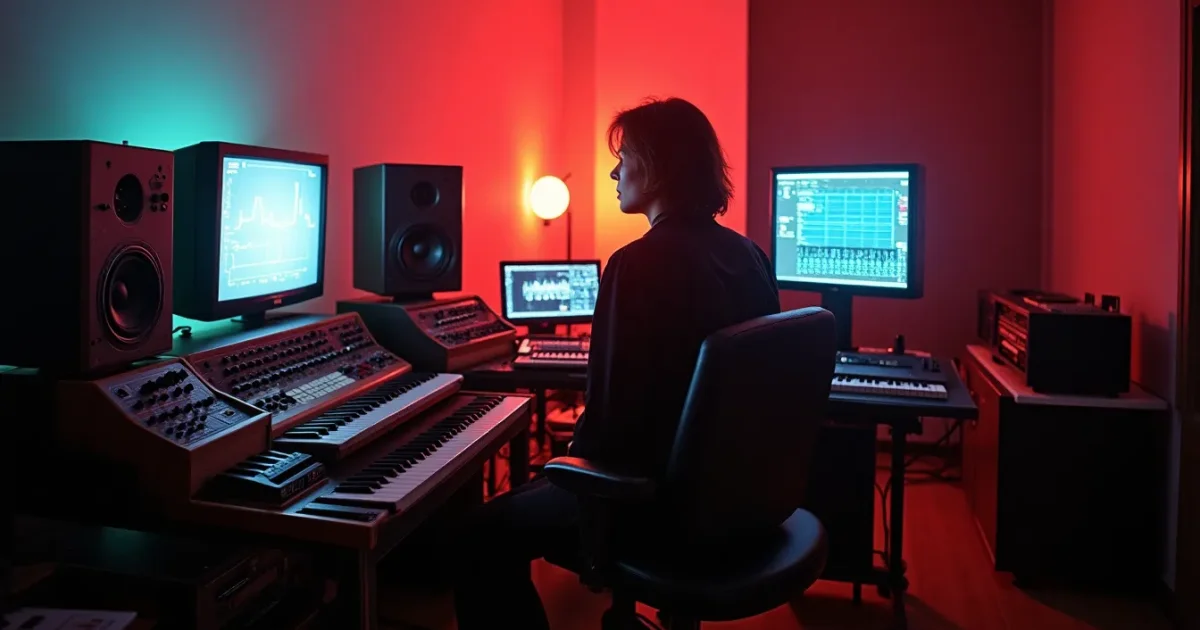
Twelve groups: a map of Germany
1. Kraftwerk - Düsseldorf
Pioneers of electronic music. "Autobahn" (1974) - the first international hit. "The Man-Machine" (1978), "Computer World" (1981) - albums that defined the language of electronic pop. Kraftwerk were not a synth-pop group in the strict sense, but without them no German electronic project would exist. Their Kling Klang Studio in Düsseldorf is the Mecca of electronic music.
2. Alphaville - Münster/Berlin
"Forever Young" (1984) and "Big in Japan" (1984) - two singles that made Alphaville an international name. A group from Münster that moved to Berlin. Marian Gold - vocals with a characteristic vibrato. The album "Forever Young" (1984) is one of the best-selling German synth-pop albums. More in the "Forever Young" deep dive.
3. Camouflage - Bielefeld
"The Great Commandment" (1987) - the debut single, reaching #59 on the Billboard Hot 100 (US) and #14 in Germany. Camouflage's sound is close to Depeche Mode: dark synthesisers, melancholic vocals. A group from Bielefeld - a small city in North Rhine-Westphalia. The album "Voices & Images" (1988) is their best.
4. Silent Circle - Cologne
"Touch in the Night" (1985) - a hit that balances between synth-pop and italo disco. Silent Circle is a project of producer Axel Breitung, recorded in Cologne. More on Silent Circle in the Silent Circle profile. The group represents the German italo disco scene, which often overlapped with synth-pop.
5. Propaganda - Düsseldorf
"Dr. Mabuse" (1984) and "Duel" (1985) - two singles released on ZTT Records (UK) with producer Trevor Horn. Propaganda is a German group, but their production is British: Trevor Horn brought his Fairlight CMI technique and gated reverb. The result: a hybrid of German electronics and British pop production. The album "A Secret Wish" (1985) is a masterpiece.
6. DAF (Deutsch Amerikanische Freundschaft) - Düsseldorf
Gabi Delgado-López and Robert Görl. "Tanz mit mir" and "Kebab Träume" - early singles. DAF were more electronic body music than synth-pop, but their influence on the German scene is fundamental. Minimalism: one synthesiser, one drum machine, one vocal. No pads, no arpeggios - only rhythm and voice.
7. Hubert Kah - Munich
"Limousine" (1985) - a hit that combined a schlager melody with synth production. Hubert Kah is a bridge between the German variety tradition and electronic music. Producer Michael Cretu (later of Enigma) worked with Hubert Kah on several tracks.
8. C.C.C.P. - Germany
A project balancing between italo disco and synth-pop. "American Soviet" - one of the known tracks. C.C.C.P. is an example of the German dance scene that used Soviet/Russian themes in a framework of synth sound.
9. Celebrate the Nun - Hanover
A group from Hanover that released the album "Meanwhile" (1989). H.P. Baxxter and Rick J. Jordan - future founders of Scooter - were members of Celebrate the Nun. The sound is pure synth-pop with female vocals. The group did not have major commercial success but became the launchpad for Scooter.
10. Modern Talking - Berlin/Munich
Dieter Bohlen and Thomas Anders. "You're My Heart, You're My Soul" (1984) - a single that sold more than 6 million copies. Modern Talking is the most commercially successful German pop duo of the 80s. Their sound is Eurodisco, not pure synth-pop, but their influence on the German scene is undeniable. More in the Modern Talking phenomenon.
11. Bad Boys Blue - Cologne/Bonn
"You're a Woman" (1985) - a hit that balanced between italo disco and synth-pop. Bad Boys Blue - an international project (vocalist British, producers German), recorded in Germany. The sound is close to Modern Talking but with a darker timbre. More in the Bad Boys Blue profile.
12. Die Krupps - Düsseldorf
An industrial/electronic group that influenced EBM and synth-pop. "Wahrheit oder Pflicht" - an early release. Die Krupps - an example of the German scene where electronic music crossed with industrial. Their metallic percussion and synthesisers created a sound that later influenced Nine Inch Nails and Rammstein.
Map of cities and studios
The German synth-pop scene of the 80s was geographically concentrated in three regions. Düsseldorf - Kraftwerk, Propaganda, DAF, Die Krupps. Kling Klang Studio - the epicentre. Berlin - Alphaville, part of the scene around Hansa Studios. Cologne/Bonn - Silent Circle, Bad Boys Blue. Munich - Hubert Kah, the legacy of Musicland Studios and Giorgio Moroder. Bielefeld - Camouflage, a provincial scene. Hanover - Celebrate the Nun.
Düsseldorf is the capital of German electronics. Kraftwerk, Propaganda, DAF, Die Krupps - all from one city. This is not accidental: Düsseldorf in the 70s and 80s was a centre of the German avant-garde, with galleries, art scene, and musical underground. Kling Klang Studio is not just a studio but a philosophical centre where musicians came from all over the world.
Berlin - the second centre. The divided city, with its underground scene and underground clubs, gave freedom to experiment. Alphaville recorded "Forever Young" in Berlin. Hansa Studios (where David Bowie and Iggy Pop recorded) was available to German electronic projects.
Munich - the third centre, the legacy of Musicland Studios and Giorgio Moroder. The Munich school of disco (Donna Summer, "I Feel Love") gave German synth-pop its rhythmic foundation. More on the Munich sound in the Italian labels deep dive, many of which were distributed through German labels like ZYX Music.
Differences from the British scene: five parameters
German and British synth-pop of the 80s - two different approaches to one genre. Five parameters where they diverge:
- Origins. British - from new wave and post-punk (Human League, OMD). German - from krautrock (Kraftwerk, Neu!) and disco (Moroder, La Bionda).
- Tempo. British - 110-125 BPM, closer to pop. German - 120-140 BPM, closer to dance music. German groups more often crossed with italo disco and Hi-NRG.
- Vocals. British - expressive, melodic (Marc Almond, Andy Bell). German - restrained, even (Marian Gold, Stefan Weidner). German vocals are colder, closer to spoken-word.
- Production. British - warm, with live instruments (guitars, bass, drums on some tracks). German - fully electronic, sequencer-based, without live instruments.
- Lyrics. British - personal, romantic, political. German - more abstract, philosophical, sometimes in German (DAF, Die Krupps).
These distinctions are not absolute. Alphaville, for example, sounded closer to British synth-pop than German. Camouflage were nearly indistinguishable from Depeche Mode. But on average, the German scene was more "mechanical" and less "romantic" than the British.
Legacy
German synth-pop of the 80s is not a footnote in electronic music history. Kraftwerk created the language, Alphaville and Camouflage made it popular, Propaganda connected it to British production, DAF took it to minimalism. Without this scene there would be no modern German techno, no 90s Eurodance, no 2010s synthwave. Twelve groups, twelve cities, one decade - and a sound that has not aged.
Connection with italo disco
German synth-pop and italo disco are two genres that constantly crossed paths in the 80s. Silent Circle and C.C.C.P. - projects that belong to both genres. Modern Talking and Bad Boys Blue - Eurodisco projects with synth-pop aesthetics. ZYX Music - a German label that released both Italian italo disco and German synth-pop.
This crossing is not accidental. Italian producers brought their tracks to Germany for distribution (through ZYX, Polydor, Metronome). German producers travelled to Italy for vocalists and studio musicians. The result was a hybrid sound impossible to unambiguously assign to one country. Modern Talking - German producer (Dieter Bohlen), German vocalist (Thomas Anders), German label (Hansa), but the sound is the italo disco formula. Silent Circle - German producer (Axel Breitung), but the melody is the Italian school.