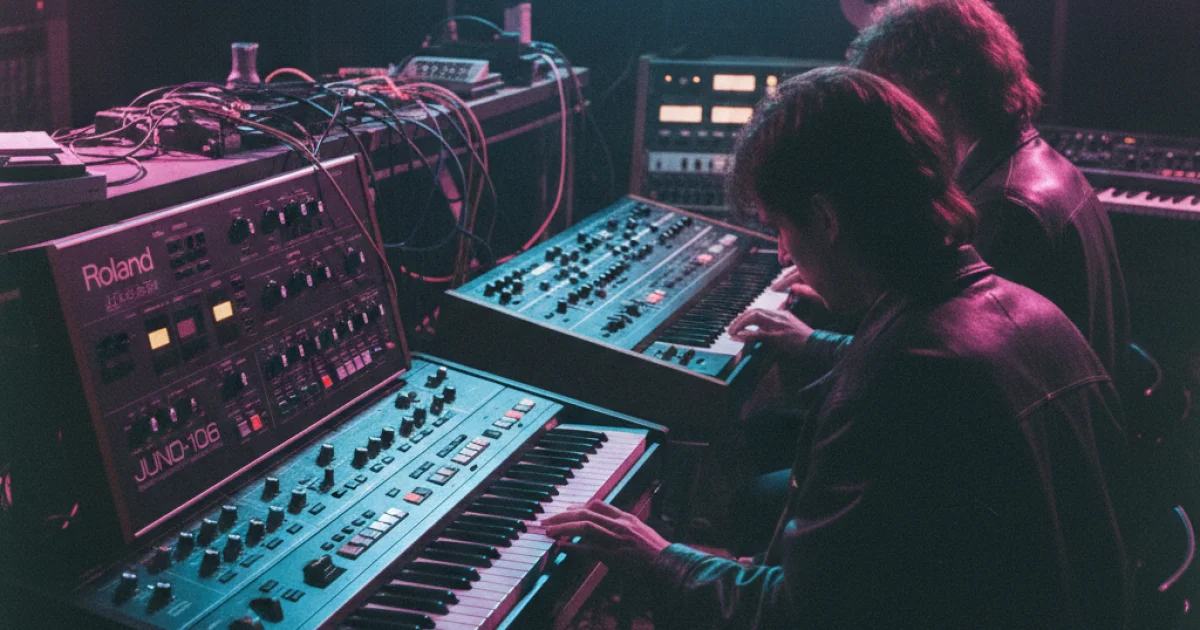
Italo Disco is first and foremost a synthesizer genre. Without them, it wouldn't have existed. A specific set of instruments used by Italian producers in the '80s created the recognizable sound we now instantly identify as "Italo Disco." Here's what those synths were and why specifically those.
The Golden Era of Synths
The early '80s are a unique moment in the history of electronic music. Synthesizers had become cheap enough for small studios to afford. At the same time, the technology reached a level that let them create genuinely musical sounds. Before that, synths were either very expensive or primitive. The '80s landed on the golden middle.
Italian producers were in the right place at the right time. They bought new synth models in bulk and started experimenting. Their approach to these instruments is what defined the genre's signature sound.
Roland Juno-60 and Juno-106: The Foundation
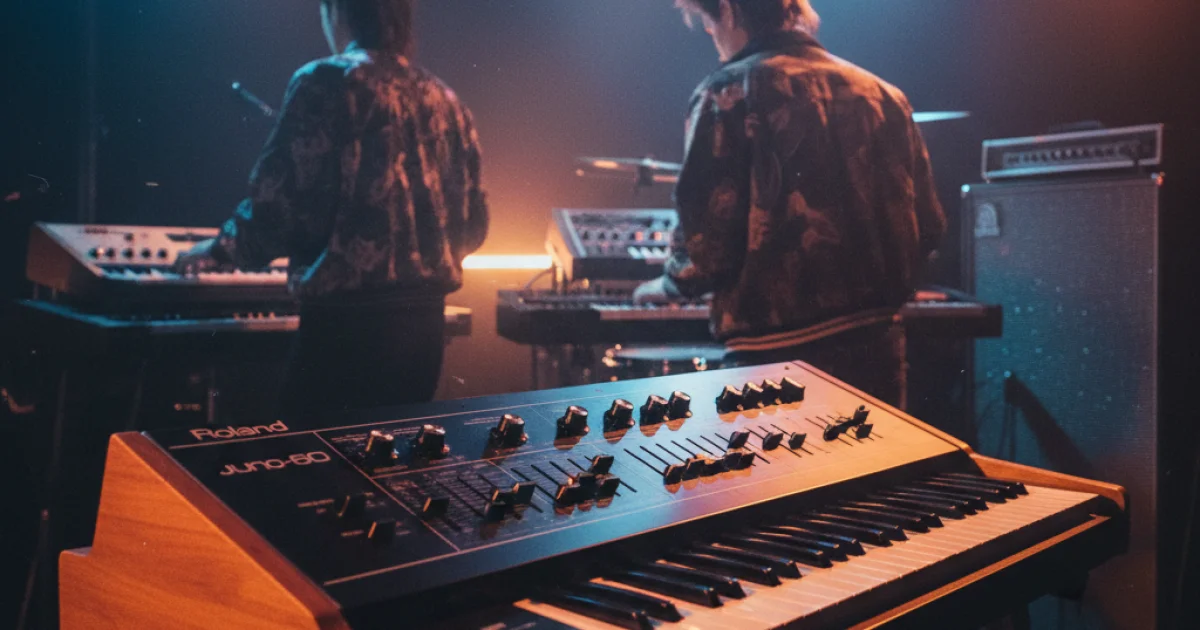
If you have to pick one instrument without which Italo Disco wouldn't exist in its familiar form, it's the Roland Juno series. The Juno-60 came out in 1982, the Juno-106 in 1984. Both were absolute hits among Italian producers.
Why Juno?
- Price. These instruments were relatively affordable for small studios.
- Ease of use. The Juno didn't require complex programming - the sound could be dialed in and recorded quickly.
- A signature "warm" analog timbre. Exactly what pop music needed.
The signature "springy" Italo Disco bass you hear in dozens of hits is most often a Juno-60. The famous string parts in the genre's melancholy ballads are often the same instrument.
Yamaha DX7: The Digital Revolution
The 1983 release of the Yamaha DX7 changed '80s music radically. It was the first commercially successful digital synth using FM synthesis. The sounds it produced were unlike anything that existed before - shiny, "digital," signature electronic timbres.
The DX7 instantly became an industry standard. Every self-respecting producer had to own one. Italian studios were no exception - the instrument appears in recordings of practically every significant Italo Disco artist of the mid-'80s.
A specific sound - the famous "electric piano" (E. Piano 1) of the DX7, which plays in hundreds of tracks across genres. In Italo Disco it was used for balladic moments, for romantic melodic lines, for building an "elegant" sound.
Roland TR-808 and TR-909: The Heart of Rhythm
Without drum machines, Italo Disco would have been impossible. Two key models - the Roland TR-808 (released in 1980) and the TR-909 (1983). Both became industry legends.
The TR-808 gave Italo Disco its signature boomy bass drum, sharp claps, and specific percussion sounds. The TR-909 was more "lively," with more natural sounds closer to real drums. Producers used both models depending on the mood they needed.
The signature "clap" sound on the second and fourth beats that appears in thousands of Italo Disco tracks - that's the TR-808. The recognizable kick hitting every beat is often the TR-909. The combination of these sounds defined the rhythmic face of the genre.
Korg Polysix: An Alternative Path
A less famous but important participant in the story is the Korg Polysix, released in 1981. This synth was cheaper than the Juno and offered a different sound - more "metallic," sharper. Some Italian producers preferred it, and their tracks have their own recognizable sound.
Sequential Circuits Prophet: Premium Class
In higher-end studios you might find a Prophet-5 or Prophet-10 from Sequential Circuits. These were among the most prestigious analog synthesizers of the era, with a powerful sound and wide capabilities.
But for mass-market Italo Disco, the Prophet was more of an exception - its price made it unavailable to most studios. Where it was used, though, you can hear it - the sound carries more "power" and "depth."
E-mu Emulator: The Sampler Era
A separate category - samplers. In the early '80s, sampling was a revolutionary technology. The E-mu Emulator was one of the first relatively affordable samplers. Italian producers used it to create orchestral parts (instead of recording real orchestras), exotic instruments, and unique sounds.
The famous "choral" parts in Italo Disco tracks are often sampled sounds played back on an Emulator or similar device.
How the Sound Changed
Different periods of Italo Disco used different toolkits:
- Early period (1982-1983). Mostly analog synths - Juno and similar.
- Middle period (1984-1986). The DX7 joins in, and the sound gets brighter and more "digital."
- Late period (1987-1988). More samplers, closer to Eurodance.
That's why an experienced listener can identify the approximate year of a track's recording from the sound - synth timbres change along with the technology.
Legacy
Today all the synths mentioned are cult instruments. Prices for an original Juno-60 in good condition reach several thousand euros. The DX7 has also become a collector's piece. The TR-808 and TR-909 are undisputed legends, studied and cloned by modern software developers.
Contemporary producers working in the synthwave aesthetic specifically hunt down these instruments - originals or emulations. Because without the signature timbres of the Juno, DX7, and TR-808, you can't recreate the authentic sound of the '80s. And that sound is still in demand - in mass culture and in niche genres.
The history of Italo Disco is also the history of how specific technologies shape musical genres. Without affordable synthesizers, Italo Disco as we know it wouldn't have existed. With different instruments, there would have been a different sound.
You can test that thesis in reverse: in 2019 Behringer released a Juno-60 clone called the Deepmind for about a quarter of the original's price - and a wave of Bandcamp-scene releases immediately appeared that sound exactly like 1983 Italo Disco. The instrument came back to market and the genre came back to production, with no special effort on the part of culture. It's a rare case where the hypothesis about the connection between technology and sound can be seen in action with modern equipment.
The signal path and the difference from a talk box are explained in the guide to vocoders in music.
Two DCOs, aftertouch and the PG-800 are covered in the Roland JX-8P profile.