
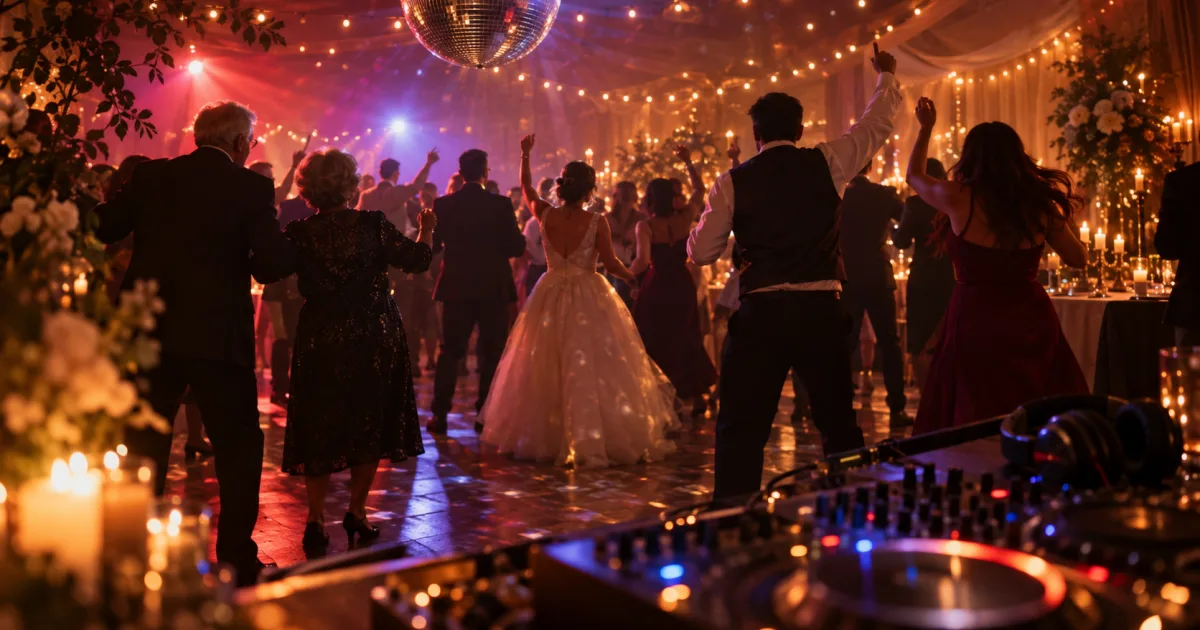
Wedding dance floor songs are chosen by guests, not by charts: grandparents, parents and the couple's friends dance in the same room, and each generation has its own music from its youth. A workable scheme: the couple writes two short lists in advance, "must play" and "do not play"; the dancing is split into blocks; each block has songs everyone knows; and the meaning of every lyric is checked beforehand. This guide comes from Russian family weddings, so the playable examples are Russian and European hits in Disco Magic dance reworks: old songs the older guests know, with a beat the younger ones are used to. It is about the guests' dancing, not the couple's first dance. A ready-made dance background is in our retro remixes for a party collection, but do not play it at a wedding from start to finish; the section on lyrics explains why.
Two lists from the couple
The same advice comes from The Knot, wedding planner Mindy Weiss and the Russian site Weddywood: the couple gives the DJ or host a list of songs that must be played and a list of songs that must not. The Knot notes that the DJ will most likely ask for a do-not-play list. Wedding planner Mindy Weiss advises making both lists and otherwise giving the DJ free rein, because a good DJ reads the floor. The Russian site Weddywood likewise recommends showing the DJ the tracks that should not be heard.
- Must play. A short list: the couple's favourites, the parents' song, whatever the friends will not leave without. A long list ties the hands of whoever runs the evening.
- Do not play. Songs tied to exes, to hard times in the family, or simply worn out. No reasons needed.
Ask about bans even for the obvious hits. In a FiveThirtyEight survey (2017, USA, 182 wedding playlists), some of the most banned songs were also among the most requested: the better known a song is, the more likely someone is tired of it. Those are American data and the list itself does not transfer, but the observation is useful.
Who is in the room: three generations, three eras
| Guests | Approximate birth years | The music of their youth | Where to look here |
|---|---|---|---|
| Grandparents | 1945-1960 | Soviet pop and film songs of the 60s and 70s | Soviet songs |
| Parents | 1965-1980 | The 80s and 90s: Modern Talking, Russian pop, Eurodance | 80s, 90s |
| The couple and friends | 1990-2002 | Current music and 2000s hits from childhood | 2000s and the couple's own list |
The years are a starting estimate, not a rule. Memory research offers one helpful finding here: young adults also respond strongly to the music of their parents' generation, the music that played at home. Hence our assumption, not a proven fact: an 80s hit in a fresh dance arrangement may suit both older and younger guests, because the first know the song and the second are at home with the beat. Those studies measured memories, not dancing.
The sequence of dance blocks
There is no single norm, and sources differ. Mindy Weiss suggests moving through eras from oldest to newest and not peaking in the first hour; in her experience older guests leave earlier. Weddywood advises alternating styles and languages and building the night in waves with breathers. The scheme below combines the two. Adjust the block lengths to your own evening.
Arrival and dinner: background
"Yagoda malina" (Valentina Legkostupova, 1987): a light song recognised at any table.
Geronimo's Cadillac (Modern Talking, 1986): steady background for the parents' generation.
First dance block: start with the elders
Older guests find it easier to dance early in the evening, to their own music. Singalong songs fit here.
"Carefree (Bunny Song)", the song about hares from the 1969 film comedy "The Diamond Arm": every generation in Russia knows the chorus.
"Vinovata li ya": a table song the older half of the room joins in. Its story is about deceit, so it is a song for singing together, not a dedication to the couple.
"Modnitsa" by Kombinatsiya: a bridge from the elders to the parents' generation.
The peak: songs everyone knows
Coco Jamboo (Mr. President, 1996).
"Vozdushnyi shar" by Mr. Credo (1998).
Let's All Chant (The Michael Zager Band, 1977): a disco standard with a chorus you can shout without knowing the words.
After dinner, when the older guests start to leave, it is time for the couple's and friends' music: that is their must-play list, and retro gives way to current songs.
Slow dances
An honest warning. Our catalogue is mostly dance reworks and original songs, and it has no confirmed slow recordings. A song can be called "Medlyak" (Russian slang for "slow dance") and still not be slow: our rework of the Mr. Credo song with that title is a dance track, and a machine tempo estimate agrees. For the slow block take original recordings from the couple's list and check the tempo of each by ear: a title and a memory will not tell you.
Finale
"Kogda moi druzya so mnoy" (1976), a song about friendship that everyone sings, children and grandparents alike.
"My zhenilis. Teper ofitsialno" ("We Got Married. It Is Official") is a humorous Disco Magic original about married life. The chorus has a colloquial word in it; listen first and decide whether it suits your crowd.
Check the meaning of the lyrics, not the title
Mindy Weiss always suggests reading the lyrics: sometimes the songs couples pick are about breaking up. Two well-known examples.
- Every Breath You Take by The Police (1983) is often taken for a tender love song. Sting said in a 1993 interview that he had not realised at the time how sinister it is and that he was thinking of surveillance and control. The quote is given as cited in the Wikipedia article on the song, which refers to The Independent; we did not read the interview itself.
- I Will Always Love You was written by Dolly Parton in 1973 as a farewell to her business partner and mentor Porter Wagoner. It is a song about parting, however grateful.
Our own catalogue has traps of the same kind. We checked the lyrics against transcripts, and this is worth knowing before a wedding:
| Recording | What the title suggests | What it is actually about |
|---|---|---|
| "Papa" | A father-daughter dance | A father who left the family. Not suitable. |
| "Medlyak" | A slow dance | A dance rework, not a slow song; the story of one night. |
| "Den rozhdeniya" ("Birthday") | A party song | We have three recordings with this title; in two of them the hero celebrates alone. |
| "Belye rozy" (the Disco Magic original) | The famous Laskovyi Mai hit | It is a different song, and its theme is loss. |
| "Klyanus" ("I Swear") | A wedding vow | A story of leaving a troubled home. |
| "Selskiy kaif" | A cheerful disco number | Crude language and a drug theme. It appears in the 90s and party collections, so do not play those collections at a wedding from start to finish. |
The rule is simple: one person listens to every song on the list in full and reads the words. It takes an evening and spares you an awkward moment in front of the parents.
For a father-daughter dance, the Disco Magic original "Dochenka" ("Darling Daughter") fits by meaning. A machine tempo estimate says it is not slow, so first hear whether it is comfortable to move to.
Original or modern version
- Take the original when the recording itself matters: the voice the parents remember, the song from their own wedding, a slow dance.
- Take a dance rework for the shared blocks: it has a steady dance beat and the song stays recognisable. The words are usually the same, but not always: some foreign hits are sung here in Russian.
- Do not play the original and a rework of the same song back to back: the second one feels like a repeat.
You can see what kinds of reworks exist in old songs in a modern rework and covers of Russian songs: the recordings name the original artist.
A backup plan
- Keep ten spare songs that everyone is sure to know. If a block falls flat, change it without regret.
- Download the music in advance: reception at country venues lets you down. Downloads here are free with an account.
- Appoint one person to take guests' requests and check them against the do-not-play list.
- If a friend rather than a DJ runs the music, borrow the evening structure from our 90s disco programme for a corporate party.
What we checked and what we did not
The stories of the songs in our catalogue were checked against lyric transcripts; transcripts can contain errors, so listen to the chosen recordings yourself before the wedding. We did not judge tempo or danceability by ear. The advice on lists and block order comes from wedding media and interviews, mostly American: working practices, not norms. Original years are given as in our catalogue records.