February 1984. Roland releases the Juno-106 - a six-voice analog synthesiser with digitally controlled oscillators and a built-in chorus. Three chorus positions - I, II, III - become the machine's most recognisable feature. The chorus effect in 80s music is not decoration but a structural element of the sound: without chorus the Juno-106 sounds thin and dry; with it - wide and warm. But chorus was not only in synthesisers. Boss CE-1 on guitar, Roland Dimension D in the studio, double-tracked vocals - four different applications of one idea: making a single source sound like several.
What is chorus: the physics of the effect
According to Wikipedia, chorus is an audio effect that occurs when individual sounds with approximately the same time and very similar pitches converge. The effect is characterised by a "rich, shimmering quality" absent from a single source. The shimmer comes from beating - an acoustic phenomenon where two close frequencies create a pulsing amplitude.
Electronic chorus simulates this effect: the input signal is mixed with one or more delayed copies. The pitch of the added voices is modulated by a low-frequency oscillator (LFO) - similar to a flanger, but with longer delays and no feedback. Stereo chorus enhances the effect by offsetting the LFO phase between left and right channels: sound appears to come from multiple positions in the stereo field.
In synthesisers, chorus can be implemented in two ways: through a separate electronic chorus circuit through which all notes pass, or through multiple slightly detuned oscillators per note. The Juno-106 uses the first approach - a built-in chorus circuit; the Prophet-5 uses the second (two oscillators per voice, which can be detuned).

Juno-106: chorus as signature sound
The Roland Juno-106 is a six-voice synthesiser with one DCO per voice, released in February 1984. According to Wikipedia, it was Roland's bestseller until the D-50. 128 patches, MIDI - one of the first analog synthesisers with MIDI. But the key feature is the built-in chorus with three modes. The Juno-106 chorus made a single DCO wider: one oscillator per voice sounds thin, but chorus turns it into a dense, warm, wide sound.
Three chorus modes on the Juno-106: I - light, II - medium, III - pronounced. Mode I adds a subtle shimmer, sufficient for accompaniment. Mode II - standard for most patches: width without overdoing it. Mode III - maximum depth, used for pads and lead parts. The difference from an external chorus pedal is integration: the chorus is built into the synthesiser's signal path and optimised for its timbre.
The Juno-106 chorus sound is one of the most recognisable in pop music. According to Wikipedia, the Juno-106 was used by Vince Clarke, Frankie Goes to Hollywood, Vangelis, William Orbit, Daft Punk, Tame Impala, Calvin Harris. In Italo Disco production, the Juno-106 with chorus on pads is a standard palette: width, warmth, motion.
Boss CE-1 and CE-2: the guitar chorus of the 80s
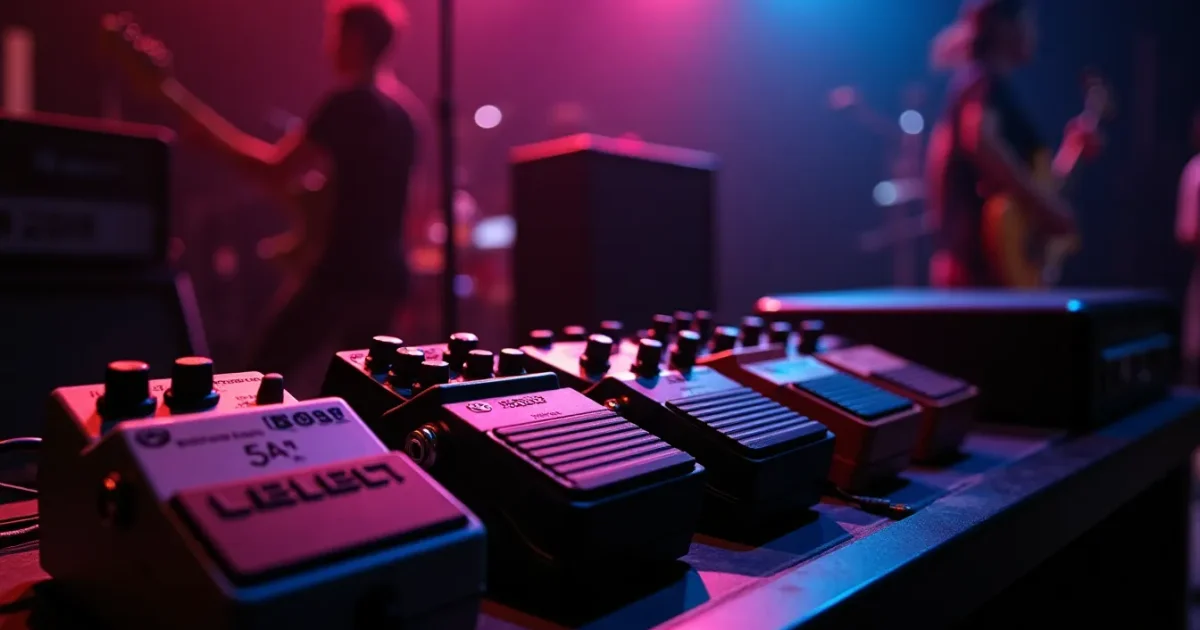
The Boss CE-1 (1976) is one of the first chorus pedals on the market. According to Wikipedia, the CE-1 was based on the same circuit as the Roland Jazz Chorus amplifier. Originally designed for keyboard players, it quickly found use among guitarists - for example, John Frusciante of the Red Hot Chili Peppers. The Boss CE-2 (1978) - a smaller version in the standard Boss enclosure - became a popular choice for guitarists in the 80s.
Andy Summers of The Police is the chief populariser of guitar chorus in the 80s. "Don't Stand So Close to Me," "Walking on the Moon," "Every Breath You Take" - all built on chorus-processed guitar. Summers' dense, shimmering sound is the result of a CE-1 (or CE-2) over a clean guitar tone. Without chorus the part would sound dry and flat; with chorus it fills the stereo field and creates atmosphere.
The Boss CE-3 (1982) added a stereo output. The Boss DC-2 Dimension C (1985) - a more complex chorus concept without the wobbling pitch that other pedals produce. Dimension C gives a more static but wide stereo picture - a sound closer to studio rack chorus than to pedal chorus.
Dimension D: the studio rack chorus
The Roland SDD-320 Dimension D is a studio rack chorus, produced from the late 70s. Dimension D does not wobble pitch like a pedal chorus; it creates a stationary widening of the stereo image. The sound becomes wider without motion - this is the "dimension." Dimension D was used on vocals, guitar, keyboards and the mix as a whole. Its sound - dense, wide, without modulation artefacts - was the standard of 80s studio production.
The difference between a pedal chorus (CE-2) and a studio chorus (Dimension D) is in modulation depth. The CE-2 creates motion: pitch slowly shifts, the sound "flows." Dimension D creates width without motion: the sound stays in place but fills the stereo field. Both effects are chorus, but with different artistic goals. In Italo Disco production, Dimension D was often used on vocals and pads - where space without wobble is needed.
Vocal chorus: double tracking
The fourth application of chorus in the 80s is vocal. Double tracking - recording the vocal twice on two tracks and mixing them - is the oldest way to make one voice sound like two. The effect is the same as chorus: two slightly different sources create shimmer and width. The difference is method: double tracking is manual (the singer performs twice), chorus is electronic (the delay circuit does the work).
In the 80s, automatic double tracking (ADT) appeared - a short delay with slight pitch modulation simulating a second vocal take. ADT is, in essence, a chorus set to minimum depth: barely perceptible shimmer that makes the vocal wider without an obvious effect. Tony Banks of Genesis used ADT on Phil Collins' vocal; Italo Disco producers used it on session singers' vocals.
Chorus and double tracking can widen a vocal part. A finished mix does not always reveal whether that width comes from an effect or several recorded takes; a firm attribution needs session evidence.
Four applications of chorus: a summary map
Chorus in 80s music operated on four levels, each with its own toolkit and aesthetic goal. On synthesisers (Juno-106, Jupiter-8 with chorus circuit) chorus made a single oscillator wider - turning a thin timbre into a dense one. On guitar (Boss CE-1, CE-2) chorus created a shimmering stereo field that filled the space between bass and vocal. In the studio (Dimension D, Lexicon) chorus was applied to a finished mix or individual tracks - vocals, pads, guitar - for width without motion. And on vocals (double tracking, ADT) chorus masked inaccuracies and made the voice "studio."
All four applications are variations of one idea: one source sounds like several. The difference is how obvious the "several" is to the listener. On a synthesiser, chorus is invisible: the sound is simply "good." On Andy Summers' guitar, chorus is the main effect defining the sound. In the studio, Dimension D works as glue: binding instruments into a single stereo field. On vocals, chorus is a mask: a perfect voice does not need chorus, but perfect voices do not exist.
This universality - from synthesiser to mix - made chorus the defining effect of the decade. Reverb worked on space, compression on density, but chorus worked on width. And in the 80s, width was everything.