
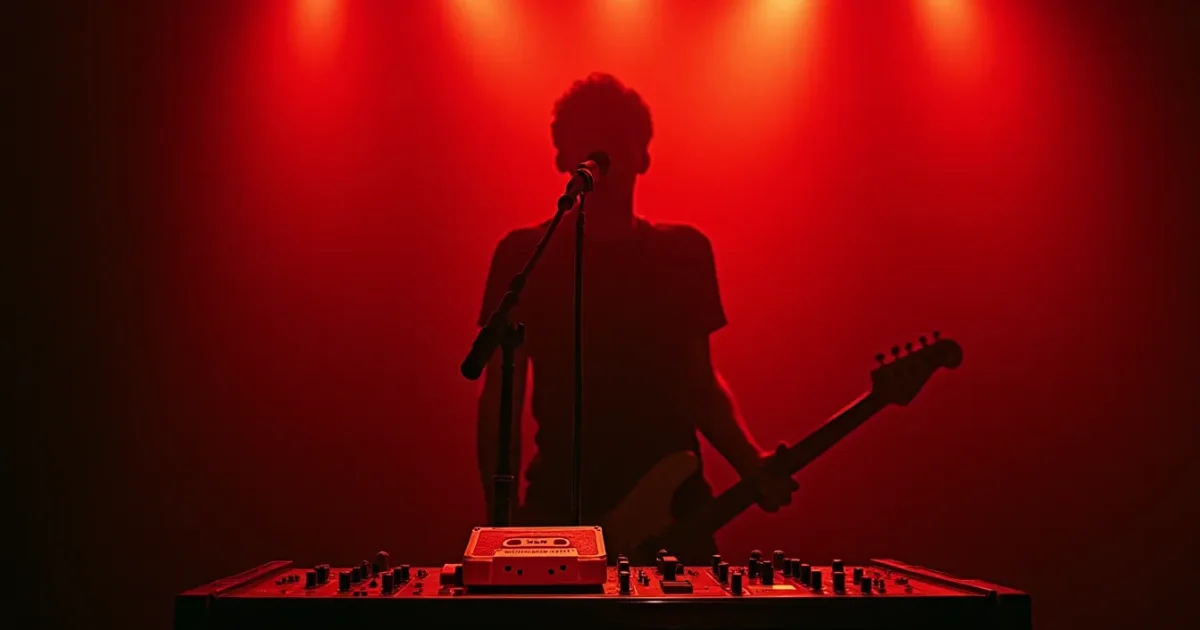
12 December 2007. Alexander Pushny posts a cover of “Zelenoglazoe Taxi” - in the style of Rammstein, with a German lyric “Du Taxi mit den Augen grün”. The song he is covering was written by composer Oleg Kvasha to lyrics by Valery Panfilov in 1987 and originally performed by Kvasha himself. In twenty years one Soviet эстрада piece gathered at least nine documented versions, from a disco remix to an English-language pop cover. “Zelenoglazoe Taxi” is useful because it shows exactly which arrangement levers move when someone else's song becomes your own. Let us take these levers apart on Russian examples.
Changing genre and rhythm section
The catalogue includes a treatment of “Imya moyo” (DJ Unix / Voyazh), listed as Drum and Bass. It provides a concrete example for comparing a familiar song with a new genre version; the player opens the Disco Magic & valex77 recording.
A different case is “Svet v okontse”, an adaptation with reworked verses and a chorus from Sergei Galanin’s “A chto nam nado”. It does not re-record the entire source song. Galanin discusses the song in a Rock FM interview about his solo album “Sobachiy vals”.
The most visible trick is to carry a song into another genre, which automatically replaces the rhythm section. Pushny's version is not just “a heavy arrangement”: the Rammstein rhythm section, with its driving guitar stomp and march, replaces the original эстрада pulse, and the German lyric sits in that rhythm more tightly than the Russian would. A year earlier, in 2007, Global Deejays worked the same trick in reverse: the Austrian group took Kvasha's vocal from his 2000 album “Tantsevalny Proekt Kvasha” and sat a dance beat under it - a club track that played on the in-game radio station Vladivostok FM in Grand Theft Auto IV.
In 2009 the American band Brazzaville cut its own English-language version - “Green Eyed Taxi” - and presented it at a children's home in Zelenograd. Here the genre shift is softer: a band arrangement with a live rhythm section instead of an 80s эстрада delivery, but without the language change it would have stayed a recognisable cover of Kvasha rather than a free-standing piece. A genre transfer almost always means a rhythm-section transfer too: new drum and bass parts make the song different at a physical level.
Nine versions of one song
To see the levers at a glance, here are the documented versions of “Zelenoglazoe Taxi”:
- Oleg Kvasha (1987) - the original, the composer performs it himself;
- Mikhail Boyarsky (November 1987) - a recording for a Melodiya long-play;
- Lyapis Trubetskoy (mid-1990s) - an unauthorised reworking; the conflict with Kvasha through the Russian Authors' Society led to four lawsuits;
- Global Deejays (January 2007) - a dance remix built on Kvasha's vocal from the 2000 album “Tantsevalny Proekt Kvasha”;
- F. R. David (2007) - an English-language version for the NTV project “Ty - Superstar!”;
- Alexander Pushny (12 December 2007) - a Rammstein-style version in German;
- Brazzaville (2009) - the English-language “Green Eyed Taxi”;
- Zhora Kryzhovnikov, film “The Best Day” (2015) - an in-scene mashup;
- IOWA and RSAC (2021) - a cover and video with Yandex.Taxi.
One track - and almost the full set of tricks: a faithful re-recording (Boyarsky), an unauthorised reworking (Lyapis), a remix (Global Deejays), a language transfer (F. R. David), a genre shift (Pushny, Brazzaville), a mashup (Kryzhovnikov).
Changing the vocal delivery
Sometimes a song is reworked without touching melody, language or tempo - only the voice. The “Buranovskie Babushki”, a folklore ensemble from the village of Buranovo in Udmurtia (the average age of its members was 70 by 2010), began covering well-known hits in their native Udmurt in 2008, starting from Native Language Day. Their repertoire took in Viktor Tsoi's “A Star Called the Sun”, Boris Grebenshchikov's “The Golden City”, Vladimir Butusov's “Walking on Water”, the Beatles' “Yesterday” and Queen's “We Are the Champions”.
The trick here is not the translation as such (though that is there too) but a swap of the very character of the voice: instead of a male rock or pop vocal, elderly female folklore voices, ensemble delivery, a different timbre. At the 2012 Eurovision in Baku this approach carried the ensemble to second place with the song “Party for Everybody”. The same lever - changing the vocal delivery while keeping the recognisable material - works in a studio cover too: swap a male lead for a female one or vice versa, and the song reads differently at the same melody.
Language transfer
Translating the lyric is a separate lever, and on Russian material it has run both ways. F. R. David, a French singer invited by Iosif Prigozhin for the NTV project “Ty - Superstar!” in 2007, recorded an English-language “Zelenoglazoe Taxi”; the translation was done in Moscow, the rights to the song and to the translation were bought by the English company “Attack Concert”, and the version went onto the singer's album Numbers (2008). In the other direction - from Russian into other languages - language transfer was pushed to the limit in the “KINOproby” tribute (2000): “Sunny Days” was cut in Russian, Ukrainian and French at once, because all three sat on Tsoi's music, and the album also included a single three-language version.
There is also transfer between languages of the post-Soviet space. In the first part of the television cycle “Old Songs About the Main Things” (premiere on the night of 31 December 1995 to 1 January 1996 on ORT) the closing song was “Be Well and Live Richly” - a Russian translation of the Belarusian song “Byvaytsa zdarovy”. Language transfer here does not break recognisability, because the melody and harmony stay; only the text layer changes, and the cover gains a new addressee.
Tempo and dance adaptation
A tempo change is the lever that separates a dance cover from a lyrical original. Global Deejays did not re-record the vocal: they took the ready phonogram of Kvasha's voice and sped the context around it up to a club tempo, turning an эстрада piece into a dance track. This is a borderline case - technically closer to a remix, because an existing recording is used rather than re-recorded. Where this line - between a cover and a remix - runs, we worked through in a separate piece on the four concepts.
The dance adaptation of Soviet songs in the italo-disco style is a separate line in which several levers move at once: a four-on-the-floor rhythm section, a synth bass, a tempo in the dance corridor. How exactly this approach is built and what it does to the original is broken down in the piece on Soviet songs in the italo-disco style; concrete tracks of this kind sit in the Disco Magic catalogue too - for instance the italo-disco reworking of “Sedaya Noch” and the story of the “Ostansya” cover.
When everything moves at once: a mashup
In the comedy “The Best Day” by Zhora Kryzhovnikov (2015) a version of “Zelenoglazoe Taxi” appeared in which several levers are on at once. The song is first sung by a male voice - the non-professional singer Sergey Lavygin - to the 80s music, and then by a female voice, Olga Seryabkina, to the Global Deejays remix. This is no longer a cover in the strict sense but an in-scene mashup: two eras of one song's arrangement collide inside a single scene.
Detail: “Zelenoglazoe Taxi” is a rare case where one song lets you trace almost the whole set of tricks in a row - genre change (Pushny), rhythm-section change (Brazzaville), tempo change (Global Deejays), language transfer (F. R. David), mashup (Kryzhovnikov). Nine versions are, in effect, a textbook on arranging a cover on one body of material.
When the melody stays and the context changes
The opposite pole is covers that deliberately keep the melody and recognisability of the original while moving the song into a new performing context. “Old Songs About the Main Things” - a cycle of ORT musical films from the late 1990s (producer Konstantin Ernst, musical producer Alexander Kutikov, arrangement by Felix Ilinykh, director Dmitry Fiks) - is built exactly this way: Soviet film songs are sung by 90s stars, keeping the melody under a new arrangement. The first part alone has about nineteen pairings: “Good Girls” (from “Devchata”) by Larisa Dolina and Irina Otiyeva, “Because We Are Pilots” (from “The Sky Slowpoke”) by the group Na-Na, “Oh, the Kalina Blooms” (from “The Kuban Cossacks”) by Angelika Varum, “The Way You Were” (from “The Kuban Cossacks”) by Sofia Rotaru, “The Dark Barrows Sleep” (from “A Great Life”) by Nikolai Rastorguev.
“Nezhnost” (“Tenderness”) by Alexandra Pakhmutova to lyrics by Grebennikov and Dobronravov (1965, first heard in December 1965 at the Column Hall of the House of Unions in Maya Kristalinskaya's performance) gave several such contextual versions: it was sung by Tatiana Doronina's character in the film “Three Poplars on Plyushchikha” (1967, director Tatiana Lioznova), Tatiana Bulanova recorded it for “Old Songs About the Main Things 2”, Thomas Anders released an English variant “Tenderness”, and the Belgian guitarist Francis Goya made an instrumental version for the album “A Tribute To Alexandra Pakhmutova” (2002). The melody is constant - the voice, the language and the genre frame change.
A similar case is “Am I to Blame”, a sentimental romance by composer Alexey Muravlyov (the text is attributed to Felix Dallada) that in time became a folk song. In early 1995 the ensemble “Golden Ring” under Nadezhda Kadysheva released, on Soyuz Studio, the album “Am I to Blame…”, which became a best-seller: a folklore-ensemble delivery moved a pre-revolutionary-origin piece into a new context - out of a chamber romance and into the mass эстрада of the 90s.
Why move these levers at all
Each lever solves its own task. A genre and rhythm-section change carries a song into a new audience and a new listening context - from эстрада to a dancefloor or to rock. A vocal-delivery change shifts the addressee and the register of meaning: “A Star Called the Sun” from an Udmurt folklore ensemble does not sound like Tsoi's urban romance but like a communal song. A language transfer widens the geography - F. R. David takes a song known in the Russian-speaking space and makes it English. A tempo change makes a song fit a new format - a club set or a radio format. A mashup collides eras for a dramatic effect.
In practice a cover rarely moves only one lever: Global Deejays change tempo and rhythm section at once, the Babushki change vocal delivery and language, Pushny changes genre, rhythm section and language. But breaking it down into separate tricks helps explain why one cover reads as “the same song, differently” and another as a quite different piece. The line runs along which layers of the original were kept and which were replaced; the rest is a matter of taste and the arranger's brief.