
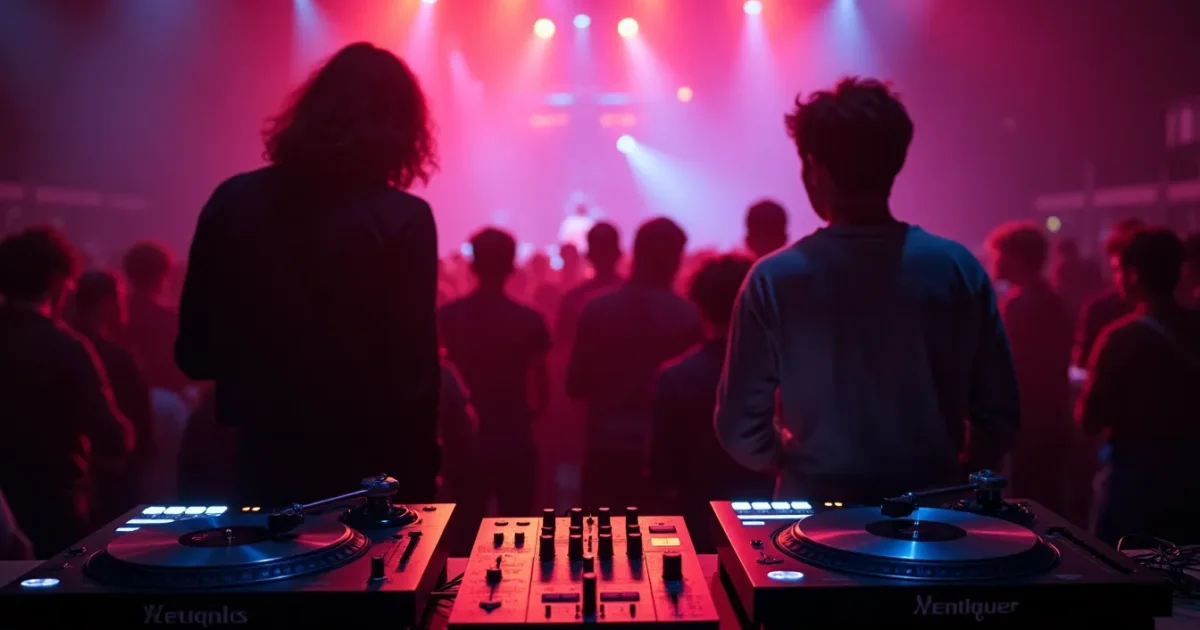
The Technics SL-1200 arrived in October 1972. The Pioneer CDJ-500 - in 1994. Between these two models lies the boundary that separated the 80s disco from the 90s: vinyl gave way to CD, the analog synthesizer to the sequencer, the live MC to the DJ set. The key "disco 80s 90s" is searched 131,196 times a month - but the difference is not in "mood", it is in technology, carriers and the format of the evening. Below are five concrete distinctions, each with a model and a date.
Carrier: vinyl → CD → MiniDisc
In the 80s, disco worked on vinyl. The standard - Technics SL-1200, a series of direct-drive turntables introduced in October 1972 by Matsushita under the Technics brand (per the English Wikipedia article on Technics SL-1200). The SL-1200 influenced the emergence of hip hop, turntablism and electronic music in the 80s. Vinyl gave control: you could mix smoothly, loop a break, scratch. But it wore out, was expensive and heavy - a crate of forty records weighed more than the DJ.
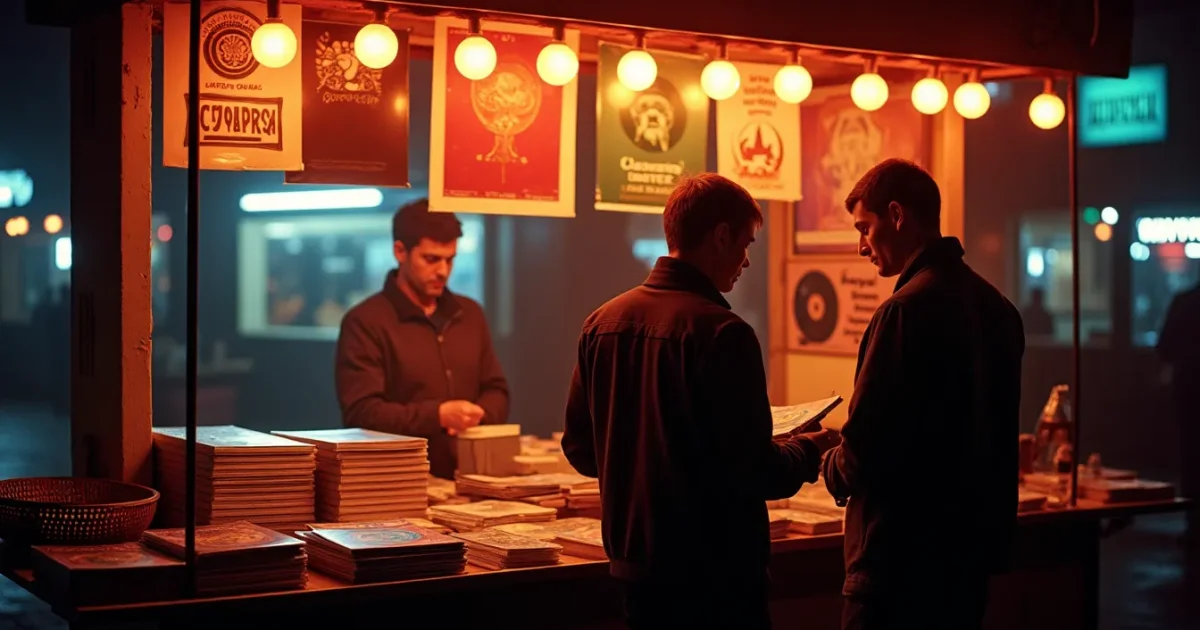
Cassettes were cheaper, but rewinding killed the set's momentum. At Gorbushka in Moscow - a market that grew out of a phonograph collectors' club founded in autumn 1987 - the first compact discs appeared in 1992-1993 (per the Russian Wikipedia article on Gorbushka). Branded CDs were expensive; pirate copies ten times cheaper. In 1997, Gorbushka entered the Guinness Book of Records for "fastest piracy": four hours after Microsoft Office 97 launched, pirate copies were already on the shelf. Music spread by the same route.
In 1992, Sony introduced the MiniDisc - a magneto-optical disc holding 60-80 minutes of digital audio (per the English Wikipedia article on MiniDisc). MiniDisc gave instant track access like a CD, but was smaller and rewritable - DJs carried their own compilations on it. The format lasted until 2013 but never became a club standard: it was displaced by CD, and then by USB.
The breakthrough in DJ work with CDs came in 1993: Denon DJ released the first rack-mounted dual-deck CD player with a jog wheel and instant cue button for DJs (per the English Wikipedia article on CDJ). It quickly became the industry standard in clubs and among mobile DJs throughout the 90s. In 1994, Pioneer released the CDJ-500 - its first CDJ player with a jog wheel, pitch control of ±10% and a Master Tempo function that changed speed without altering pitch. Earlier still, in 1986, the Technics SL-P1200 became the first CD player with a jog wheel at all - but it was Denon and Pioneer that made the format mainstream.
The real break came in 2001 with the Pioneer CDJ-1000: the first CD player to accurately emulate a vinyl turntable, including scratching. Before the CDJ-1000, few clubs installed CD decks - DJs preferred vinyl, because music came out on it earlier and in greater quantity. The CDJ-1000's adoption was helped by the arrival of recordable CD-R and CD-RW media: a DJ could record their own track at home and bring it to the club on a disc, rather than ordering an expensive acetate that wore out after a few plays.
Sound: analog synthesizer → sequencer and sampler
80s italo-disco was recorded on analog synthesizers. Savage's "Don't Cry Tonight" (1983) - Prophet-5 (pads with slow attack), Moog Prodigy (eighth-note bass), Roland Jupiter-8 (melodic hook), LinnDrum (drum machine with live claps on beats 2 and 4). Every sound was generated physically, in real time, by a musician's hands on the keys. Arrangements existed only on paper and in the producer's head - sequencers were used in italo-disco but did not dominate. Tempo - typically 118-128 BPM.
90s Eurodance was sequencer music. Kick, bass, melody - all programmed in a sequencer; vocals split into male rap verses and female chorus (per the Russian Wikipedia article on Eurodance). Tempo - 110-150 BPM, four-on-the-floor kick on every beat. Samplers replaced live synth parts: instead of playing a bassline on a Moog, the producer programmed it in a sequencer and adjusted the pitch. Snap!, assembled in Frankfurt by Michael Münzing and Luca Anzilotti in 1989, were the first to combine hip-hop vocals with electronic music - and became the template for all subsequent Eurodance projects. In May 1995, seven Eurodance songs sat in the Italian top-10 simultaneously - the genre's peak.
Songs were assembled around a single: the producer hired a rapper and a singer, placed the hook in the first ten seconds. The faces in the video did not always match the voices on the record - "shadow vocalists" Nana Hedin, Giovanna Bersola, Sandra Chambers and Ennerly Gordon sang for those who lip-synced on camera. More on how this sound relates to its predecessor in the article on Eurodisco vs Eurodance differences.
Evening format: live MC → DJ set
An 80s disco at a Soviet community centre is not a DJ in headphones. It is an MC with a microphone, announcing dances, running contests and playing records. Music came from vinyl; pauses were filled with voice. The evening's structure broke into fragments: dance - announcement - dance - contest - dance. There was no continuous flow, physically, because changing a record in three seconds took a professional, and the MC was not a DJ but an entertainer with a turntable. Gaps between tracks were filled with voice, the next dance announced, or a "guess the melody" contest.
The DJ as an independent figure - a professional who shapes a continuous music stream without an MC - arrives in Russia in the 90s alongside Eurodance and club culture. In parallel, track length changed. An italo-disco single from 1983 - 4:05 (Savage "Don't Cry Tonight"), 12-inch club mix up to 6:30. A Eurodance single from 1993 - 3:44 (2 Unlimited "No Limit"). Tracks grew shorter, structure denser: hook in the intro, verse, chorus, all in 3:30-4:10. A DJ set of 40 tracks at 3:40 each is two and a half hours of continuous flow - something a live MC could not physically deliver.
Italo-disco in the 80s spread through compilations: the "The Best of Italo Disco" and "Italo Boot Mix" series on the German label ZYX stretched to 16 volumes and ended in 1991 (per the English Wikipedia article on Italo disco). 80s DJs bought these compilations and played tracks from them - original singles were scarce, and a ZYX compilation held up to sixteen tracks. In the 90s, "Dance Machine" compilations (a French TV-concert series) and Italian compilations followed the same model: the compilation as the source of repertoire, not individual singles. On the transition from disco to Eurodance, read the article from disco to Eurodance.
Volume: analog mastering → digital
Records from 1983 were mastered in an analog chain: wide dynamic range, peaks far from the ceiling, low average level. Records from 1993 were already digital, with compression and limiting: higher average level, peaks squeezed toward 0 dB. On the dancefloor this means an 80s italo-disco track sounds quieter than a 90s Eurodance track at the same knob position - a 6-8 dB gap. A DJ mixing two decades must compensate with gain staging, or every transition sounds like a drop. The same difference is audible comparing Baltimora's "Tarzan Boy" (1985) and Snap!'s "The Power" (1990) on one console: the first is analog mastering with a wide range, the second is digital with compression. More on BPM and mixing technique in the dance music BPM guide.
Models and dates: a quick reference
- 1972 - Technics SL-1200, direct-drive turntable. The 80s standard
- 1982 - ZYX begins licensing italo-disco for the German market. "The Best of Italo Disco" compilations - 16 volumes through 1991
- 1986 - Technics SL-P1200, first CD player with a jog wheel
- 1989 - Technotronic "Pump Up the Jam", the starting point of Eurodance
- 1992 - Sony MiniDisc. First CDs appear at Gorbushka
- 1993 - Denon DJ, first rack-mounted CD player for DJs. The 90s club standard
- 1994 - Pioneer CDJ-500, first Pioneer CDJ with a jog wheel
- 2001 - Pioneer CDJ-1000, first CD player with true vinyl emulation. The 2000s club standard
What stayed the same
Despite five differences, 80s and 90s disco rested on the same foundation: a four-on-the-floor kick on every beat. Italo-disco from 1983 (128 BPM) and Eurodance from 1993 (130 BPM) are the same rhythmic pattern, performed by different instruments. The tempo intersection zone - 120-130 BPM - allows mixing tracks from both decades without a tempo jump. Italo-disco evolved into Italo house around 1987, and Italo house into Eurodance by 1989: one branch, different leaves. More on what "retro 80s-90s" means as a phenomenon in the article on retro 80s-90s music.
The differences - in one line
- Carrier: vinyl → CD (1993, Denon) and MiniDisc (1992, Sony)
- Sound: analog synthesizers (Prophet-5, Jupiter-8) → sequencer and sampler
- Evening format: live MC with a microphone → continuous DJ set
- Volume: analog mastering (wide range) → digital with compression
- Track length: 4:00-6:30 (12-inch) → 3:30-4:10 (single)
In 1993 Denon DJ did for the DJ what the Technics SL-1200 did for disco in 1972: gave a format that became the standard for ten years. The difference is that the SL-1200 worked with vinyl - a medium that physically wore out - while Denon and the Pioneer CDJ-500 that followed worked with CD, which did not wear out, gave instant start and held seventy minutes of music on one disc - a full DJ set without changing the carrier. 90s disco was faster, louder and more technological - but the kick stayed the same.