
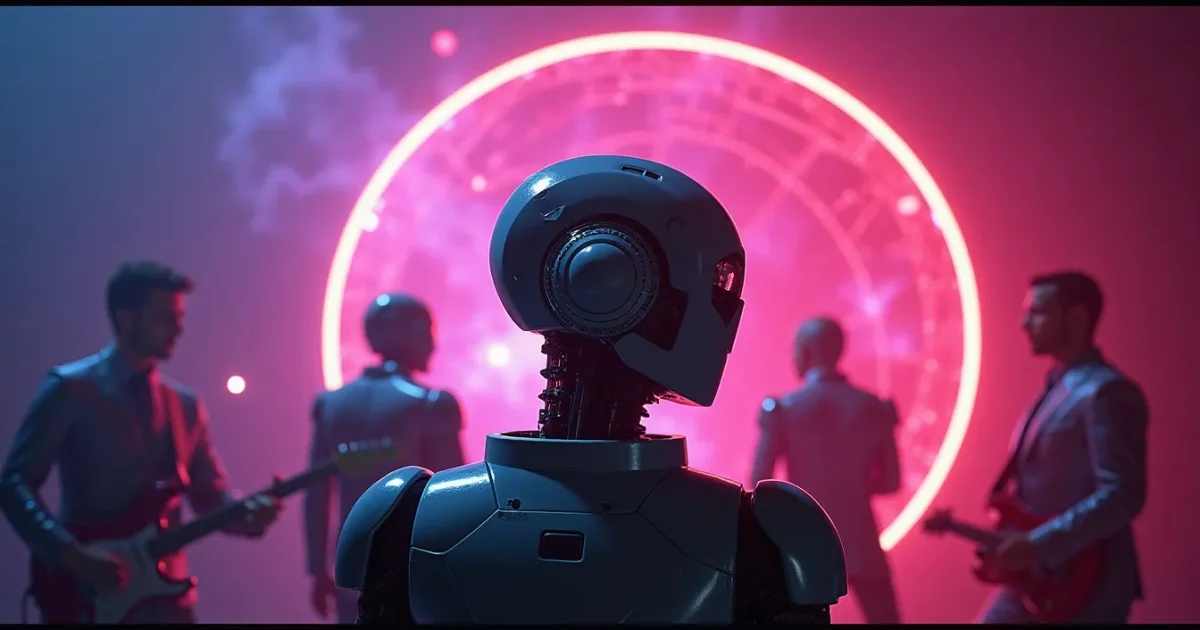
1984. The label Memory Records released the 12" "Void Vision" under the name Cyber People. Catalogue number MEMIX 028, producers Alessandro Zanni and Stefano Cundari, main writer Giorgio Spagna. This was not a group in the usual sense: no fixed members, no touring line-up, no magazine biography. Yet Cyber People became one of the flagships of spacesynth - the space-themed branch of Italo Disco where the vocoder and synthesizer matter more than the human voice.
A faceless project
Cyber People appeared by the same scheme as many Italian studio projects of the 1980s: a label manager assembled a team, chose a memorable name, and commissioned a run of singles. Unlike Den Harrow or Ken Laszlo, Cyber People had no handsome frontman or video clips. The sleeves showed abstract neon graphics, spaceships, and robots; on the radio were instrumental tracks in which the melody was sung by a synthesizer instead of a vocalist.
The project's real name is listed on Discogs as Giorgio Spagna. He wrote the first three key releases and set the signature sound: a thick arpeggiator, bright lead synths, vocoder fragments, and a tempo around 120-128 BPM. After Spagna left, production continued with Stefano Cundari and Mirko Limoni, who released a fourth single for Memory Records.
Detail: on some pressings the project name was spelled "Ciber People" - a spelling later used by ZYX Music for separate releases outside the original Memory Records canon.
Memory Records: the soil it grew in
Memory Records was one of the key Italian labels of the late 1980s. Founded by brothers Franco and Fernando Bianchi, it was home to Radiorama, Ken Laszlo, Brian Ice, and many others. The label had a clear export strategy: records were distributed through ZYX Music in Germany, making the tracks available to European clubs and radio stations.
Cyber People received full studio support from the label. Alessandro Zanni oversaw the overall sound and A&R, while Stefano Cundari handled mixing and arrangement. As a result every project single sounded expensive and recognisable - a rarity for instrumental Italo, which often slid into cheap "space" kitsch.
The presets and sonic ideas of Cyber People were later reused in other Memory projects. The same arpeggiator, the same way of stacking lead lines, the same vocoder "robotisation" became part of the label's sonic DNA.
"Void Vision" and "Polaris": what is inside
The first release "Void Vision" (1984, MEMIX 028) is in two parts: the main theme and a slow version. The track is built on a major-key harmony with a long arpeggiated bass reminiscent of Koto and Hipnosis, but with the warmer sound of the Roland Jupiter-8. Vocoder touches appear not as a full vocal, but as another instrumental layer.
The second single "Polaris" (1984/1985) became the project's best-known track. It is recognised by the opening lead riff that sounds like a spaceship signal and by the solid 4/4 beat with handclaps. "Polaris" had no singing - only vocoder fragments and the title repeated as a hook. That made the track versatile: it could be played in an Italo set, a spacesynth programme, or even an early trance mix.
- Void Vision - MEMIX 028, 1984, instrumental, written by Giorgio Spagna.
- Polaris - Memory Records, 1984/1985, probably the most recognisable Cyber People track.
- Digital Signal Processor - 1988, the last original single on Memory Records, with a later, rave-oriented sound.
- Doctor Faustu's - 1986, released under the Ciber People spelling.
Spacesynth: the edge of Italo Disco
Spacesynth - a subgenre of Italo Disco that formed in the mid-1980s - is built on space themes, arpeggiators, and vocoders. Cyber People, Koto, Hipnosis, Laserdance, and Proxyon worked the same territory: they removed the vocal and replaced it with a melodic synthesizer. The result sounded like dance music and a science-fiction film soundtrack at the same time.
The main difference between spacesynth and ordinary Italo Disco is the role of melody. In Italo Disco the chorus is usually sung by a vocalist; in spacesynth the same function is performed by a lead synthesizer. The bass line also becomes more "singable": it does not simply hold the tonic but moves through the scale, creating harmonic development. In this sense Cyber People are closer to Koto than to Radiorama.

Legacy and today
In 1998 ZYX Music released a joint 12" Koto / Ciber People / Proxyon - "Space Rock", where the old brand formula met late Eurodance. In 2016 the compilation album Void Vision (The Album) came out, and in 2024 the vinyl Best Of Cyber People appeared. That shows the interest has not dried up: collectors and new listeners keep finding in these recordings the pure sound of analogue synthesizers, which is hard to reproduce digitally.
Cyber People matter for understanding Italo Disco because they demonstrate an alternative path for the genre: not "singer + producer + video" but "studio team + synthesizer + concept". Their tracks are still used in mixes when a DJ wants to move from Italo Disco to spacesynth without a sharp change of mood.
Cyber People on the dance floor: how DJs used the tracks
Italo Disco DJs valued Cyber People for their clean instrumental structure. Unlike vocal tracks, where the video and lyrics set the mood, instrumental spacesynth allowed records to be mixed together without clashing voices. "Polaris" often appeared at transition points: the solid beat kept the dance floor moving, while the melodic lead prepared the listener for the next track.
In late-1980s sets Cyber People sat alongside Koto, Proxyon, and Laserdance. These tracks worked as a bridge between vocal Italo and heavier Eurobeat: the tempo was fast enough, but the absence of words made the transition smooth. Today retro-scene DJs continue the practice, dropping "Polaris" into programmes where they need to change emotion without losing rhythm.
The original canon and later reincarnations
It is important to distinguish the original Memory Records releases from later ZYX Music issues under the Ciber People name. The original canon is Giorgio Spagna, Alessandro Zanni, and Stefano Cundari: "Void Vision", "Polaris", "Digital Signal Processor", and related 12" releases. The later Ciber People hit "The Night" is the work of producer Humphrey Robertson, who used the name for his own project.
For the collector this difference matters: original Memory releases are more expensive and rarer, especially the first Italian pressing MEMIX 028. ZYX reissues and modern vinyl compilations are convenient for listening, but they do not replace the original lacquer cut and 1980s artwork.
Technical details of the sound: how the space effect was achieved
Cyber People's sound is easy to recognise by several technical devices. First, arpeggiator-driven bass: the bass line does not simply play notes but moves through the scale in sixteenths, creating a sensation of flight. Second, LFO filter modulation on lead synthesizers gives the melody a "floating" character. Third, vocoder fragments are used not as a voice but as another synthesizer layer.
Giorgio Spagna favoured the Roland Jupiter-8 for lead sounds and the TR-808 for drums. The combination of the Jupiter-8 with chorus/delay produced a wide, almost orchestral sound from a minimum of tracks. The vocoder - most likely a Roland VP-330 or equivalent - added a human yet inhuman atmosphere. This instrument set became the standard for spacesynth.
An important part of the mix is reverb and delay. In "Polaris" there is enough effect to create a sense of huge space, but not so much that the drums lose definition. The balance of "space" and "dance floor" is the project's main achievement. That is why Cyber People tracks do not sound like film soundtracks: they remain danceable.
Collecting: which vinyl to look for
For the collector the first purchase should be the Italian original MEMIX 028 "Void Vision" or the MEMIX release of "Polaris". Original sleeves were printed in Italy and stand out with saturated colours; ZYX reissues often use rescanned or cropped artwork. The price of an original 12" on Discogs ranges from €20 to €80 depending on condition and whether the picture disc is included.
Besides vinyl, look for limited CD compilations such as Void Vision (The Album) and Japanese pressings, whose mastering quality is higher than European ones. Modern vinyl "Best Of" releases are convenient for listening, but the mastering is sometimes too compressed. If the goal is to get as close as possible to 1984, the original 12" remains the best choice.
5 reasons to revisit Cyber People today
- Pure analogue sound. No plug-in can exactly reproduce the character of a Roland Jupiter-8 and VP-330 recorded to tape.
- Set versatility. Spacesynth moves from Italo Disco to Eurobeat without vocal clashes.
- Short but dense discography. You can collect everything in an evening and understand the logic of the genre.
- Visual culture. Cyber People sleeves are an example of 1980s retro-futurism that is used today in design and fashion.
- Connection across eras. From Memory Records to ZYX and from spacesynth to modern synth-wave - Cyber People lie on that chain.
Influence on synth-wave and retro-futurism
Since the 2010s Cyber People's sound has been actively reworked in synth-wave and spacesynth revival. Projects such as Dynatron, Waveshaper, and Carpenter Brut use the same devices: arpeggiator, vocoder, space themes. The difference is in arrangement - modern tracks are often darker and slower, stressing atmosphere over danceability.
Cyber People matter to this wave because they proved instrumental synth could be commercially successful. Their sleeves - with ships, neon, and robots - became the visual language of retro-futurism used today in album artwork, video games, and fashion collections.
If the space-themed side of Italo Disco interests you, read about space disco, Koto: flagship of the genre, and spacesynth. If you want the label's story, start with Memory Records and the Bianchi brothers and Discomagic Records.