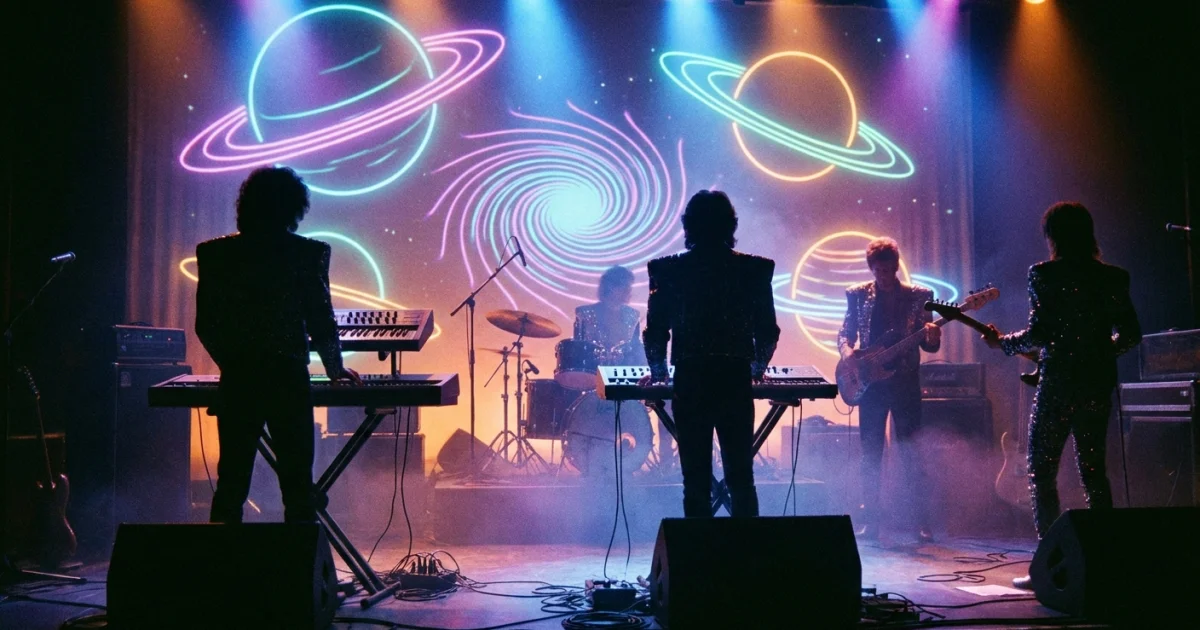
Space disco is a specific subgenre at the crossing of Italo Disco, instrumental electronics, and futuristic pop music. Its markers: alien timbres, cosmic track titles, no vocals, hypnotic rhythms. A niche but important direction that became one of the main sources of modern synthwave. Here's what space disco is, who defined it, and where it led.
Defining the Subgenre
Space disco is a variety of Italo Disco with a focus on futuristic, cosmic aesthetics and a mostly instrumental sound. Main characteristics:
- Minimal vocal - either fully absent or used only as a textural element.
- Cosmic timbres. Synth sounds associated with the "future" and "space."
- Long instrumental sections. Tracks can run 6-10 minutes, without song structure.
- Hypnotic rhythmics. Repeating patterns that build a trance state.
- Futuristic titles. "Visitors," "Humanoid Invasion," "Jabdah," "Galaxy."
That aesthetic separates space disco from vocal Italo Disco, though the two subgenres often overlap.
Origins of the Genre
Space disco grew from several sources:
- Kraftwerk. The German group laid the foundation for "robotic," futuristic electronics in the '70s.
- Donna Summer + Giorgio Moroder. "I Feel Love" 1977 showed the possibilities of sequencer bass and instrumental "cosmic" sound.
- Rockets. A French-Italian group in silver suits, direct ancestors of space disco.
- Films. "Star Wars" 1977 and "Alien" 1979 built cultural interest in cosmic aesthetics.
By the start of the '80s this soil was ready for the birth of a full-fledged subgenre.
Main Artists
Space disco as a formed subgenre has its own "great five":
- Koto. Andrea Cresci's Italian project, flagship of the genre.
- Laserdance. A Dutch team with an energetic approach.
- Hipnosis. An Italian project with a cinematic sound.
- Rygar. An Italian team with references to video games.
- Proxyon. A Dutch project close in spirit to Laserdance.
These artists defined the boundaries and possibilities of the genre. All others working in space disco followed their aesthetic guidelines.
Key Tracks
The cosmic branch of Italo Disco produced several canonical compositions:
- Koto "Visitors" (1985) - the flagship track of the genre.
- Koto "Jabdah" (1986) - the meditative side.
- Laserdance "Humanoid Invasion" (1986) - the energetic manifesto.
- Hipnosis "Pulstar" (1983) - the Italo version of the Vangelis classic.
- Rygar "Turn Me On" (1986) - the genre's dance hit.
For fans of instrumental electronic music these tracks are the canonical list.
Aesthetic Elements
Space disco visually and conceptually used a standard set of elements:
- Stars, planets, galaxies on record sleeves.
- Robots and androids in videos and on promo photos.
- Futuristic architecture in photo sessions.
- "Techno-language" titles - "Humanoid Invasion," "Cybertron," "Laser Mind."
- Silver and metallic costumes on artists.
That built a cohesive visual-sonic image that was easily recognizable.
Technological Base
Space disco required a specific technical arsenal:
- Roland Jupiter-8 synths - for "cosmic" timbres.
- Yamaha DX7 - for bright, "digital" sounds.
- Sequential Prophet-5 - for powerful, wide chords.
- Sequencers for repeating patterns.
- Echo and reverb effects to build "cosmic" space.
That was a more expensive arsenal than a typical Italo Disco's. Space disco producers often worked in studios with bigger budgets, which explained the more "premium" sound of their work.
Commercial Standing
Space disco was never mass mainstream. Its commercial numbers:
- Typical 12-inch single run: 5000-20000 copies (vs. 100000+ for vocal hits).
- Chart entries. Rare - mostly in specialized club charts.
- Radio rotation. Limited - mostly on night and specialized radio stations.
- Distribution. Mainly among DJ circles and enthusiasts.
It was a niche ecosystem with a loyal but small audience.
Geographic Distribution
Space disco had specific geography of popularity:
- Italy. Birthplace of the subgenre, but not the main market.
- Germany. A strong audience among electronic music fans.
- Netherlands. An active local scene (Laserdance, Proxyon).
- Scandinavia. A substantial audience, especially in Sweden.
- Eastern Europe. Less than vocal Italo Disco, but a noticeable segment.
- Japan. An unexpectedly big audience from the '80s to today.
Japan is a special case. The Japanese audience especially loved technological, futuristic music, and space disco fit that aesthetic perfectly.
Peak and Decline
The peak of space disco fell in 1985-1988. In those years the main works of the genre came out, artistic reputations formed, the audience took shape. By the end of the '80s activity began to drop - as in Italo Disco overall.
In the '90s the genre nearly moved into the shadows. Individual projects kept working (Laserdance), but there was no mass interest. Space disco was considered "outdated," pushed out by house, trance, other more modern genres.
A Second Birth Through Synthwave
The revival of space disco happened in the 2010s with the rise of the synthwave movement. Modern artists - Kavinsky, Mitch Murder, The Midnight, FM-84, Timecop1983 - openly inherit the '80s space disco aesthetic.
The 2011 soundtrack to the film "Drive," using Kavinsky's "Nightcall" and other track work, introduced millions of young listeners to a sound whose roots are in space disco. After "Drive" the genre gained a mass audience it didn't have in the '80s.
Influence on the Gaming Industry
Space disco had significant influence on video game soundtracks. "Hotline Miami," "Far Cry 3: Blood Dragon," "Cyberpunk 2077" use synthwave tracks that are direct heirs of space disco. For players it builds an instant association with a specific aesthetic - neon, futuristic, retro.
Some classic space disco tracks go directly into games. Koto, Laserdance, Hipnosis regularly show up in game soundtrack music libraries. It's one of the longest monetization channels for a niche 40-year-old genre.
Niche Collecting
Original records by space disco artists are one of the most valuable niche categories on the vinyl market. Prices for rare Koto, Laserdance, lesser-known Rygar-type project releases can reach 200-500 euros a copy.
That's explained by a combination of factors: limited '80s runs, steadily rising demand from modern synthwave enthusiasts, the status of a cult rarity. For serious electronic music collectors space disco is a required segment.
A Place in History
Space disco takes a special place in the history of dance electronics. Not the most mass, but one of the most influential subgenres. Its aesthetics and sonic solutions defined the development of retro electronics for decades forward. Modern synthwave exists largely thanks to space disco pioneers.
For an Italo Disco fan, getting acquainted with space disco is a required step. It's an alternative reality of the genre, where the vocal is optional and space became the aesthetic anchor. On Spotify the playlist "Space Disco Essentials" with tracks by Koto, Laserdance, and other key artists by 2024 gathered more than 1.5 million subscribers. For a niche 40-year-old genre that's a great indicator of a living audience that keeps growing.