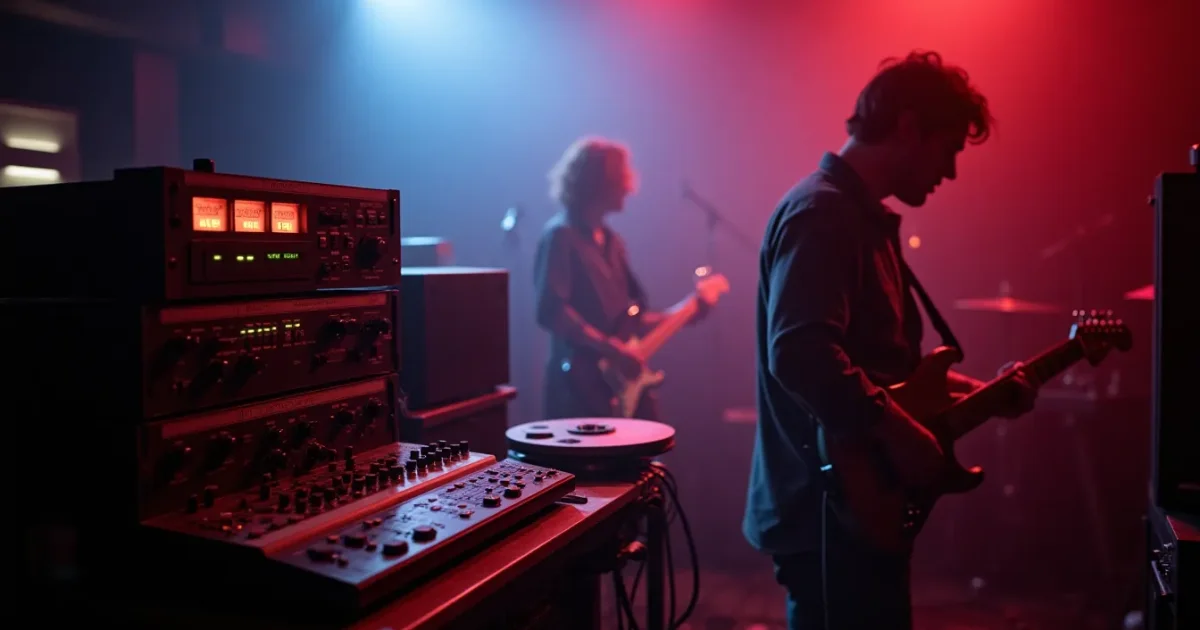
1979. Eventide released the H949 - an effects processor that became one of the main tools of sound processing in the late 1970s and early 1980s. The H949 is an improved version of the legendary H910 and one of the first affordable harmonizers. The main keyword is Eventide H949, and in this article we explain how this device changed the pitch of voices and drums and why it matters for Italo Disco.
What is a harmonizer?
A harmonizer is a device that changes the pitch of sound in real time. Unlike simply speeding up or slowing down tape, a harmonizer allows you to change pitch without changing duration. This opens huge possibilities for processing vocals, drums and other instruments.
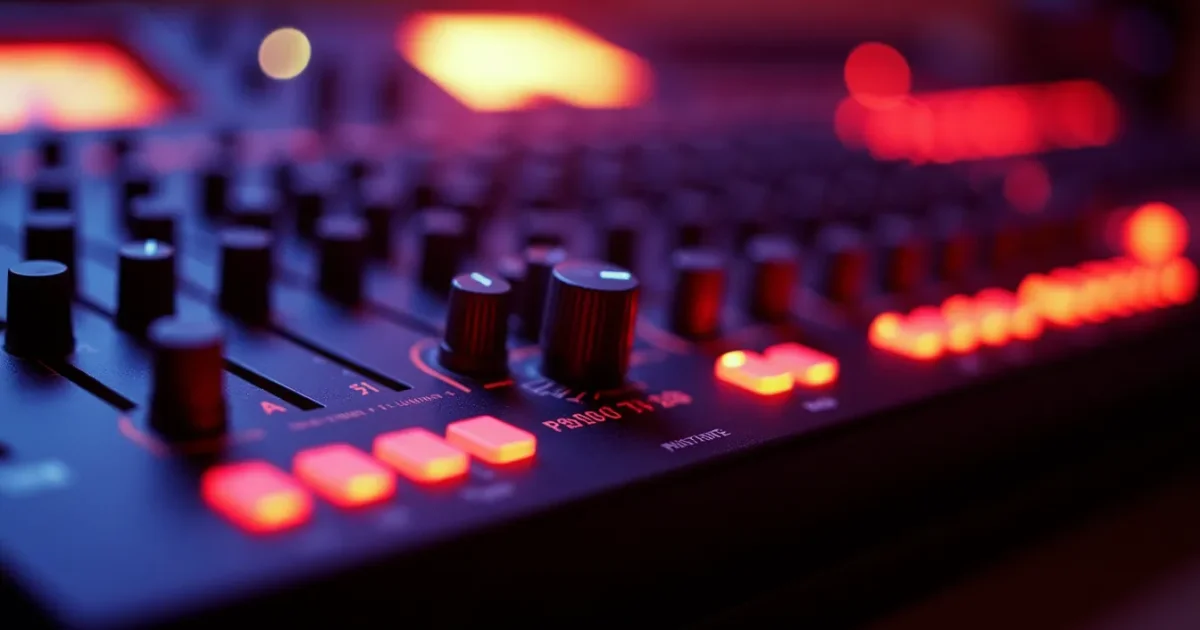
The Eventide H949 could shift pitch an octave up or down, add detune, create harmonic voices and make exotic effects. All this was controlled from the front panel without needing to program complex algorithms.
Technically the H949 used time compression and expansion of the signal followed by resampling. This created characteristic artifacts - a slight "metallic" sound or flutter on shifted copies. The listener does not need to understand the math, but it is important to know that these artifacts became part of the aesthetic.
Important to understand: the H949 was not a synthesizer. It did not generate new sound but transformed existing sound. This made it a universal tool for any studio.
From H910 to H949
The first Eventide Harmonizer H910 came out in 1974 and revolutionized studio processing. But it had limitations: noticeable artifacts, instability and a limited range. The H949, released in 1979, improved pitch-shift quality, added new modes and became more reliable.
The main innovations of the H949: better shift quality, MicroPitch mode for light detuning, and the ability to use feedback to create swelling effects. These features made the processor popular not only in radio and advertising but also in pop music.
The H949 became a workhorse in many professional studios. It was expensive but paid for itself through versatility. One device replaced several specialized units: pitch-shifter, doubler, delay and harmonizer.
The H910 was used on recordings by David Bowie, Kraftwerk and Brian Eno. The H949 inherited this audience and expanded it, offering cleaner sound and additional modes.
How the H949 changes vocals
The most obvious use of the H949 is vocal processing. Shifting pitch an octave down made a male voice deeper and more monstrous. Shifting up created a "little person" effect or a female voice from a male voice. When mixed with the original, dense vocal textures were created.
In Italo Disco the H949 was used to create additional vocal layers. Many tracks have a good lead vocalist, but in the chorus an processed "double" appears - this is the result of pitch-shift. This technique adds drama and width.
In addition, the H949 helped hide the limitations of vocalists. If a singer did not hit the notes or sounded weak, their voice could be processed, harmonized and embedded into a dense mix. This was especially valuable for Italo Disco studio projects where vocalists often changed.
The H949 also allowed vocals to become more "robotic" without a vocoder. A strong shift with feedback turned the voice into something mechanical, which fit well with the electronic aesthetic of Italo.
Processing drums and percussion
The H949 worked well not only with voices. Pitch-shifting drum sounds created unusual effects. For example, a kick shifted down an octave became deeper and more powerful. A snare shifted up sounded like a percussion click or rimshot.
Combined with Italo Disco drum machines, the H949 allowed producers to vary drum sounds without re-recording. A producer took a standard TR-808 sample, ran it through the H949 and got a new timbre. This saved time and expanded the palette.
The MicroPitch effect was used to thicken drums. A slight pitch shift up and down, then mixed with the original, gave the feeling of "double" drums. This technique is still used in modern music.
The H949 could also turn simple drums into sound effects. A clap shifted up became cymbal-like, while a hi-hat shifted down became a short bass rumble. This made transitions and drum fills more interesting.
Connection to Italo Disco
Italo Disco actively used studio effects, and the H949 was one of the available professional tools. Although not every Italian studio could afford an Eventide, the major labels and production centers had such processors.
The vocoder - another popular Italo Disco effect - was often combined with pitch-shift. First the voice was turned robotic through the vocoder, then processed by the harmonizer to add harmonies or octave shifts. The result can be heard on many tracks with vocoder.
The H949 also helped create spacey effects and pads. A synthesizer sound run through pitch-shift with feedback turned into something new - a sonic texture difficult to obtain otherwise.
Sound examples without formulas
Imagine a singer's voice. Without processing it sounds natural. If you run it through the H949 with a shift of +5 cents and mix it with the original, the voice becomes wider but remains recognizable. If you shift by +12 semitones, you get a second voice singing the same melody higher. If you shift by -12, a bass voice appears.
The same with drums. A kick without processing sounds like a standard kick. Through the H949 with micro-detune it becomes fuller and bigger. With an extreme downward shift it turns into a low rumble like a sub-bass.
It was this ability to transform familiar sounds that made the H949 indispensable. It did not require the user to know math - only hearing and a sense of effect.
H949 in the history of studio technology
The H949 became a bridge between early experimental pitch-shifters and the digital processors of the 1990s. It showed that changing pitch could be not a technical task but a creative tool. Producers began thinking of pitch-shift as an effect, not a correction.
Later Eventide models such as the H3000 added more algorithms and better quality. But the H949 remains in memory as a classic device that sounds special because of its analog limitations. The artifacts and imperfection of the shift became part of its character.
The H949 also influenced the development of vocoders and other vocal processors. The idea of taking a voice and turning it into an instrument or texture became a common theme in 1980s electronic music.
Modern significance
Today the H949 is a rarity. Original working units are valued by collectors. But the ideas of the H949 live in modern plugins: pitch-correction, harmonizers, doublers and creative pitch-shift - all of this grew from devices like the H949.
For the modern Italo Disco producer, understanding the H949 is useful because it explains how the genre's "spacey" vocal sound was achieved. Not everything was done with vocoders: some effects came from pitch-shift and harmonization.
The Eventide H949 is an example of how one technical device can influence the sound of an entire era. It was not noticeable to the listener by name, but its effects sound on thousands of records. For Italo Disco it became one of the tools that turned ordinary vocals and drums into electronic magic.