
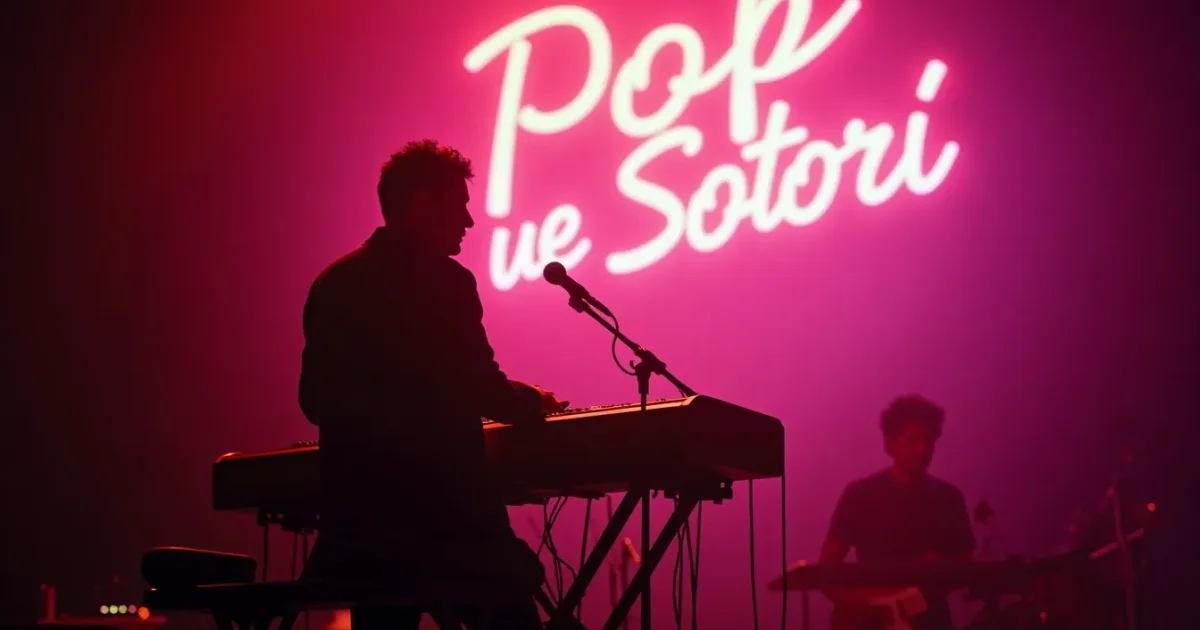
When people talk about synth-pop they usually remember the British: Depeche Mode, the Human League, OMD. But France developed its own variant - more melancholic, more chanson-like, with an emphasis on vocals and a cinematic atmosphere. French synth-pop was born in the late 1970s, gained momentum from the French electronic school and the new wave, and by the mid-1980s had its own face: Étienne Daho, Indochine, Les Rita Mitsouko. This article tries to understand how French synth-pop differs from the British version and why it still influences modern music.
French roots: from musique concrète to pop hits
France contributed more to electronic music than is commonly assumed. In 1948 Pierre Schaeffer created musique concrète, a technique of editing recorded sounds. In 1928 Maurice Martenot invented the ondes Martenot, one of the first electronic instruments, later used by Olivier Messiaen. In the 1970s Jean-Michel Jarre and Cerrone made electronics mainstream: the album Oxygène (1976) and the disco hit Supernature (1977) sounded European but sold globally.
This tradition - a link between academic electronics and the pop format - distinguishes the French approach from the British one. If British synth-pop grew out of pub rock and punk, the French version grew out of radiophonic studios, film music and variété, the light entertainment song. That is why French synth-pop often sounds more cinematic and less dance-oriented.
Étienne Daho: synth-pop as chanson
The debut album by Étienne Daho, Mythomane, was released in 1981. Critics noted his low, whispery voice, close to Leonard Cohen or Chet Baker, and "synthesizer" arrangements. But Daho was never a "pure" synth-pop artist: his songs were primarily chanson, simply with electronic processing.
The key album is Pop satori (1986), recorded with a then-young William Orbit. Here the synthesizers are no longer just background; they are part of the drama: cold pads, electronic drums, echo. The song "Week-end à Rome" (1984) became so big that the British group Saint Etienne adapted it into English as "He's on the Phone" (UK #11). It is a rare case of French synth-pop directly influencing the British pop scene.
An important trait of Daho: he never chased the club hit. His electronics serve intimacy, not the dance floor. Even dance remixes of his songs - "Épaule Tattoo" reworked by William Orbit - keep the vocal closeness. Here synth-pop works as a continuation of the French chanson tradition, not as an offshoot of rock or disco. Daho's voice does not need a dance-floor delivery; a whisper and half-whisper are enough to hold attention. This makes his records closer to poetry recorded on a synthesiser than to pop hits supplemented with lyrics.
Indochine: new wave with synthesizers
The band Indochine, formed in Paris in 1981, began as rock/new wave, but synthesizers were present from the start. Their first album L'Aventurier (1982) sold over 250,000 copies; the single "L'Aventurier" became the song of the summer of 1983 in France. It was followed by Le Péril Jaune (1983), 3 (1985) and 7000 Danses (1987).
In Indochine synthesizers work as a dramatic layer: they add exoticism, cinematic atmosphere, sometimes Eastern motifs. Singer Nicola Sirkis performs with the emotional charge of The Cure or Duran Duran, but with a French intonation. The group became hugely popular not only in France but also in Scandinavia and Latin America - for example, in Peru they sold about 400,000 records by the late 1980s.
Indochine proved that French synth-pop could be a rock band: not a solo vocalist behind a synthesizer, but a full line-up of guitars, bass and drums where keyboards are just one colour.
Les Rita Mitsouko and others: pop eclecticism
Les Rita Mitsouko - the duo of Catherine Ringer and Fred Chichin - combined synthesizers with punk, rockabilly, funk and French chanson. Their hit "Marcia Baïla" (1985) became one of the most recognisable French tracks of the 1980s. Here synthesizers do not dominate; they are part of a broader palette: electronic drums, guitar riffs, unpredictable song structures.
This eclecticism is another feature of the French variant. British synth-pop was often built on a clear scheme: front person, synth, drum machine. The French mixed styles, allowed oddities and permitted themselves to be too "arty" for pure pop format. In France electronics were not seen as a threat to "live" music; on the contrary, synthesizers often appeared alongside acoustic guitar, piano and live drums, creating a hybrid that British listeners might have considered too pop for the underground and too arty for the charts.
How it differs from British synth-pop
Let us compare five parameters:
- Language and vocals. French synth-pop is sung in French and often retains a chanson manner: whisper, conversational tone, emotional outbursts. The British variant is more neutral and radio-formatted.
- Harmony. French songs more often contain minor progressions, melancholic chords and the influence of the French song tradition. British synth-pop tends toward major-key pop simplicity.
- Rhythm. The French version is less dance-oriented: drums are not always four-to-the-floor and tempos can drift. British synth-pop is closer to disco and new wave with a steady beat.
- Context. The French genre grew alongside cinema (Jarre, Schaeffer), fashion and visual art. The British version grew alongside club culture, pubs and street fashion.
- Legacy. British synth-pop directly spawned the electropop of the 1990s and 2000s; the French version influenced Air, Daft Punk, Kavinsky and M83 - artists who look at electronics through the lens of cinema and nostalgia.
Legacy: from French touch to synthwave
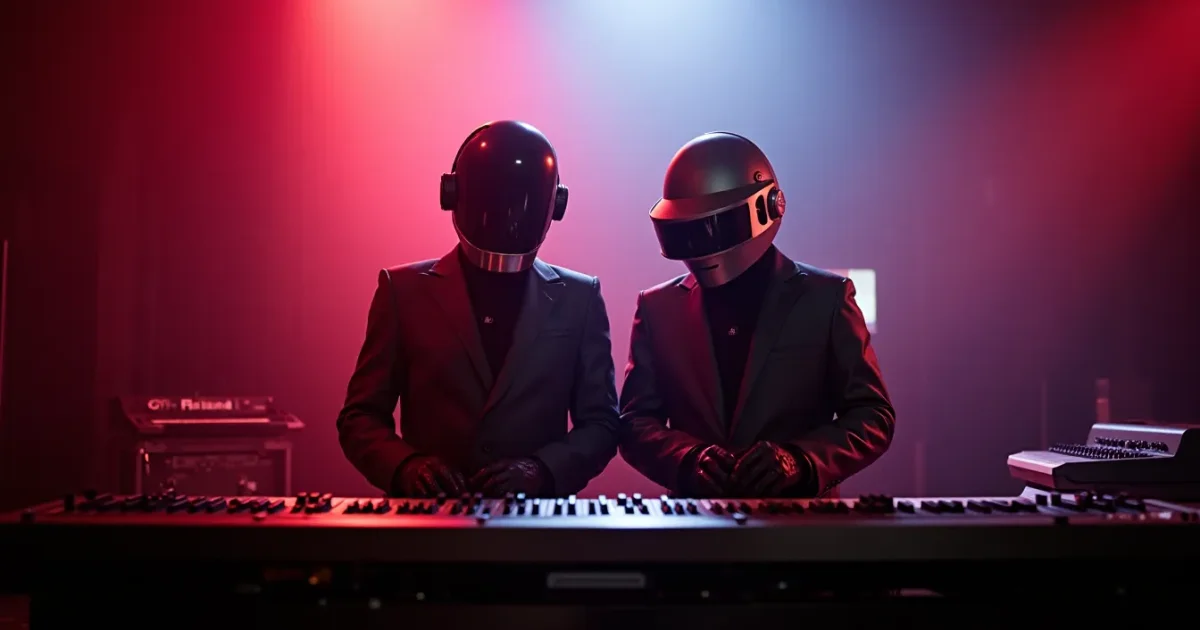
In the 1990s French touch appeared - an electronic wave led by Daft Punk, Air, Cassius and Étienne de Crécy. Air in particular inherited the cinematic quality of Daho and Jarre: their album Moon Safari (1998) sounds like the soundtrack to a non-existent French film of the 1970s. Daft Punk took disco-funk samples and wrapped them in a robotised aesthetic, but their French origin shows in their attention to sound texture.
In the 2000s Kavinsky and Justice continued the tradition: their music is not just dance tracks but sound pictures. Kavinsky said in interviews that many of his compositions begin as images from 1980s films. That is a direct line from Daho and Jarre to modern synthwave.
In the 2000s Kavinsky and Justice continued the tradition: their music is not just dance tracks but sound pictures. Kavinsky said in interviews that many of his compositions begin as images from 1980s films. That is a direct line from Daho and Jarre to modern synthwave.
Modern carriers of the French synthesizer sound
After Kavinsky, French synth-pop / synthwave split into several branches. M83 inherited the cinematic, major-key nostalgia, adding guitar noise and childlike vocal lines. Chromatics and College, though not French, worked in the same aesthetic and often released on French labels. Laurent Garnier and other French touch representatives kept the link between club electronics and melodic pop feeling. Even modern French indie artists such as Polo & Pan or Paradis use synthesizers not for the dance floor but for atmosphere, continuing Daho's tradition.
Technology: what the French variant sounds like
The key instruments repeat those of British synth-pop: Roland Juno-60 and Jupiter-8, Yamaha DX7, LinnDrum, Roland TR-707. But French records more often use analogue string pads, melancholic slow attacks and reverb as a spatial layer rather than as an effect. Bass can be soft and "singing" rather than tight and octave-based as in Italo Disco. Vocals are often recorded close to the microphone with gentle compression to preserve the intimacy of chanson. These details create the "French" tint: the same technology, but the emphases are placed differently.
Why this matters for Italo disco
For the Italo disco listener French synth-pop is interesting because it is a continental neighbour of the same European synthesiser boom. Italy produced danceable, melodic Italo disco; France produced a more artistic, vocal, chanson-like version. Both directions used the same instruments: Roland Juno, Jupiter, TR-707/808, Yamaha DX7, LinnDrum. But the results differ in temperament.
If Italo disco is a discothèque, French synth-pop is a cinema. Both genres grew from the same technological shift - the availability of polyphonic synthesizers and drum machines - but went in different directions. For Disco Magic & valex77 this means that French sounds can be borrowed for melancholic pads and vocal intimacy while keeping Italo disco rhythm and melody. Such hybrids are not canonical Italo Disco, but it is in these blends that new retro hits are born.
What to listen to next
Start with the key albums: Pop satori by Étienne Daho, L'Aventurier by Indochine, The No Comprendo by Les Rita Mitsouko. For comparison with the British - Architecture & Morality by OMD and Violator by Depeche Mode. For the modern continuation - Moon Safari by Air, OutRun by Kavinsky, Hurry Up, We're Dreaming by M83. And if you want to explore the European synthesiser chain further, read about space disco and spacesynth, how Italo Disco differs from Hi-NRG, and the key European electronic instrument, the PPG Wave 2.3.
Bottom line: French synth-pop is not a copy of British synth-pop but a parallel branch of European electronics. It kept French vocal intonation, cinematic quality and artistic ambition, and through Air, Daft Punk, Kavinsky and M83 it continues to influence world music. Understanding this branch helps avoid confusing European retro aesthetics with a homogeneous synth-pop mass, and to hear whether Italian, French or British temperament underlies a given record. French synth-pop teaches that electronics can be cold in sound and warm in emotion at the same time - a quality valued in any retro sound.