
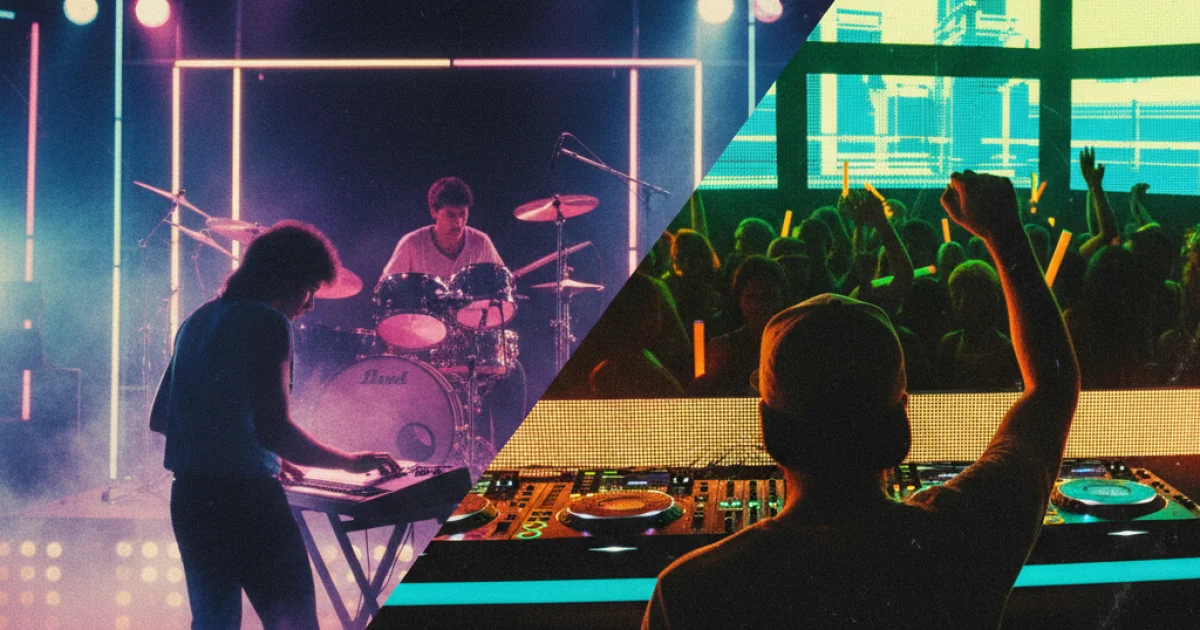
Genres rarely die abruptly - more often they mutate into something new. Italo Disco didn't vanish after 1988; it gradually turned into Eurodance. Let's look at how that happened, where the line runs, and why even fans sometimes can't tell one from the other.
1988: The Pivot Point
By the end of the '80s, classic Italo Disco had run out of road. The audience was tired of sugary melodies, the producers were tired of recycled arrangements. At the same time, a new music arrived from Chicago and Detroit - house and techno. Harder, more rhythmic, without the familiar hooks.
European producers stood at a fork: make pure house like the Americans, or adapt it for a European audience? Most chose the second route. That's how a hybrid was born.
What Changed in the Sound
The main difference between Eurodance and Italo Disco lives in three layers:
- Rhythm. Italo leaned on a synth bass and a melody; Eurodance borrowed house's hard four-on-the-floor kick, piled on heavy bass, and pushed the tempo up to 130-140 BPM.
- Vocals. The lone male singer with an Italian accent was gone; the new formula was "female vocal + male rap." Dr. Alban, 2 Unlimited, Culture Beat, and Snap! all worked that template.
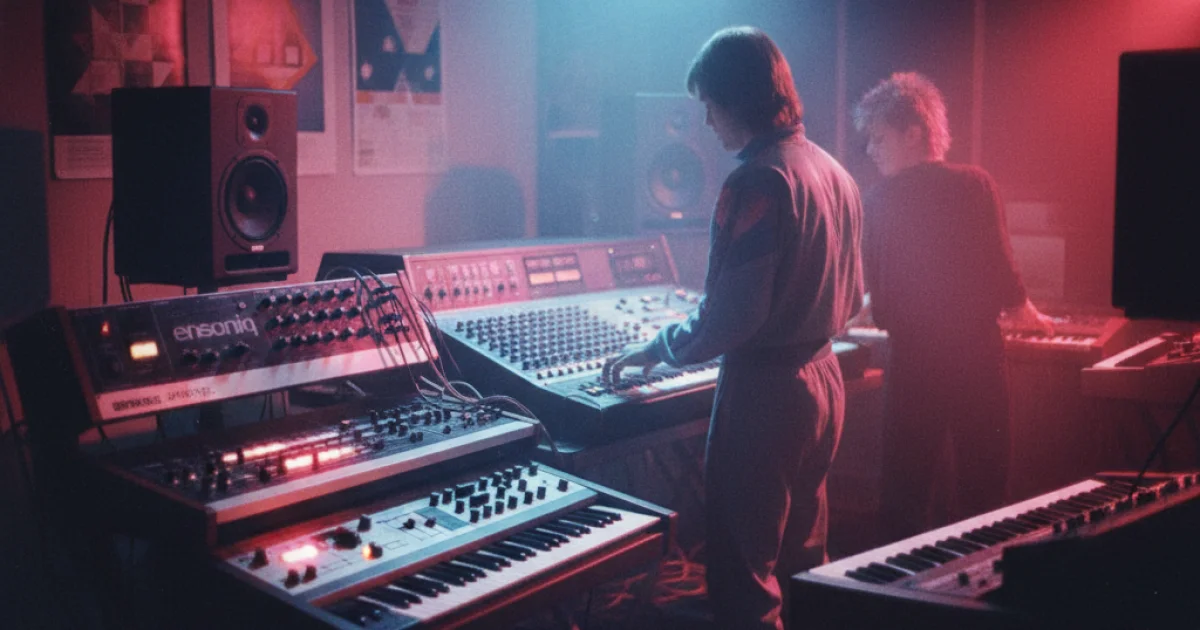
- Instruments. The Roland Juno and Yamaha DX7 gave way to samplers and digital gear. The sound got cleaner - but lost its analog warmth.
Who Crossed Over, Who Stayed
Some Italian producers glided into the new genre. Mauro Farina, who wrote hits in the '80s for Ken Laszlo, worked with Ice MC in the '90s and was making classic Eurodance. The label ZYX Music, which had helped build Italo Disco, kept putting out Eurodance compilations.
But plenty of '80s artists didn't survive the transition. Den Harrow, Savage, Ryan Paris - their run ended with the golden era. They kept performing, but they stopped making new hits.
A Geographic Shift
If Italo Disco was primarily an Italian genre, Eurodance became truly pan-European. The centers of production shifted to Germany (Frankfurt Trax), the Netherlands, Belgium, and Scandinavia. Italy was still in the game, but no longer out front.
Interestingly, it was at this exact moment that the former Eastern Bloc became a huge market. In the early '90s, Russia, Poland, and Czechoslovakia soaked up millions of Eurodance CDs - for an audience that had just discovered Western dance music, it was the perfect product.
Where the Line Runs
There's no clean date. You can roughly say that classic Italo Disco ran 1983-1988, the transition period was 1988-1991, and Eurodance's peak ran 1992-1997.
There are also hybrid tracks that are hard to classify. Early Corona or Alexia records, for instance, are already Eurodance by sound but carry the melodic sensibility of Italo Disco. That subgenre is sometimes called Italo Dance or Italo House - it lived alongside Eurodance throughout the '90s.
Despite all the differences, the two genres share roots. Both are European responses to American dance music, both put melody ahead of experimentation, both are pop music in the truest sense, with no artistic pretensions. They get confused and lumped together under the "Eurodisco" umbrella all the time.
The line between them sometimes can't even be drawn within a single track. Corona's "The Rhythm of the Night" is Eurodance by the beat but Italo Disco by its melodic bones. And it was produced by Roberto Zanetti - a.k.a. Savage. One man closed one era and opened the next, with no pause in between.
The terminology and the boundary between styles are set out in the guide to Italo Disco and Eurodance.
Modern Eurodance in the Disco Magic catalog - for example, "Be Mine" (a cover of PRO-X) and "Where Are We" (a cover of Superboyz): the 90s formula in new arrangements.