
1983, Terni, Italy. The trio My Mine - Stefano Micheli, Carlo Malatesta and Danilo Rosati - records "Hypnotic Tango" on the Progress Record label. The single comes out in two formats: 7-inch - 3 minutes 44 seconds, 12-inch - 6 minutes 10 seconds. In Germany the track climbs to #5 and stays in the chart for 18 weeks. In Switzerland - #10. A song that gave a subgenre its name and outlived its creators by forty years.
Hypnotic Tango by My Mine: song history from Terni to the charts
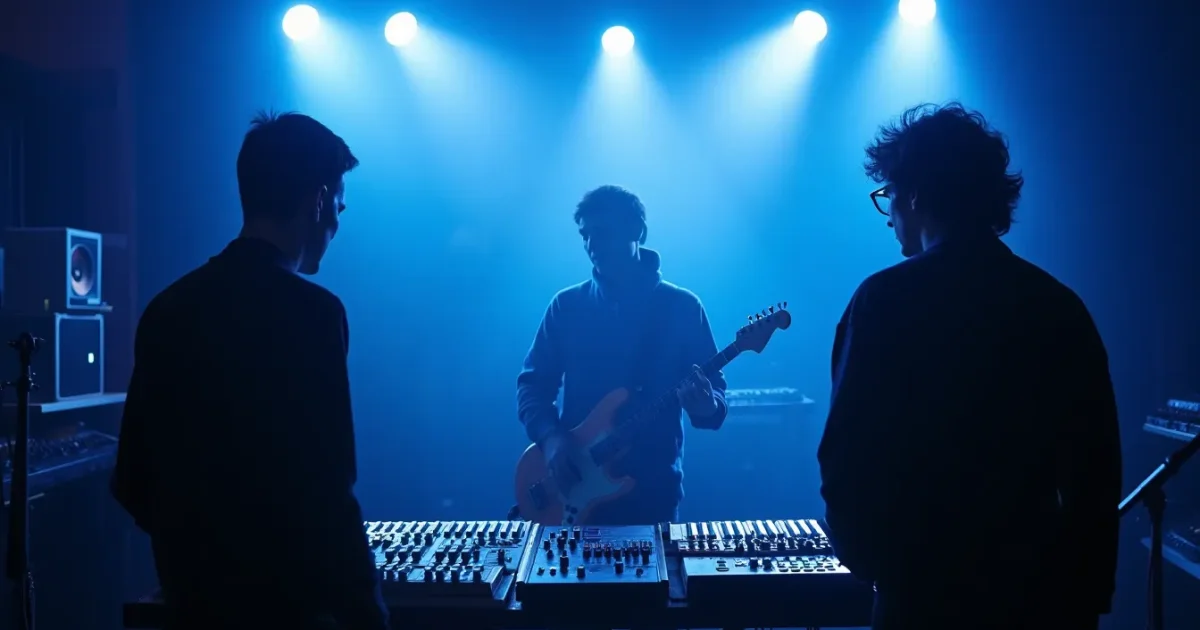
My Mine formed in 1983 in Terni - an industrial town in Umbria, a hundred kilometres north of Rome. The lineup: Stefano Micheli (vocals, keyboards, trumpet), Carlo Malatesta (vocals, keyboards) and Danilo Rosati (keyboards, sequencer, drum machine). Three studio musicians, not a single guitarist - standard for Italo disco, a genre built on synthesisers and drum machines where a guitar was redundant.
The single's producer - Lemon. Songwriters - Ginko and Tayx (pseudonyms; Stefano Micheli later used the name Steve Tyx). The label - Progress Record, one of the Italian indie labels specialising in Italo disco. Catalogue number for the 7-inch single - CIV 47001, for the 12-inch - CIV 47501.
Detail: on the B-side of both formats - an instrumental version: 4:01 on the 7″ and 5:20 on the 12″. The instrumental was longer than the vocal edit on the 7″ but shorter than the extended mix on the 12″ - a rare configuration for Italo disco, where the B-side usually matched the A-side in length.
What makes the riff hypnotic
"Hypnotic Tango" is built on a single synthesiser riff that runs through the entire track - hence the title. The riff plays sixteenth notes in a minor key, creating a "running" melody that does not let go. The bassline follows the riff an octave below, and the rhythm section is a classic Italo disco pattern: four-on-the-floor kick, clap on 2 and 4, eighth-note hi-hat.
Tempo - around 125 BPM, the genre's standard corridor. The 12″ version's structure: extended intro (16 bars of pure beat), two verses, two choruses, breakdown (16 bars), final chorus, outro. On the 7″ version the intro is cut to 4 bars and the breakdown is absent.
The instrumentation is typical for 1983: an analogue synthesiser for bass and riff, a drum machine for rhythm (likely a Roland TR-808 or LinnDrum - standard in Milan and Bologna studios of the period), a sequencer to sync the arpeggio to tempo. Three instruments, three tracks, one hook - and the hook is strong enough that the track needs nothing else. The word "hypnotic" in the title was not marketing hyperbole: the riff works as a hypnotic pattern - a repeating figure that puts the listener into a trance-like state.

Progress Record: a one-hit label
Progress Record - an Italian indie label releasing Italo disco singles in the first half of the 80s. The CIV 47xxx catalogue series was used for singles, CIV 47xxx with a suffix for 12-inch maxi-singles. The label was not large: the catalogue included a few dozen releases, and "Hypnotic Tango" was the most successful of them.
For the German market Progress Record worked through the distributor Blow Up (catalogue series INT 110.xxx). This scheme was typical: an Italian label recorded the track in Italy, a German partner pressed and distributed in West Germany, Austria and Switzerland. Most Italian Italo disco labels - Discomagic, Memory, il Discotto - had similar German distribution channels.
Germany as the main market
Like most Italian Italo disco projects, My Mine found success abroad, not at home. In Italy "Hypnotic Tango" did not chart - the Italian market by 1983 was oversaturated with its own product. Germany was the main buyer: West Germany Media Control Chart - #5, 18 weeks in the top 100.
Switzerland: #10, 8 weeks. Belgium: #32. In Austria, the USA, Norway, Denmark and Finland the track did not appear. The German release came out on the Blow Up label with catalogue number INT 110.543 - the distribution network through which Italian labels reached the German market.
In the German year-end chart for 1984, "Hypnotic Tango" placed in the top 100 - confirmation that the track spent nearly half a year in the chart. For an Italian indie label with one significant release, that was the commercial ceiling.
The Stone album and the vocalist change
After the success of "Hypnotic Tango" My Mine recorded a second single - "Zorro" (1984). The track flopped: Germany #63, and only for one week. The reason - the group deliberately moved away from the sound of "Hypnotic Tango," attempting a more innovative approach. The production team advised replacing Stefano Micheli with an English-speaking vocalist.
In 1985 Darren Hatch arrived from London - the son of songwriters Tony Hatch and Jackie Trent. Tony Hatch was a British composer and producer who wrote hits for Petula Clark, Bobby Vee and The Casuals in the 60s. Jackie Trent was a singer and songwriter, Tony Hatch's wife. Darren Hatch grew up in a musical family and had the vocal training that Italian Italo disco producers were looking for the English-language market.
With Darren Hatch the group recorded the album Stone, produced by Mauro Malavasi - one of the leading Italian producers of Italo disco and Eurodisco. Recording took place at Fonoprint Studios in Bologna - a studio connected to the Casoli family and the Italian Records label. Mauro Malavasi had previously worked with projects such as Change and Baba Yaga, and his production signature - a tight bassline, clean brass, vocal ensemble.
The album Stone came out in 1985. Besides the title track and "Cupid Girl," the record included "Can Delight" - the group's last single. None of the album tracks repeated the success of "Hypnotic Tango." In 1986 the group disbanded. The Japanese release of Can Delight came out as a separate release - the Japanese market was the only one where My Mine album tracks had demand after the split.
"Gradually the many hours of work devoted to experimenting with new styles and new sounds began to seem sterile; at least to some of us. We parted amicably."
- Stefano Micheli, on the breakup of My Mine
Return: Bananarama, Benny Benassi and the 40th anniversary
In 2005 the English group Bananarama interpolated "Hypnotic Tango" in the song "Look on the Floor (Hypnotic Tango)." The single reached #26 on the UK Singles Chart and #2 on the Billboard Dance Club Songs in the US. Interpolation - not a cover but a melodic borrowing: the My Mine riff became the foundation of a new Bananarama track, and a new audience discovered the original.

Bananarama - a British pop group with a string of 80s hits: "Cruel Summer" (1983), "Venus" (1986). By 2005 they were looking for material that would connect their pop legacy with dancefloor relevance. "Hypnotic Tango" fit: a recognisable riff, dance tempo, Italian melancholy. Billboard Dance Club Songs #2 - Bananarama's highest position in the American dance chart in their entire career. The original "Hypnotic Tango" gained a second life: streaming of the 1983 original grew after the Bananarama single came out.
In September 2023, for the 40th anniversary of "Hypnotic Tango," Italian DJ Benny Benassi and Albertino released a new remix. Benny Benassi - a Grammy winner in 2008 for his remix of Public Enemy's "Bring the Noise." In its first month the "Hypnotic Tango" remix gathered over 400,000 streams. My Mine planned an EP for 2024 with Italian producer D4D (Giovanni De Rosa) on the AbNormal Music label.
The 2016 revival
In 2016 My Mine founders Carlo Malatesta and Danilo Rosati revived the group with a new vocalist, Ilaria Melis. They released two singles: "Like a Fool" (2016) and "Love Is in the Sky" (2018). Stefano Micheli did not participate in the revival - he had left the group back in 1986 and worked under the name Steve Tyx until his death, releasing solo material on Bandcamp. The revival did not repeat the commercial success of the debut: "Like a Fool" and "Love Is in the Sky" came out on digital platforms without a label distributor and did not chart. But the fact that the group returned 30 years after the breakup is itself telling: "Hypnotic Tango" remained in cultural memory long enough for a revival to make sense.
Stefano Micheli died in 2025. "Hypnotic Tango" is the only My Mine track that outlived the era, the creators and the format it was released on.
Why "Zorro" flopped
"Zorro" - My Mine's second single, released in 1984. Germany #63, one week in the chart. The failure was not about recording quality but a strategic mistake: the group spent a month developing a "more innovative" sound and abandoned the formula that made "Hypnotic Tango" a hit. The sixteenth-note riff, the minor key, the four-on-the-floor kick - all of it was replaced by a more complex arrangement that gave the listener nothing to grab onto in the first bar.
This is a rule of Italo disco: the hook must land in the first 10 seconds. "Hypnotic Tango" delivered the hook at second 3. "Zorro" spent 30 seconds on an intro, and DJs did not play it. One hit defined everything - and the ten best tracks of 1983 in Italo disco is almost entirely made up of groups that had one or two significant singles.
What to listen for next
"Hypnotic Tango" in the context of Italo disco in 1983: My Mine → "Don't Cry Tonight" by Savage → "I Like Chopin" by Gazebo. Three tracks, three labels, three approaches to the synthesiser riff - but one formula: extended intro, eighth-note bassline, sixteenth-note melodic hook.
The career path of My Mine is an illustration of an Italo disco rule: one hit defined everything. "Zorro" flopped, the Stone album did not take off, and three years after the debut the group ceased to exist. Forty years later "Hypnotic Tango" plays in clubs, streams on platforms and gets remixed by Benny Benassi - and no one remembers "Zorro." One hit, one formula, one destiny - and forty years of resonance.