
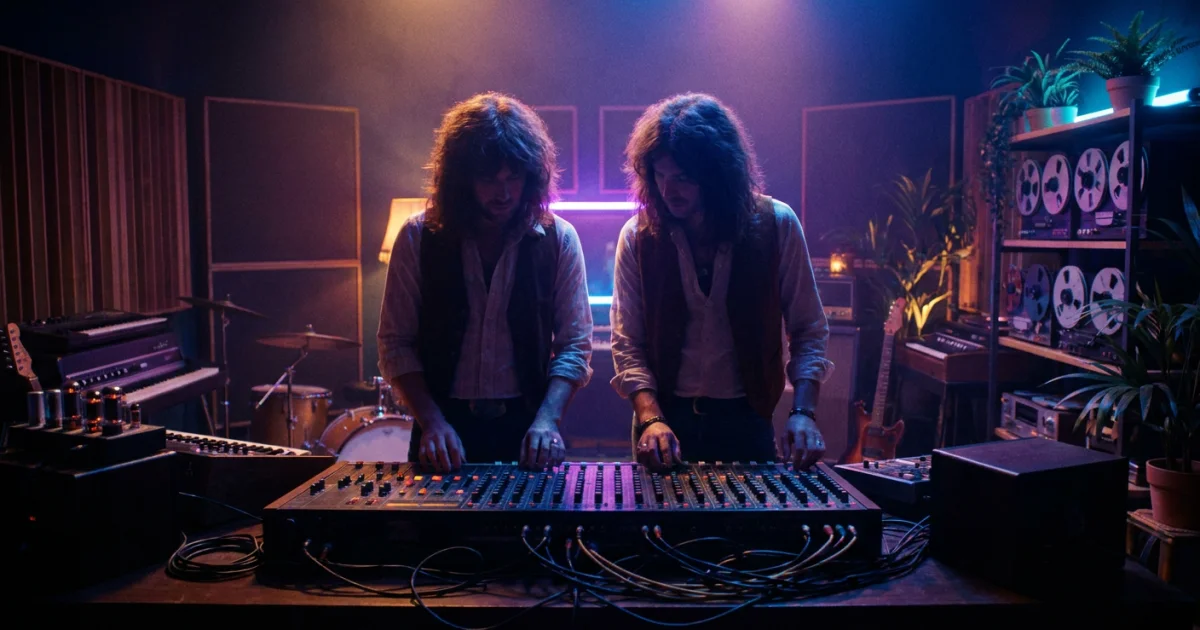
Before Italo Disco appeared as a genre, two Italian brothers were already working on its foundations. Carmelo and Michelangelo La Bionda - a production duo from Sicily whose influence on Italian dance music is hard to overstate. They recorded the first hits in the style that would later become Italo Disco, they opened the road for dozens of artists, they were one of the bridges between European and American disco. Here's the story.
Sicilian Brothers
Carmelo and Michelangelo La Bionda were born in Sicily - Carmelo in 1949, Michelangelo in 1952. Southern Italian roots gave their music a signature Mediterranean mood - sunny, melodic, with the emotional openness characteristic of the south of Italy.
In the late '60s they moved to Milan, where they worked as session musicians and writers for various Italian performers. Their names weren't printed on record sleeves, but their music played on many Italian hits of the time.
Recording in Munich
A turning point in La Bionda's career - a move to Munich in the mid-'70s. There they worked at the Musicland studio, owned by Giorgio Moroder. It was the center of European electronic pop at the time, and contact with Moroder gave the brothers access to cutting-edge technology and methods.
In Munich they learned the possibilities of sequencer synths, learned to work with electronic drum production, absorbed Moroder's approach to dance electronics. Then they brought that knowledge back to the Italian industry.
Bandido: the Breakthrough
La Bionda's main hit is 1979's "Bandido." The composition came out at the very end of the classic disco era, but already contains all elements of future Italo Disco. A springy synth bass, an energetic beat, a memorable melody, signature dance delivery.
The track became an international hit - charted in Italy, Germany, France, many other European countries. For the La Bionda brothers it was a commercial breakthrough, pulling them out of the shadow of session work into the status of independent artists.
One for You, One for Me
Another significant La Bionda hit is 1978's "One for You, One for Me." This is possibly the longest-living track by the brothers - it's used in films, commercials, compilations to this day. The signature melody sticks on first listen.
The composition shows how La Bionda could work across different registers. From the more dance-oriented "Bandido" to the more melodic "One for You, One for Me" - both approaches worked, both compositions had commercial success.
Where Italo Disco Only Begins
It's important to understand La Bionda's historical place. They worked before Italo Disco had formed as a fully-fledged genre. Their early hits are transitional compositions between late American disco and a forming Italian approach.
Without La Bionda, Italo Disco as a genre would have appeared later or differently. They blazed the trail - showed that Italian producers can make dance music capable of competing with American examples. The next generation - Mauro Farina, Giombini, Pulga - worked in their footsteps.
Production Work
Besides their own hits, La Bionda actively worked as producers for other artists. They produced records by Italian performers, helped new artists reach the market, shared their experience with electronic music.
That was a parallel track of their career - their own releases plus producing others. That approach is typical of experienced producers who see value not only in personal fame but also in developing the whole industry.
Work With Gepy & Gepy
One interesting La Bionda collaboration - their work with the Italian group Gepy & Gepy. The brothers produced their records, helped shape the sound. This was one of many teams working in the La Bionda orbit in the mid- and late '70s.
Such a producer ecosystem was typical for the Italian music industry of the time. One strong producer (or producer team) could launch or support dozens of artists - spreading influence across the whole scene.
Transition Into the '80s
With the start of the '80s, La Bionda adapted to the new genre landscape - the flourishing Italo Disco. They kept working, but no longer as main artists, more as producers and writers for young performers of the genre. Their own performing career gradually moved to the background.
That's a deliberate choice. The brothers didn't try to compete with younger generations - they took on the role of industry elders helping new artists, sharing experience. That approach ensured a long presence in the field without chasing shifting trends.
Italian Cinema
An interesting page of La Bionda's career - work on soundtracks for Italian films. They wrote music for comedies, youth dramas, sometimes more serious projects. That broadened their creative range and gave them steady income outside the pop industry.
The connection between Italo Disco and Italian cinema is deeper than it seems. Artists like La Bionda worked in both fields, creating points of intersection between music and film.
Modest Public Presence
Unlike many Italo Disco stars, the La Bionda brothers were never media figures in the literal sense. They rarely gave interviews, didn't take part in reality shows, didn't build public images. They were interested in the work, not the fame.
That approach made them less known to the general public than their peers like Savage or Den Harrow. But in the professional environment everyone knew and respected them - a hidden reputation operating at another level.
Revival of Interest
With the general Italo Disco renaissance of the 2010s, La Bionda got new attention. Collectors study their discography, DJs include "Bandido" and "One for You, One for Me" in their sets, music journalists dissect their contribution to the making of the genre.
In 2018 La Bionda recorded new versions of their classic hits for the compilation "La Bionda Revisited." The project got good reviews from the specialized press and showed that even 40 years later the brothers can work with their material without loss of quality.
A Place in History
La Bionda are among the key figures of Italo Disco's prehistory. Without them the genre would have appeared later or in a different form. They were a bridge between '70s American disco, Moroder's European electronic pop, and the flourishing Italian genre of the '80s.
For serious understanding of the roots of Italo Disco, knowing La Bionda is required. These aren't second-tier artists but pioneers, whose name is often undeservedly forgotten next to more promoted successors.
Bandido Forty Years Later
By 2024 "Bandido" on Spotify - over 18 million streams. Not the highest figure among Italo Disco classics, but for a track released even before the formal birth of the genre, it's a telling result. The composition keeps finding audiences through retro playlists and algorithmic recommendations.
In 2023 Carmelo and Michelangelo marked 50 years of working together - a rare round date for a music duo. Both still live in Italy, occasionally take part in industry events, maintain their catalog. A quiet but long career with a noticeable cultural trace - not worse, and possibly better, than a loud rise and a fast fall.