
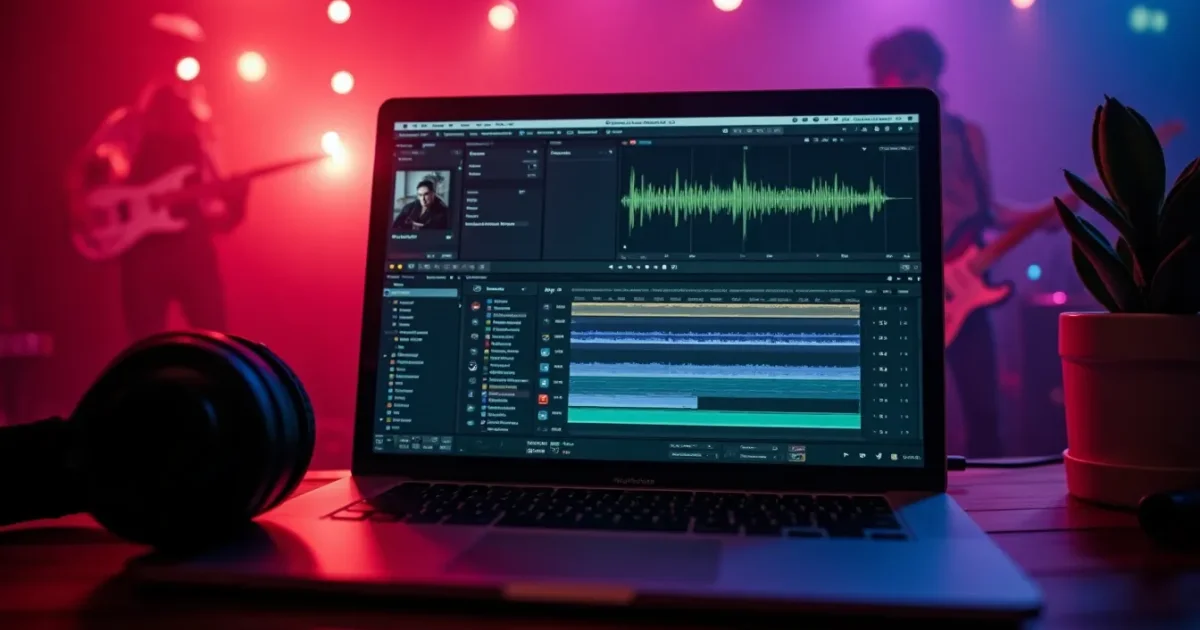
29 October 2019: the streaming service Deezer releases Spleeter into open source - a TensorFlow library that splits a finished recording into vocals, drums, bass and “other”. In its first week the GitHub repository collects over 5,000 stars. Modern covers after that date are made differently: instead of re-recording the song from scratch, a producer takes the original, runs it through a neural network and gets tracks - stems - which can be reassembled into a new arrangement. This is not a remix in the old sense and not a cover in the old sense: the line between them blurs.
From spectral editing to neural networks
Source separation technology - music source separation, or stem separation - took shape as a field in the mid-1990s. The task was: given one mixed file, extract separate tracks without the original multitrack sessions. For a long time the quality was poor: algorithms left phase artefacts, vocals “bled” into instrumental stems and vice versa.
The shift came in late 2018, when commercial neural-network tools appeared that split a recording into four stems - vocals, drums, bass, other. Deep-learning advances and models like Wave-U-Net delivered higher quality and fewer artefacts. The first providers were iZotope RX, AudiosourceRe Demix and RipX DeepMix. But the real breakthrough came when Deezer open-sourced Spleeter.
Spleeter: open code changes the rules
Spleeter is a Python library built on TensorFlow with pretrained models for 2-, 4- or 5-stem separation. On a GPU it processes audio 100 times faster than real time - a four-minute track splits in a couple of seconds. The presentation took place at the ISMIR 2019 conference in Delft. Open code meant any developer could plug separation into their app - and by 2020 dozens of web services offered karaoke backing tracks and instrumentals from any song.
Detail: Spleeter was not the first vocal-extraction tool - centre-channel removal and phase-inversion plugins existed before. But those methods worked only on stereo recordings with vocals dead-centre and destroyed everything else in the central image along with the voice. A neural network distinguishes sources by their spectral “fingerprint”, not by panning.
Restoration and reverse engineering
Stem separation turned out to be useful not only for new covers but for restoring old recordings. Wikipedia's “Music source separation” article mentions two notable cases: Disney Music Group used stem separation to work on its back catalogue, and Beatles recordings were split and enhanced using these technologies - the engineers working on the project also advanced the algorithms themselves. When multitracks from the 1960s no longer exist, neural separation is the only way to get separate drum or vocal tracks from a mixed mono or stereo file.
For covers this means a reverse direction too: not just “take a modern track apart into stems” but “take a vinyl recording from 1983 apart to get a clean vocal for a new cover”. Producers used to hunt for studio acapellas that did not exist for every release. Now a digitised single is enough - the neural network extracts the vocal with losses, but in most cases usable for reassembly.
Original stems and AI separation: not the same thing
Wikipedia's “Music source separation” article draws a key distinction. Stems in the traditional sense are tracks exported from a project file during mixing: groups of similar sounds combined into one stem (“all backing vocals” or “all synthesisers”). They give high quality and further isolation potential. AI separation gives four basic groups - vocals, bass, drums, other - and stops there. The quality of these stems is good enough for volume adjustments and effects, but not always for solo listening: residual reverb stays in the extracted vocal, kick bleed stays in the bass.
Detail: the deeper a model is trained to separate - piano, strings, winds individually - the more spectral anomalies appear in each output stem. Four-group separation gives cleaner results than eight. For a cover this means: take the four basic stems and replace three of them entirely, rather than trying to isolate a single guitar from an 80s mix.
Demucs and Logic Pro: two paths
In parallel with Deezer, Demucs developed - a project from Facebook AI Research (Meta). The facebookresearch/demucs repository gathered over 10,000 stars on GitHub. By 2022 the team presented HTDemucs - a hybrid model with transformers, published at the ICASSP conference. On 1 January 2025 the Demucs repository was archived - Meta stopped active development, but the open code remains available.
Apple chose another path. In May 2024 Logic Pro 11 shipped - the first full-number update since 2013. Among the new features is Stem Splitter, built directly into the DAW. It analyses an audio file and breaks it into vocals, drums, bass and guitar. The feature requires Apple Silicon - M-series chips - and runs locally, without sending data to the cloud. Alongside Stem Splitter came ChromaGlow - a plugin emulating the warmth of analogue circuitry.
By 2025 separation moved beyond the basic four stems: developers offered models for isolating piano, strings, winds, acoustic guitar and synthesisers. The finer the separation, the more spectral anomalies - but for building a cover from stems this is often not critical: getting a clean vocal is enough to rebuild a new arrangement underneath it.
What changes in cover practice
Stem availability changes not only the speed of work but the very concept of a “cover version”. A cover used to mean a new recording: a new singer, new instruments, a new arrangement from zero. Now a cover can be assembled from the original vocal, extracted by a neural network, and new instrumental backing recorded on top. The singer does not perform again - their voice is taken from the original.
- Re-recording vocals over new stems. The original vocal is extracted, cleaned, moved into a new project. Instrumental stems are replaced entirely. This is the most common “modern cover” format on YouTube.
- Rhythm-section replacement. Bass and drums are extracted and replaced with new ones; the other stems stay. The result is a “reissue” with an updated groove, not claiming a full reworking.
- Stem mashup. The vocal of one song is layered over the instrumental of another - both sides obtained through separation. Without neural networks this required an acapella and an instrumental version, which labels rarely published.
- Reverse cover. The original instrumental stays, the vocal is replaced with a new one - recorded by a different performer. This is the opposite of a traditional cover, where the vocal was the main thing.
DJ and karaoke: two mass applications
The two most widespread uses of stem separation lie outside studio covers. The first is karaoke: creating an instrumental from a song that has no official backing track. Dozens of sites use the technology to attract users who want to sing their favourite song. The second is DJing: real-time track separation during a set to create mashups on the fly. A DJ loads a track into the software, it splits into stems, and individual parts can be triggered on pads for live performance.
For cover culture both uses create the backdrop against which a professional cover must stand out. A karaoke instrumental and a DJ mashup are technical operations. A cover is an interpretation. When anyone can get an instrumental of any song in seconds, the value of a cover shifts from “I can play this” to “I can reimagine this”.
Short format and the cover
Stem separation coincided with the spread of short formats. TikTok, launched internationally in 2018, set the norm of a 15-30 second fragment: enough for a hook, too little for a full cover. A cover in short format is not a whole song but its most recognisable fragment, replayed or reassembled. Producers working for TikTok and Reels often limit themselves to the chorus: intro and verses stay off-stage. Billboard noted a case where a fan-made slowed-down version of Lykke Li's “sex money feelings die” (2018) spread across TikTok in thousands of videos and caused a surge in streams of the original - the label RCA Records traced the growth to the user cover.
What has not changed
A neural network separates a recording but does not compose. Harmony, melody, lyrics and song structure remain the author's. Stem separation removes the technical barrier - the absence of a multitrack - but does not remove the legal one: using extracted vocals in a new arrangement requires the same clearances as any other cover. The mechanical licence in the US, in place since 1909, grants the right to re-record someone else's song, but using the original phonogram - even split into stems - falls under master-recording licensing, not just composition licensing.
The difference between modern synth-pop and a cover of 80s disco in the 2020s is not in genre but in method. What used to require studio time and session musicians is now done on a laptop. But the ear can tell a cover made with an understanding of the original from a cover assembled by a neural network “as is” - the first sounds like an interpretation, the second like a collage.
The link to modern eurodance artists is direct: many of them work precisely in the logic of “vocals from stems plus a new beat”. For a concrete example, see Disco Magic’s cover of Masterboy’s Feel the Fire.
On 1 January 2025 the Demucs repository on GitHub was switched to read-only - Meta stopped support. Spleeter from Deezer has not been updated since 2020. But the tools that depend on them keep working: open code does not die with the company. Stem Splitter in Logic Pro 11, released in May 2024, is the first case where stem separation is built into a mainstream DAW and available without installing Python and TensorFlow. The neural network that in 2019 required a GPU and a programmer's skills runs in 2024 with one click on a MacBook Air. The technology has become invisible - and a cover assembled from stems has become the norm, not an experiment.