
In June 1985 Dire Straits released the album Brothers in Arms. The single “Money for Nothing” from that album climbed to #1 Billboard Hot 100 for three weeks that September. It became the first clip ever played on MTV Europe on 1 August 1987, and the only Dire Straits track to reach US #1. The key fact: the song is a satire of MTV itself. The guitarist wrote it from the point of view of an appliance delivery man who envies the rock stars he sees on television. And this song of hatred toward MTV became MTV's biggest hit of 1985.
How Mark Knopfler overheard a conversation
In early 1985 Mark Knopfler, Dire Straits's guitarist and sole songwriter, walked into an appliance store in New York. Two delivery workers were watching a wall of televisions tuned to MTV. Knopfler caught their conversation.
In a 1985 Rolling Stone interview Knopfler said: “One worker said: „look at this monkey with the makeup". They were watching a Prince or Cyndi Lauper clip. The second said: „he gets money for nothing, and chicks for free". The third said: „this isn't rock and roll, this is a faggot" (in 1985 this word was in common use; Knopfler later apologised). I stood there for 20 minutes listening, and thinking: I have a song”.
Knopfler pulled out a notebook and literally transcribed the workers' words. The entire lyric of “Money for Nothing” is a direct quote from that conversation. Even the most controversial line - “that little faggot with the earring and the makeup” - is word-for-word what he heard.
Knopfler, 1985: “This isn't my point of view. It's satire. I wrote down the words of an ordinary working-class person who envies and hates. The song is about class resentment. But many listeners took it literally. That's always the risk of satire”.
Recording: AIR Studios Montserrat, November 1984
Dire Straits recorded “Money for Nothing” at AIR Studios on Montserrat - the same studio where The Police cut “Every Breath You Take”. Producers - Mark Knopfler and Neil Dorfsman.
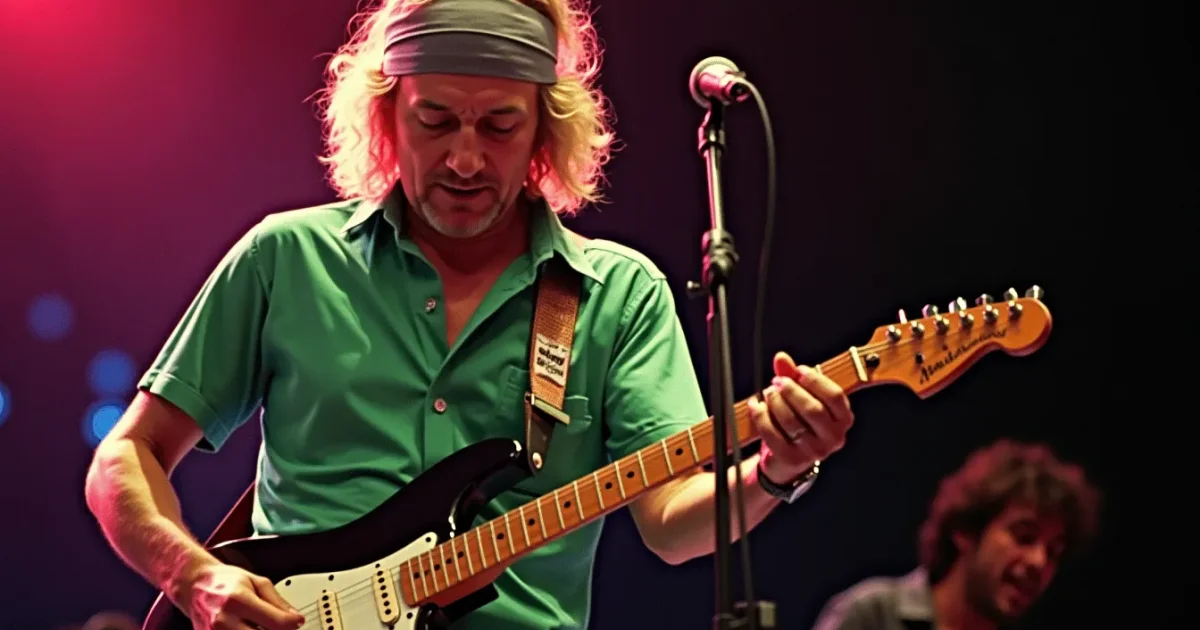
The famous guitar riff of “Money for Nothing” is one of rock's most recognisable guitar parts. Knopfler plays a Gibson Les Paul Junior through a Laney Supergroup amp. The secret of the sound is a specific recording technique: the cab was miked with a Shure SM57 aimed not at the speaker centre, but at a 45-degree angle. That produces the characteristic “whistle” with a sharp attack.
The riff itself is a three-note figure in G major. Knopfler plays it with his fingers (no pick), which gives the unique articulation. This “fingerpicked electric guitar” technique became a Knopfler trademark.
Sting as backing vocalist and opening voice
The song's intro - the voice singing “I want my MTV”. That voice is Sting, frontman of The Police. He was on the same island of Montserrat at the time, working in parallel on his own solo album The Dream of the Blue Turtles (released in June 1985).
Sting dropped by AIR Studios and Knopfler asked him to sing one phrase. Sting recorded “I want my MTV” to the melody of his own The Police song “Don't Stand So Close to Me” (1980). It's a melodic quote - listeners who know the Police song will hear it.
Sting received 25% of the writing credit on “Money for Nothing” for that one phrase. It was Knopfler's call: “if I used your melody without permission we'd be in court. Better to split credit. You get 25% fair”.
Over 40 years that 25% has brought Sting roughly $15-20 million in royalties - more than he made from some of his own hits.
“Sting walked into the studio, had a coffee, sang four notes, and walked out. For that he got a quarter of the writing credit on one of the decade's biggest songs. It's a story about how one phrase can be worth millions.”
- Neil Dorfsman, producer, Sound on Sound, 2005
Sound anatomy
- Key: G major, modulating to A major on the bridge
- BPM: 136
- Length: 4:38 (single), 8:26 (album)
- Knopfler's guitar: Gibson Les Paul Junior through a Laney Supergroup
- Drums: Terry Williams on a Pearl BLX kit, with live overheads
- Bass: John Illsley on a Fender Precision Bass
- Keys: Alan Clark on a Yamaha DX7
- Intro vocal: Sting
- Album: Brothers in Arms (13 May 1985, Vertigo/Warner Bros.)
- US sales: 5 million single copies (5× Platinum)
- Worldwide: 10M+ singles
- Album: 30 million worldwide - one of the best-selling CDs of the 80s
Video: 1985 computer animation
The “Money for Nothing” clip was directed by Steve Barron (director of a-ha's “Take On Me”). The concept: two computer-generated delivery workers (the ones whose conversation Knopfler overheard) move through a surrealist world, carrying refrigerators and washing machines.
The computer animation was made on Symbolics 3650 workstations at $120,000 each. Clip budget - $350,000, $200,000 of which went to computer time. In 1985 it was the most complex computer animation in music video history.
Each frame took 30 minutes to render on a Symbolics. The 3-minute video required 2 months of work by a team of 12 animators.
The clip won MTV Video Music Award 1986 for Video of the Year. It was also the first clip to use full 3D computer animation as its main visual strategy.

Chart history and bans
The single came out on 24 June 1985. By September - #1 Billboard Hot 100 for 3 weeks. UK - #4. #1 in Canada, Netherlands, New Zealand.
In 2011 Canadian rights advocacy groups filed a complaint against the song over the word “faggot”. The Canadian Broadcast Standards Council ruled that the song must be banned from Canadian broadcast. Dire Straits and Knopfler edited a version replacing the offending word with “queenie”. The revised version was cleared.
In 2018 Spotify introduced a user-friendly alternative: “Money for Nothing” now has an “edited version” option with the word replaced. The original is still available but flagged for adult audiences.
Legacy
“Money for Nothing” is a significant cultural artefact for three reasons:
1. Technologically: the first pop hit with full 3D computer animation in its video. It opened the CGI era in music videos.
2. Ironically: a satire of MTV that became MTV's biggest hit of 1985. MTV missed the irony - they celebrated “class resentment” as marketing.
3. Culturally: an example of how “authentic” words from an ordinary person (an overheard conversation) can be turned into a #1 hit - but it sparks a cultural conversation about what “authentic” means in pop music.
By 2024 “Money for Nothing” had racked up 800M+ Spotify streams and remains one of the most “guitar” songs of all time - studied by guitarists worldwide as the reference point for 80s electric guitar tone.
What to listen to next
For 1985 rock album context: Dire Straits “Money for Nothing” → Bruce Springsteen “Dancing in the Dark” (1984) → Phil Collins “In the Air Tonight” (1981). Three different takes on “adult mainstream rock” in the 80s - synths, guitar, reverb.
For the “sarcastic hit that became the main hit” parallel, try The Beatles “Taxman” (1966, George Harrison on tax, ended up a hit) and Kendrick Lamar “HUMBLE.” (2017, hip-hop sarcasm, went to #1). Three songs across three eras, all satire, all major commercial hits.