
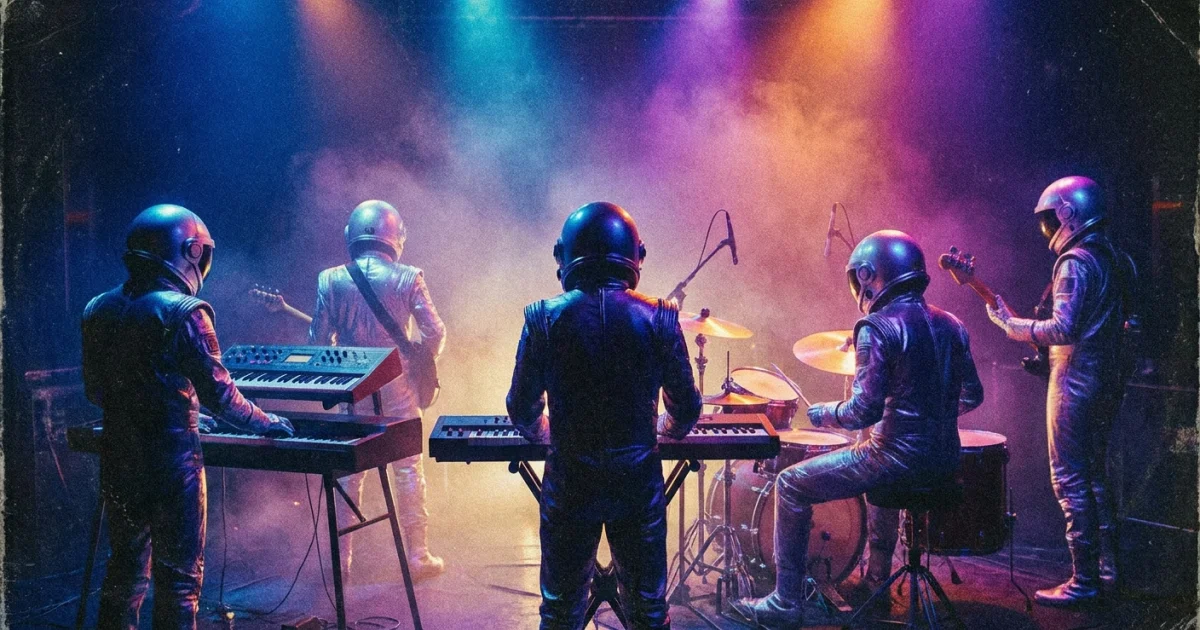
Italo Disco's family tree has ancestors without which the genre wouldn't exist. One of them is the French-Italian group Rockets. They worked before the classic Italo Disco era, but it was their aesthetic of silver robots, cosmic sound, and instrumental approach that prepared the ground for all subsequent development of space disco and Italian electronic dance music. Here's a project that was ahead of its time.
Origins in Paris
Rockets was founded in 1974 in Paris. Initially it was a French project built by four musicians - Christian Le Bartz, Alain Maratrat, Gérard L'Her, Fabrice Quagliotti. Later the lineup changed, new members appeared, including Italians - hence the French-Italian classification of the group.
The name "Rockets" was chosen deliberately - it refers to space, rockets, futurist aesthetics. That set the tone for the whole project: cosmic themes, technological sound, alien image.
Silver Robots
Rockets' main visual signature was their stage image. They performed in silver suits, silver makeup, looking like alien robots. It was a radical visual for the mid-'70s that instantly set the group apart from everyone else.
That aesthetic connected them to Kraftwerk (German "robots") and future Italo Disco projects like Kano. But Rockets were first in this visual tradition - or among the first. They set the trend, didn't follow it.
On the Road Again: the Main Hit
Rockets' best-known track is 1978's "On the Road Again." It's a cover of the Canned Heat blues composition, but reimagined in a completely new key - cosmic electronics, robotic vocal, dance beat. The result turned out unexpected and memorable.
The song became a hit in France and Italy, hit the charts in several European countries. For the group it was a breakthrough commercial success - after several experimental albums they got a mass audience.
Galaxy and Albums
Rockets were an active album project, which set them apart from most Italo Disco peers who worked mainly with singles. Their studio albums - "Plasteroïd" (1979), "Galaxy" (1980), "On the Road Again" (1978) - were whole conceptual works with cosmic themes.
It was a more ambitious approach than the mainstream dance music of the era. Rockets wanted to create not just dance-floor hits but complete artistic statements within dance electronics.
Italian Roots
Though the group was based in Paris, Italian members played a noticeable role. They brought Italian melodic influences, ties to the Italian music industry, aesthetic elements of the Southern European pop tradition.
That dual identity - French-Italian - made Rockets unique. They were neither a purely French electronic group nor a purely Italian project. A hybrid that laid the foundation for many subsequent European dance phenomena.
Space Disco: Genre Forerunners
Rockets are one of the main forerunners of what would later be called space disco. Their approach - instrumental or semi-instrumental dance electronics with cosmic aesthetics - directly influenced Koto, Laserdance, and other key '80s projects.
Without Rockets, space disco as a sub-genre would look completely different. They set the basic parameters - futuristic visual, dance electronics, minimum traditional vocal, maximum synths. All of that later became the Italo Disco standard in its instrumental branch.
Technological Possibilities
Rockets actively experimented with new technologies. At the end of the '70s they used the era's cutting-edge synths - ARP, Moog, Roland. Some instruments they even modified themselves to get the sounds they wanted.
That's an atypical attitude toward technology in pop. Most pop artists were tool consumers - using what the market offered. Rockets were creators of sonic solutions - experimenting, modifying, inventing.
Connection to the Italian Industry
In the '80s Rockets actively collaborated with Italian labels and producers. Their recordings came out on Discomagic and other key Italian structures. That created direct links between French cosmic electronics and the flourishing Italo Disco.
Such collaborations mattered for both sides. Rockets got access to the Italian market and industrial infrastructure. Italian producers learned from the French a more experimental approach to electronics and visual aesthetics.
Angel: Sunset of the Era
By the mid-'80s Rockets' commercial activity noticeably dropped. The mass public was switching to more accessible Italo Disco hits, while Rockets continued their experimental direction. 1986's "Angel" was their last notable hit of this period.
The group didn't fully break up, but moved to a mode of rare releases. Some members took up solo projects, others - backroom work in the industry. The "Rockets" brand remained, but its activity dropped to a minimum.
Cult Status
Over time Rockets acquired cult status among serious lovers of electronic dance music. Their original albums became collecting rarities, their visual aesthetic - a research subject. Online, devoted fan communities exist studying every aspect of the group's work.
Rockets' legacy is studied especially actively in France and Italy - the countries where they were most popular. There they're remembered as pioneers of electronic pop, before whom there was only academic avant-garde.
Return in the 2000s
In the 2000s Rockets returned to active concert and studio work. They released new albums, toured Europe, took part in retro events. The return was modest but telling - the brand still had value.
At retro festivals Rockets is one of the regular participants, especially at European events dedicated to '70s and '80s electronic music. For a specialized audience, meeting them is a serious event.
Influence on Synthwave
The current synthwave movement of the 2010s is the direct heir of space disco and experimental electronics of the late '70s. Kavinsky, Mitch Murder, The Midnight openly reference Rockets as one source of inspiration. Their futuristic cosmic aesthetic, technological sound, visual approach - all of it directly influenced current retro artists.
It's an interesting cycle. Rockets were ahead of their time in the '70s, didn't get mass recognition, gradually moved into a niche. 30-40 years later their aesthetic became mainstream through synthwave. Artists who didn't deliberately copy them reproduce the same moves because they work.
A Place in History
Rockets hold an important place as forerunners of Italo Disco and especially its instrumental branch. Without them the genre would look completely different. They laid the foundations of futuristic electronic dance music, which '80s Italian producers later developed.
For full understanding of Italo Disco, knowing Rockets is required. These aren't direct participants in the genre but its intellectual and aesthetic ancestors. A line of succession goes from them through Koto and Laserdance to current synthwave - a chain half a century long.
Rockets Today
In 2024 a renewed Rockets lineup continues to perform. Their concerts happen mostly in Europe, with a focus on Italy and France. New recordings come out rarely but regularly - keeping the brand in a living state.
On Discogs, original Rockets albums from the '70s and early '80s in good condition cost 50 to 300 euros. That's a level of collector value accessible to serious enthusiasts. A group that commercially didn't reach the scale of Modern Talking or Baltimora - in collecting terms is above many of them. Cult status works over a longer distance than mass fame.