
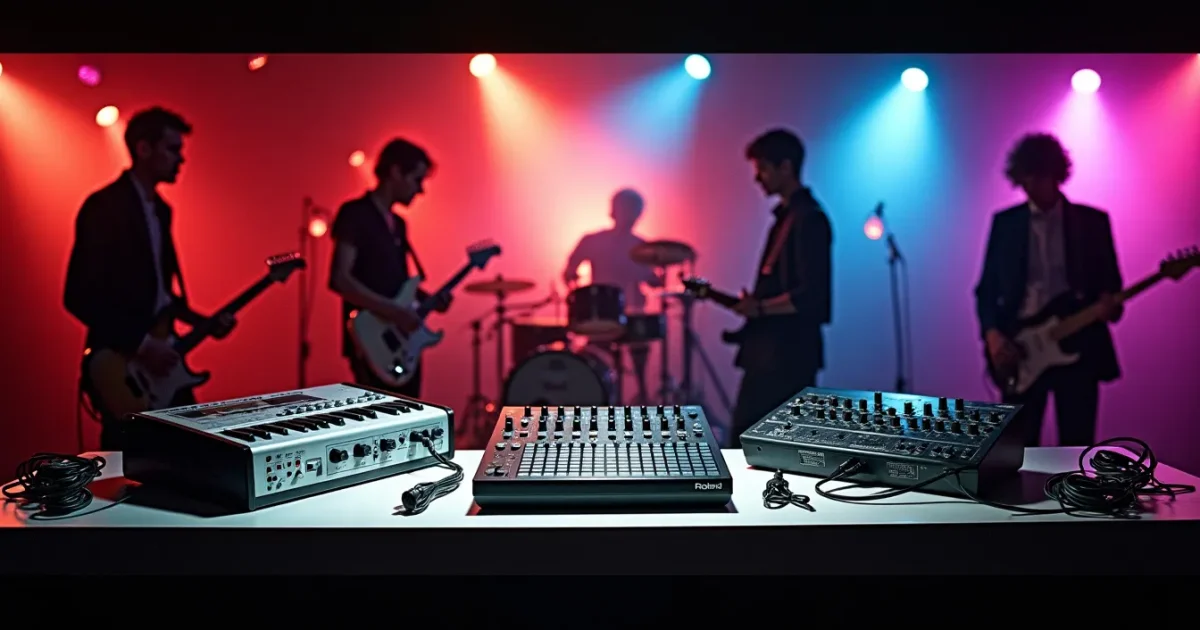
Roland is one of the companies that influenced 20th-century dance music more than almost any other. Not guitars, not ordinary synthesizers, but drum machines. TR-77, CR-78, TR-808, TR-909 - these boxes defined the sound of disco, hip-hop, techno, house and Eurodance. This article covers every Roland drum machine released before 1990: specs, history and who used them.
Roland TR-77 (1972): Roland's first rhythm machine
The TR-77 (Transistor Rhythm 77) was one of Roland's first rhythm machines. It was aimed at organists and estrada ensembles. The sound was built from analogue generators and was not programmable - only preset styles: Waltz, Fox Trot, Swing, Rock'n'Roll, Slow Rock.
Specifications:
- Fully analogue percussion.
- Preset patterns, no editing.
- Several tempos and registers.
- Used on early pop and disco recordings, but never achieved cult status.
The TR-77 sounds dry and "organ-like". Collectors value it today, but it remained on the periphery of pop music.
Roland CR-68 / CR-78 (1978): Roland's first programmable rhythm
The CR-78 was a breakthrough: Roland's first mass-market programmable rhythm machine. Users could create their own patterns from the front panel and store them. The sound was analogue, warm and "woody".
Specifications:
- Analogue kick, snare, hi-hat, cymbal, cowbell and claves.
- Programmable patterns via buttons.
- Tempo and style variations.
- Trigger output for external synths.
Notable uses: Phil Collins - "In the Air Tonight" (1981); early OMD, Blondie, Ultravox. The CR-78 became the sonic signature of early synth-pop and new wave.
Roland TR-808 (1980): the legend they did not understand at first
The TR-808 was released in 1980 and became one of the most influential electronic instruments in history. Production stopped in 1983, but the machine enjoyed decades of fame through hip-hop, techno and pop.
Specifications:
- Fully analogue percussion.
- 12 instruments: kick, snare, toms, congas, claves, cowbell, hi-hats, cymbals, handclap, maracas.
- 32-pattern sequencer, 768 notes.
- Accent, roll, flam, shuffle.
- Individual outputs.
The 808 sound is unmistakable: long "boom" kick, "snapping" snare, metallic hi-hats. In the 80s it was criticised for "not sounding like real drums". In the 90s it became the standard: Marvin Gaye - "Sexual Healing" (1982), Afrika Bambaataa - "Planet Rock" (1982), Kraftwerk - "Numbers" (1981). In hip-hop the 808 kick and snare became the foundation of almost every beat.
Roland TR-606 (1981): the little companion to the TB-303
The TR-606 was designed as a portable drum machine for bass guitarists. It became famous alongside the TB-303 - together they shaped the sound of acid techno and EBM.
Specifications:
- Analogue kick, snare, hi-hat, cymbal and toms.
- Simple sequencer, 32 patterns.
- Compact case, battery power.
- Trigger input for sync with the TB-303.
Notable uses: early acid techno and industrial / EBM. Today the 606 is prized for its dry, aggressive sound.
Roland TR-909 (1983): from analogue to samples
The TR-909 was the next step. It combined analogue drums with 12-bit samples for hi-hats and cymbals. This made the sound "realer" and "sharper" than the 808.
Specifications:
- Analogue kick, snare, toms, rimshot, clap + PCM hi-hat and cymbal samples.
- Sequencer with shuffle and accent.
- MIDI - the new standard, implemented by Roland.
- Individual outputs.
The 909 became the symbol of techno, house and Eurodance. Jeff Mills, Joey Beltram, 2 Unlimited, Snap!, Daft Punk, LCD Soundsystem all used it. Its kick is especially prized: tight, with a sharp attack, it sits perfectly under bass.
Roland TR-707 (1985): the digital sibling of the 909
The TR-707 used PCM samples rather than analogue synthesis. The sound is cleaner, "plasticky", less characterful. It was widely used in 80s and early-90s pop.
Specifications:
- PCM drum samples.
- 15 instruments.
- MIDI and DIN sync.
- User-friendly sequencer.
The 707 appears on records by New Order, Madonna, George Michael and Prince. Less cultish than the 808 or 909, it still played a key role in the transition from analogue to digital drums.
Roland TR-727 and TR-505 (1985-1986): Latin and budget
- TR-727 - the Latin version of the 707: congas, bongos, timbales, agogo, whistles, cabasa.
- TR-505 - a budget digital machine, the "little brother" of the 707/909. Used in home studios and on early demos.
The TR-727 is popular in latin house, dance-pop and world music. The TR-505 often turns up on early hip-hop and house demos.
Roland R-8 (1989): the sampling revolution
The R-8 was no longer a classic "Roland drum machine" but an advanced PCM drum sampler. It contained realistic acoustic drum sounds and was positioned as a competitor to the LinnDrum and E-mu SP-12.
Specifications:
- 16-bit PCM samples.
- Cartridge slots for new sounds.
- Advanced sequencer.
- Capable of very realistic drums.
The R-8 was used in 90s pop and rock studios whenever a "live" drum sound was needed without a drummer. Less dance-oriented than the 909, it became an important bridge to digital workstations.
Quick table of Roland drum machines before 1990
| Model | Year | Sound type | Special feature | Key genres |
|---|---|---|---|---|
| TR-77 | 1972 | Analogue | Preset patterns | Pop, disco, estrada |
| CR-78 | 1978 | Analogue | Programmable | Synth-pop, new wave |
| TR-808 | 1980 | Analogue | Cult kick and snare | Hip-hop, techno, pop |
| TR-606 | 1981 | Analogue | TB-303 companion | Acid techno, EBM |
| TR-909 | 1983 | Analogue + PCM | MIDI, techno standard | Techno, house, Eurodance |
| TR-707 | 1985 | PCM | Digital, clean sound | Pop, dance-pop, new wave |
| TR-727 | 1985 | PCM Latin | Latin percussion | Latin house, world music |
| TR-505 | 1986 | PCM | Budget | Home studios, demos |
| R-8 | 1989 | PCM sampler | Realistic drums | Pop, rock, studio |
Why Roland drum machines matter so much
Roland did not simply make machines for drummers. It created a sound palette that became the foundation of entire genres. The 808 and 909 are still used in modern music as plugins, samplers or original hardware. Their sound is so recognisable that a single kick can date a track across three decades.
Compared with Linn Electronics or E-mu, Roland built machines not to imitate live drums but to create a new electronic drum sound. That is why the 808 and 909 became cult objects: they sounded like the future, not like a replacement for a drummer.
Conclusion
Before 1990 Roland released a line of drum machines that defined pop, dance and electronic music for decades. From the organist's TR-77 to the digital R-8, each model answered its own era. But the true heroes are the TR-808 and TR-909. They turned the rhythm machine from a backing instrument into the star of the track.