
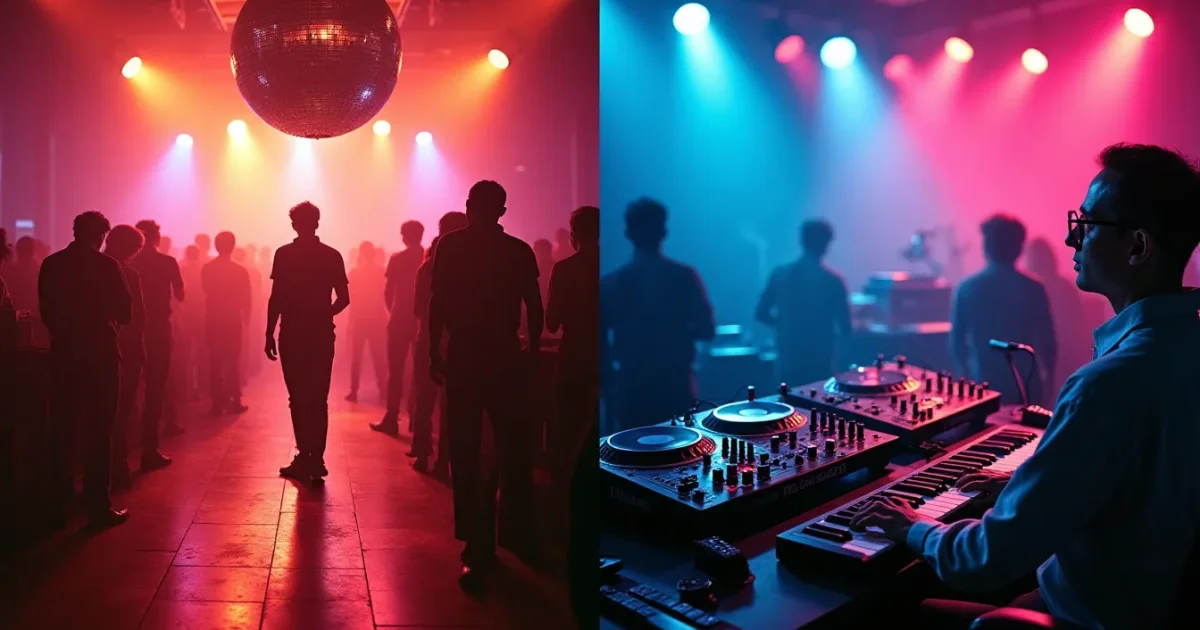
Eurodisco and Eurodance are two European dance genres separated by roughly a decade. They look alike: four-on-the-floor beats, synthesizers, vocals and club appeal. But there are important differences in sound, structure, vocals and cultural role. This article explains how Eurodance differs from Eurodisco, and why confusing them means missing half the history of European dance music.
Where and when the genres appeared
Eurodisco grew out of the American disco wave of the mid-1970s. In Europe it took shape by 1977-1979: Boney M., ABBA, Ottawan, Gazebo, Scotch, Righeira. Main centres - Germany, Italy, France, Sweden. Eurodisco kept elements of live sound: strings, brass, acoustic drums, bass guitar.
Eurodance appeared in 1989-1992 in Germany, the Netherlands and Belgium. It was a response to house, hip-hop and Italo-disco. Early names: 2 Unlimited, Snap!, Culture Beat, Masterboy, La Bouche. Everything here is electronic: samplers, drum machines, synth presets.
Rhythm section: live drums versus TR-909
In Eurodisco drums were usually recorded by live players or programmed on early drum machines such as the LinnDrum and Roland TR-808. The sound was "softer": hi-hats rustled, the kick was muted, and a bass guitar held the low end.
In Eurodance the drums come from the Roland TR-909 and samplers. The kick is tight and "rubbery", the snare snaps, the hi-hat is metallic. The tempo is usually higher - 130-150 BPM against Eurodisco's 110-128. The bass is also synthetic, with no attempt to imitate a bass guitar.
Vocals: singer and choir versus rapper + singer
Eurodisco vocals were usually uniform: a soloist or soloist, choir parts, a melodic chorus. Lyrics were about love, dancing and summer. Boney M. is choir-led disco; ABBA is pop-dissonance set to a disco beat.
Eurodance standard is the "rapper + female singer" combination. Male rap verses alternate with a female melodic chorus. Snap!, 2 Unlimited and Culture Beat set the template. Sometimes the rap was sampled (as with Snap!), sometimes performed live.
Track structure: smooth development versus punchy intro-breakdown-drop
Eurodisco is built like a song: intro, verse, chorus, bridge, outro. Dynamics are smooth, there are often instrumental inserts and solos. The dancefloor matters, but the track does not have to "explode" every 30 seconds.
Eurodance uses a more sectional, radio-friendly form:
- Intro - often instrumental, hook first;
- Verse 1 - rap or female verse;
- Chorus - big melodic hook;
- Breakdown - energy drop, often with a vocal sample;
- Final chorus + outro - maximum density.
This structure was convenient for videos and radio. It was ironically called the "Eurodance formula".
Instruments: orchestra versus machine
Eurodisco often used live strings, piano, guitar and Fender Rhodes. Vocoders and synths were present too - especially in Italian projects like Gazebo and Scotch - but the sound stayed "warmer".
Eurodance is presets: Korg M1 (House Piano, Universe), Roland JV-1080, Yamaha DX7, TR-909, Akai MPC60. Live instruments were rare. That made the sound recognisable but also homogeneous.
Cultural role: 70s glam club versus 90s rave radio
Eurodisco evokes 70s and early-80s discos: mirror ball, staircases, Saturday Night Fever. It was music for couples and groups dancing together.
Eurodance evokes rave culture, radio charts and MTV Europe. Videos featured bright costumes, neon and dancers. It was music for mass dancefloors and fitness clubs.
Comparison by parameter
| Parameter | Eurodisco | Eurodance |
|---|---|---|
| Period | 1977-1986 | 1989-1997 |
| Centres | Germany, Italy, France, Sweden | Germany, Netherlands, Belgium |
| BPM | 110-128 | 130-150 |
| Drums | LinnDrum, TR-808, live drums | Roland TR-909, Akai MPC |
| Vocals | Soloist / choir, love-themed lyrics | Rapper + singer, hook chorus |
| Live instruments | Often | Rarely |
| Cultural context | 70s discos, Saturday Night Fever | Rave, radio, MTV Europe |
| Key artists | Boney M., ABBA, Gazebo, Scotch | Snap!, 2 Unlimited, Culture Beat, Masterboy |
The bridge between the genres: Italo-disco
Italo-disco is the logical bridge between Eurodisco and Eurodance. It took melody and songcraft from Eurodisco and the cold synthesizer sound and programmed drums of future Eurodance. Groups like Modern Talking, Fancy, Silent Circle and Bad Boys Blue created the sonic soil on which Eurodance later grew.
If Eurodisco is "a song for dancing" and Eurodance is "a dance for a song", Italo-disco is "a song that sounds like a dance".
Why the distinction matters
The difference helps explain why the same listener can love both Boney M. and 2 Unlimited, but for different reasons. Eurodisco is about melody, romance and live breathing. Eurodance is about energy, density and a synthetic hook. Both are part of one European dance tradition, but each answers its own question: what does a party sound like in 1979 and in 1994?