
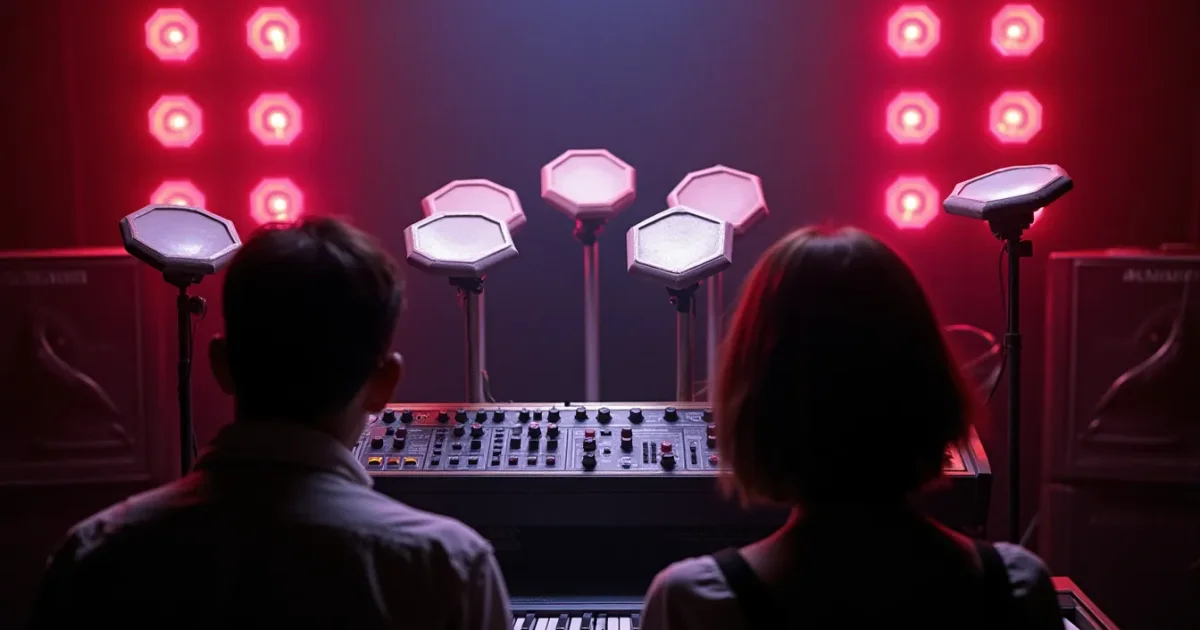
First half of 1981. The British firm Musicaid of Hatfield releases the Simmons SDS-V - the first viable electronic replacement for acoustic drums. The developers are Richard James Burgess and Dave Simmons. The machine arrives on stage at exactly the moment MTV begins broadcasting and the visual language demands a "futuristic" image: the hexagonal pads become the visual symbol of the decade. This article is about the module architecture, the origin of the pad shape and the specific songs without which the 80s sound would have been different.
Where the idea came from: spill, the stage and the "Skin and Syn" article
Burgess arrived at the SDS-V not from the studio but from a live-concert problem. On stage, drum microphones pick up everything else - guitars, vocals, keys. That is called spill, and in the late 70s it was fought with volume and shielding. Burgess wanted an instrument a drummer plays like a real kit, but whose signal goes straight to the desk - no microphones, no spill. He set the idea down in the article "Skin and Syn" in Sound International Magazine in 1979.
Burgess tried the first working prototype as early as 1979: he triggered an early SDS-V with a Roland MC-8 Microcomposer and recorded its part on Landscape's album "From the Tea-Rooms of Mars... To the Hell-Holes of Uranus". But that was programmed, not "playable" electronics. The goal remained: a drummer with his hands, the sound - synthesis.
Five modules and the front-panel knobs
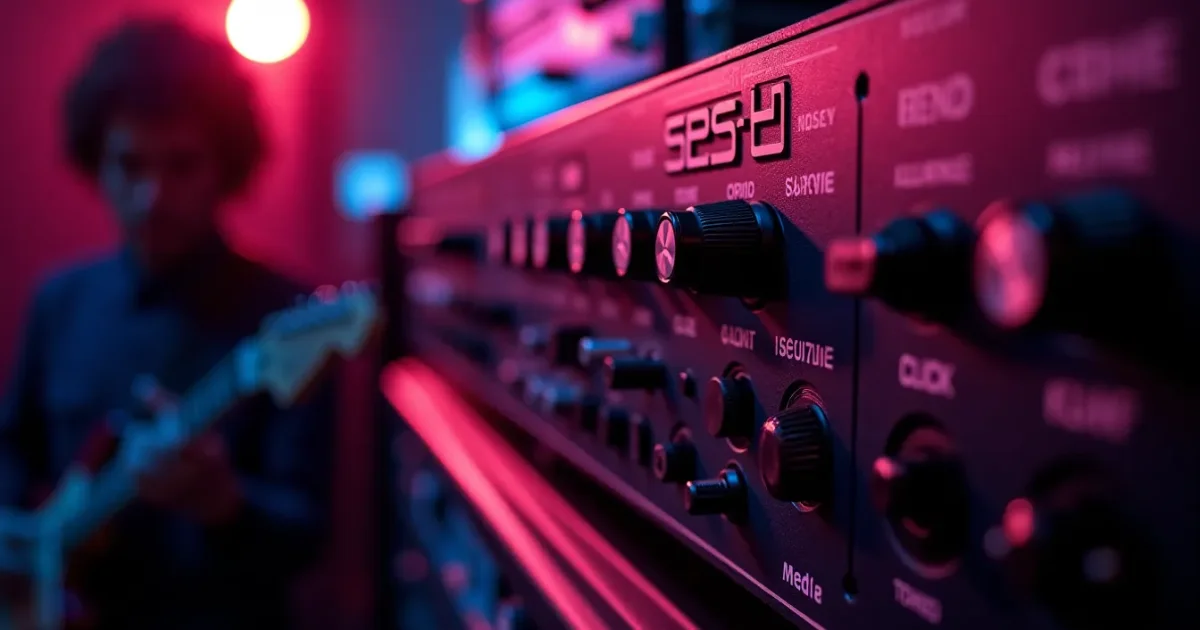
The standard SDS-V shipped with five modules: Bass Drum, Snare and three Tom-Toms. Outwardly the modules look almost identical, but the parameters are optimised for the specific drum. Each has knobs for noise level, tone level, bend, decay time, noise tone (a simple filter) and click - extra attack from the pad hit. Cymbal and Hi-Hat modules were optional, with open/closed hi-hat switched by an external pedal.
Each module had four presets - pre-tuned sounds you could dial up on the fly. The idea is simple: even a drummer who cannot programme a synth can pick a preset and get "something decent". The mixer section gave individual volume per module and a stereo output.
In terms of architecture each module is an analog synthesiser "for a drum": a noise source (white/pink), a tone oscillator, an amplitude envelope and a filter. On the toms "bend" gives the characteristic pitch "fall" - the "singing" effect. On the kick, tone sets the main resonance and noise adds a "fuzzy" low. Click is a short impulse from the pad hit, mixed into the body of the sound to create the "transient" - the attack without which an electronic drum would sound like a synth chord rather than a hit. All parameters are analog knobs with no memory: the four presets per module were fixed and switched by a toggle.
Detail: the SDS-V outputs are balanced XLR (pin 3 hot), which was unusual for live rigs in the 80s. But the pad input wiring on XLR was non-standard - the manual states pin 2 hot, pins 1 and 3 ground, which confused technicians.
Why the pads are hexagonal
The hexagonal shape was Burgess's idea, based on the principle of "interlocking shapes" inspired by a honeycomb. At the prototype stage batwings and triangles were tested, and there was even a limited "Rushmore headkits" series with fibreglass "shells". The hexagon won: it tiles tightly into a kit and is recognisable on screen at any editing speed. The very first run of about 20 pad sets was cut from wood - later they moved to plastic.
The pad material is the same extruded polycarbonate used for police riot shields. Tough, but hard: drummers complained of wrist and elbow ache after long sets. Later revisions of the SDS line got rubber pads, but many felt they lacked the "character" of the original SDS-V.
"Chant No. 1" - the starting point
The first recording where the SDS-V is played by a drummer (rather than a sequencer) was produced by Burgess himself in 1981 - Spandau Ballet's "Chant No. 1 (I Don't Need This Pressure On)". Behind the kit sat John Keeble, and this was the first production SDS-V "brain". The track climbed to #3 on the UK Singles Chart and was the first case of electronic drums sounding not like a "futuristic special effect" but as part of a pop song.
Who played the SDS-V: a map of artists
The SDS-V quickly spread across well-known rigs. Phil Collins and Genesis used the SDS-V on record and on tour - Collins met the kit through working with Robert Plant in spring 1983, and later put electronic toms on tracks like "Second Home by the Sea". Stewart Copeland of The Police laid down the SDS-V sequenced beat in the title theme of the American series "The Equalizer" (1985-1989). Neil Peart of Rush played the SDS-V from 1983 to 1989. Rick Allen of Def Leppard built a hybrid rig with SDS-V modules after losing his arm in 1984. Bobby Z, with Prince on the 1999 tour, added Simmons accents to the Linn LM-1. Jürgen "CC" Behrens of the German synth-pop group Silent Circle is another notable user, which ties the SDS-V directly to the world this blog writes about.
Other names: Bill Bruford (Yes, King Crimson, 1981-1998), Roger Taylor (Queen and Duran Duran - two different drummers with the same name), Thomas Dolby (1982 album "The Golden Age of Wireless"), Jean-Michel Jarre (live album 1982 "Concerts in China", recorded in 1981), Jon Moss (Culture Club).
Thomas Dolby used the SDS-V throughout the recording and touring of "The Golden Age of Wireless" in 1982 - the same album that carries the hit "She Blinded Me with Science". Jean-Michel Jarre took the SDS-V on the "Concerts in China" tour of 1981, where the hexagonal pads rang out in large halls before thousands for the first time - the visual effect matched the sonic one. Neil Peart of Rush rebuilt his kit around the SDS-V for the album "Signals" (1982) and kept it to the end of the decade before moving on to later Simmons models.

The sound you cannot mistake
The SDS-V's character is a "singing" tom with a long sustain and a clear pitch "fall" in the envelope. This is not a sample and not pure 808 synthesis: a hybrid of analog filters with a trigger input from the pad. It was those "singing" toms with reverb that became the signature of slow ballads and power ballads of the 80s. "In the Air Tonight" by Phil Collins, despite the rumours, was not recorded on Simmons, but later Collins and Genesis tracks made heavy use of the SDS-V. More on 80s studio technique is in the breakdown of the synths that built Italo Disco.
In production the SDS-V covered several roles at once. In pop and rock records, a "futuristic" tom on bridges and outros. In live rigs, the main drum for those who needed stage silence (no spill - no problems with the hall sound). In soundtracks, a marker of "science fiction": the "Equalizer" theme, Jean-Michel Jarre records, the Dempsey and Makepeace soundtrack with its characteristic Simmons triplets under heavy reverb. Everywhere the same anatomy: analog filter + pitch envelope + long sustain.
The difference from the TR-808 is in the trigger method. On the 808 the pattern is programmed step by step; on the SDS-V it is played by hand. So the SDS-V sits not in line with drum machines but in line with electronic drum kits: it replaces an acoustic drum, not a drum machine. More on drum machines is in the Roland TR-808 article - a different approach to the same set of tasks.
The line after the SDS-V: SDS-7, SDS-8, SDS-9
Simmons developed the line. The SDS-7 was the first model with a digital sound source (8-bit sample in EPROM) alongside the analog filters; up to 12 modules, the EPROM could be rewritten with the "Eprom Blower EPB". The SDS-8 came as a cheaper alternative to the SDS-7: a 5-channel analog synthesiser with kick, snare and three toms, with a factory sound and a "user" sound per channel. The SDS-9 was a hybrid where digital samples were mixed with analog filtering. Later models (SDS-200, SDS-800, SDS-1000) moved into the digital side and lost the "character" of the original that the SDS-V is still loved for.
Why the SDS-V is still alive
Production of the SDS-V stopped in the 80s, but demand never dropped. The reason is not nostalgia but physics: the SDS-V's analog filters are not emulated by plugins "one for one". Software clones capture the waveform but not the filter's "reaction" to the dynamics of a pad hit. So a working SDS-V rig on the secondary market costs more than it did new in 1981.
One of the curious reversions of the recent wave: the UK group Space brought the SDS-V back into the studio on the 2017 album "Give Me Your Future" - not as a retro gesture but because no plugin gave the same "singing" tom. When an instrument survives thirty years of demand after production ends, that is no longer fashion but an engineering solution that found no replacement.
The same "singing" tom turns up on Elton John's 1985-1986 records - Ice on Fire and Leather Jackets, where producer Gus Dudgeon played the SDS-V.
Burgess and Simmons did not expect that, forty years on, their hexagonal pads would become the visual label of an era. They were solving a technical problem - getting rid of spill on stage. The side effect was a sound impossible to mistake: a "singing" tom with a long sustain, a kick with a pitch "fall", a clap that sounds like a strike on a metal plate. One SDS-V module on any 80s record and the era is identified.