
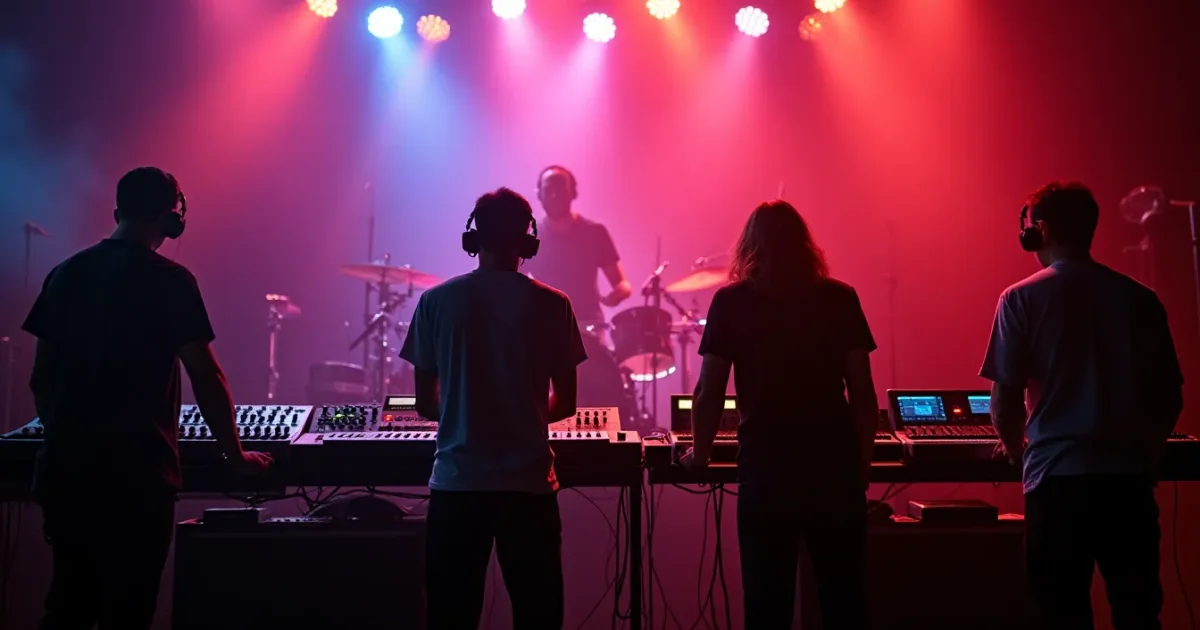
1980-1985. Four drum machines - the Linn LM-1 ($5,500, 525 units), the Oberheim DMX ($2,895), the Roland TR-808 and the Roland TR-707 - set the drum-machine sounds still recognised by ear. Put them on the same 16-step pattern and you hear that the kick, snare, clap and hi-hat of each sound different. This article is a comparison without myths: not "which is better", but why the same hit on four machines comes out different, and how that reads in a mix.
Four machines, one pattern: what we compare
Take a standard Italo Disco pattern: a kick on every beat (four-on-the-floor), a snare on 2 and 4, a clap on 2 and 4 over the snare, hats on eighths. Put it on the LM-1, DMX, TR-808 and TR-707 and listen to the kick, snare, clap and hi-hat separately. The logic is simple: on the same pattern, the difference in sound is the difference in the machine, not the arrangement.
The LM-1 (1980) and DMX (1980) are digital machines with 8-bit samples of real drums. The TR-808 (1980-1983) is analog synthesis: every sound is assembled from oscillators and filters. The TR-707 (1985) uses samples, but "plastic-er" and drier than the LM-1. Three different ways to get a drum sound - three different characters. More on the LM-1's architecture is in the Linn LM-1 breakdown, on the TR-808 in the Roland TR-808 piece.
Kick: sample versus synthesis
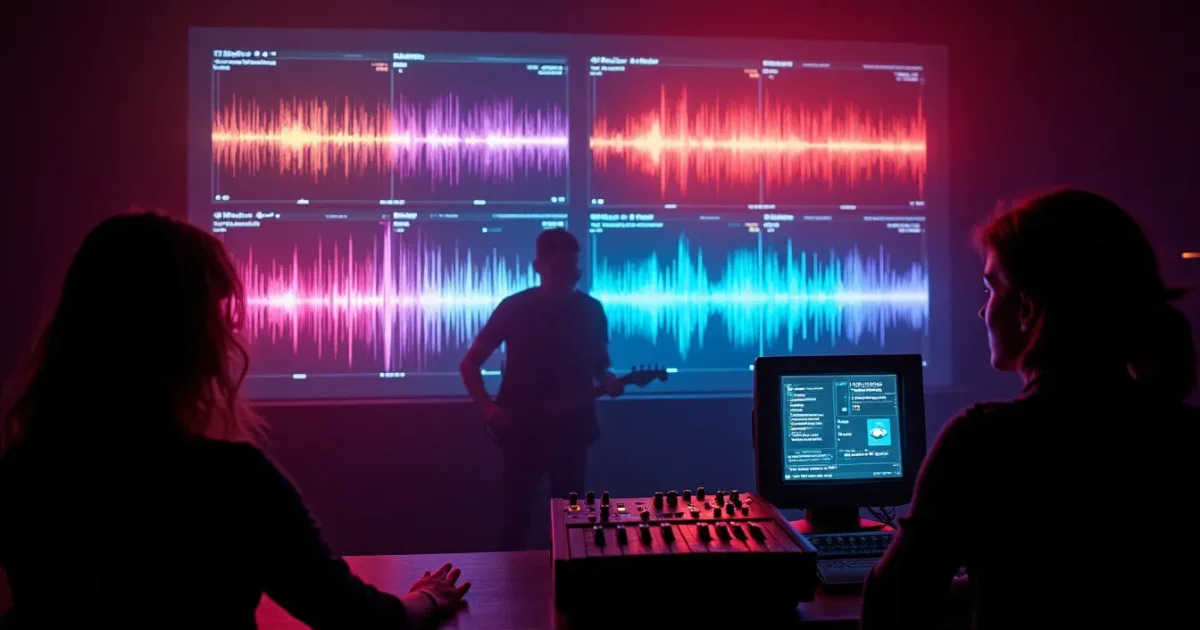
On one pattern the LM-1 kick is "fuzzy", with a faint 8-bit noise on the attack and a soft body. The DMX kick is "fatter", with a long sustain - the kick early hip-hop by Run-DMC was built on. The TR-808 kick "sings": a sine wave with a falling pitch envelope that "rings" in a resonant filter. The TR-707 kick is dry, "plastic", without heavy low end.
The difference is audible in the first 200 milliseconds. If the kick "sings" and falls in pitch, it is an 808. If it is "fuzzy" with noise, an LM-1 or DMX. If it is dry and short, a TR-707. In Italo Disco of 1983-1985 the LM-1 and DMX were more common; in house of 1986-1988, the TR-707 and 808.
Snare
The LM-1 snare is short, almost "cardboard", with an obvious noise tail. The DMX snare is "fatter" and longer, with a sustain that suits a dense beat. The 808 snare is synthesised noise through a filter: sharp, thin, with a tell-tale "metallic" overtone. The TR-707 snare is a digital sample with a very short sustain, which became the backbone of early Chicago house. On one pattern the difference in sustain length is immediate: the LM-1 and TR-707 are short, the DMX long, the 808 medium with a characteristic "ring".
Clap
The clap is the most recognisable detail. On the LM-1 the claps were recorded live (Tom Petty and the Heartbreakers) - warm, with real "air". The 808 clap is synthesised from white noise with several short envelopes that create the impression of "several hands": dry, narrow, almost electronic. The TR-707 clap is an 8-bit sample, dense, with a long tail that acid-house DJs placed on 2 and 4. The DMX clap is fat, "punchy". On one pattern the 808 clap is the driest and narrowest, the LM-1 the most "alive".
Detail: the 808 clap became the template for thousands of tracks precisely because it is "narrow" - it takes up little room in the mix and lets the bass and synths breathe. The LM-1 clap, by contrast, is "wide" and warm, but in a dense mix can clash with the bass.
Hi-hat
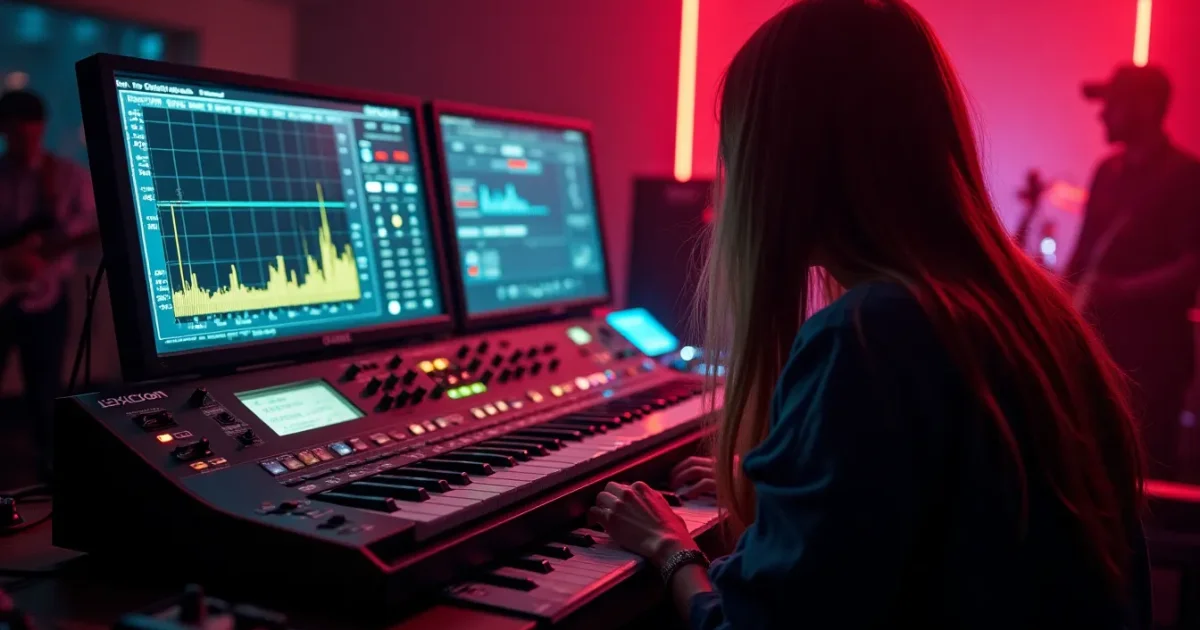
The hi-hat is the least obvious but an important part of the comparison. On the 808 hats are synthesised with a high frequency cutoff: energy concentrated in the 10-12 kHz band and above. On the TR-707 they are a digital sample with an audible top-end roll-off after 11-12 kHz. On the LM-1 the hat is a sample, but with no real cymbals: long samples did not fit in memory at the price, so the crash on Human League and Prince tracks was often replaced. On the DMX the hat is an 8-bit sample, slightly "grainier" than the LM-1. On one pattern the 808 hat is the "cleanest" and highest, the TR-707 the most "digital", the LM-1 the most "alive".
The blind test: how to identify a machine from one hit
If you put the four machines on one pattern and listen to one sound at a time, identification comes down to a few signs. Kick: "fuzzy" with noise - LM-1/DMX; "singing" with resonance and a pitch fall - 808; dry and short - TR-707. Snare: short "cardboard" - LM-1; long "fat" - DMX; thin with a "metallic" overtone - 808; short digital - TR-707. Clap: warm "alive" - LM-1; fat "punchy" - DMX; dry narrow electronic - 808; dense with a long tail - TR-707. Hi-hat: clean high - 808; digital with a top roll-off - TR-707; live sample - LM-1; grainy 8-bit - DMX.
The test needs no special equipment - just play four tracks at the same tempo and listen to the first bar of each. An experienced ear tells the machines apart in a fraction of a second, because each leaves a "fingerprint" in the first 200 milliseconds of a hit: the shape of the attack, the character of the sustain, the presence or absence of digital noise.
Detail: the LM-1 has no real cymbals - long samples did not fit in memory at the price. So the crash on Human League and Prince tracks was often replaced with a live one or a sample from another machine. That means the LM-1 hi-hat is recognisable, but the crash is not: in the crash position on LM-1 tracks there is often someone else's sound.
Processing: why the same 808 sounds different each time
The raw machine sound is half the story. On Prince's LM-1 tracks the kick and snare went through external reverb, often a Lexicon - covered in detail in the Lexicon reverb breakdown. The 808 kick on Run-DMC's records stayed dry - the DMX delivered "punch" with no effect. In Italo Disco, LM-1 and DMX kicks were often doubled with a synth on a Moog or Prophet. So drum-machine sounds on a finished track are not the raw machine but the machine plus processing: reverb, compression, layering.
Layering: the hybrid drums of the 80s
The classic 80s move is layering: an 808 kick for low end and sustain, a DMX snare for attack, an LM-1 clap for "live" air. Such a hybrid sounds "richer" than any single machine and turns up on Prince and Trevor Horn production dates. Put three machines on one pattern and you get a sound none of them gives alone. More on patterns is in the Italo Disco rhythm patterns breakdown. It is exactly layering that explains why "drum-machine sounds" on finished 80s records rarely belong to one machine.
Who played what: a short map
The LM-1 was bought by Peter Gabriel, Fleetwood Mac and Stevie Wonder; on it were cut the Human League, Gary Numan, Giorgio Moroder, ABC, Devo, Tears for Fears and Prince. Leon Russell used the LM-1 on every track of his 1979 album "Life and Love". The DMX became "the original drum machine of hip-hop": Run-DMC, Prince, Stevie Nicks, Mike Oldfield. The TR-707 (1985) was the first Roland on samples; on it "Need You Tonight" by INXS, "Move Your Body" by Marshall Jefferson and "Washing Machine" by Mr. Fingers. The LM-1 and DMX together, in The Guardian's words, turned drum machines from "toys" into "credible instruments".
The TR-707 deserves a separate accent. Released in 1985, it was the first Roland drum machine to use samples exclusively. Three tracks that effectively defined the sound of early Chicago house were cut on it: "Need You Tonight" by INXS, "Move Your Body" by Marshall Jefferson and "Washing Machine" by Mr. Fingers. The 707 is smaller and lighter than the TR-909 and synchronises over both MIDI and DIN sync, making it a workhorse of home studios. Its sounds cannot be tuned - and that very fixedness made the 707 instantly recognisable: "that snare" sounds the same on every track.
The crash and ride on the TR-707 are stored at 6-bit, which is where the "hissing wall" with the long sustain comes from - something an analog machine cannot give. Sixty-four patterns and four song chains, flam on any step, an LCD with tempo and MIDI channel - a first for Roland. Where the 808 gave a "singing" resonance, the 707 gave a dry, predictable foundation - and that predictability was exactly what house producers needed for loop-based tracks.
Digital vs analog: bit-depth as character
The logic "808 is analog, therefore better" does not hold. The LM-1 and DMX are digital 8-bit machines, and their "low resolution" (28 kHz, 8 bits) is part of the character. The TR-707, with its 6-bit cymbals, is even more extreme: low bit-depth compresses dynamics and lengthens sustain. That is not a bug but a musical instrument. Modern plugins often remove that top roll-off - which is why "clean" 808 libraries do not sound like an 808 but like an imitation.
On one pattern four machines give four different tracks. The 808 kick "sings", the LM-1 kick "rustles", the DMX kick is "fat", the TR-707 kick is "dry". That is the comparison without myths: not better-worse, but character by character.
What is audible today
In 2005 the LM-1 entered the TECnology Hall of Fame. The TR-808 is reissued, and every time buyers complain it "doesn't sound right": without a real analog circuit the filter resonance cannot be reproduced. The TR-707, which in 1985 seemed a "plastic compromise", became a cult instrument of house ten years later. The drum-machine sounds of the 80s are not a rarity but a working vocabulary producers still use. And you can spot them from a single hit - because each machine sounds its own way, and on the same pattern that is clearest of all. Four machines, one pattern, four different tracks - that is what a comparison without myths is.