
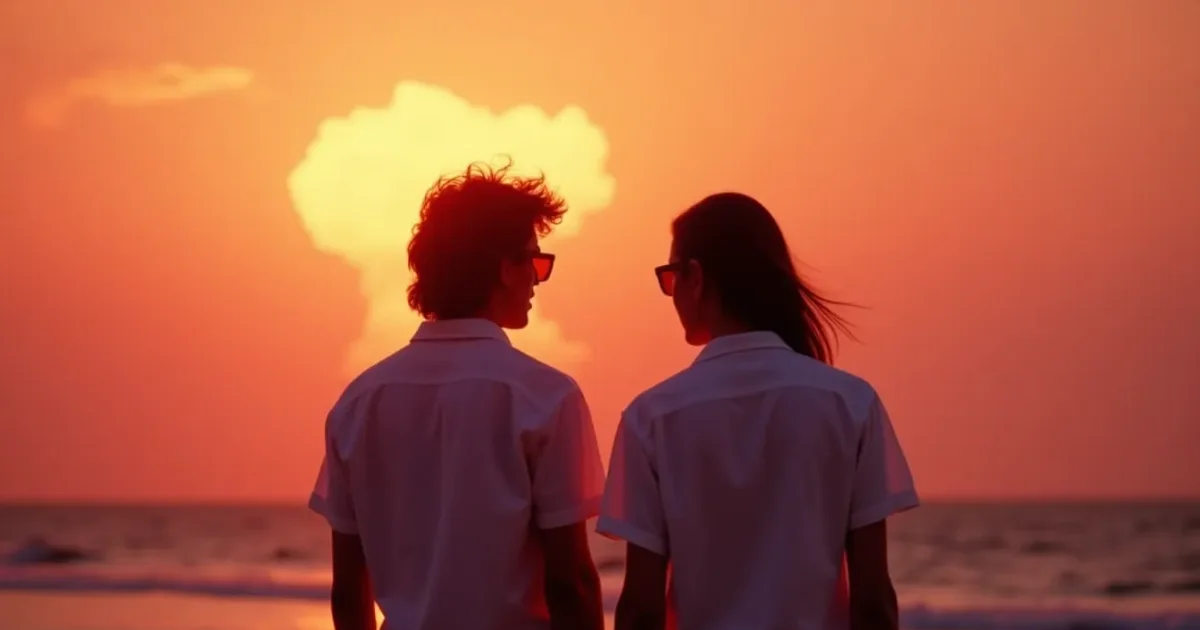
5 May 1983. The Italo-disco duo Righeira releases "Vamos a la playa" on CGD Records in Italy. The song is in Spanish - not Italian - and that is the first answer to the question in the title. "Vamos a la playa" translates as "Let's go to the beach." But behind the cheerful chorus lies a text about nuclear catastrophe: "radioactive" water, a "burning" horizon, a beach after an atomic bomb. The song reached #1 in Italy, #1 in Switzerland, #3 in Germany and sold over 3 million copies worldwide.
What language is "Vamos a la playa"
"Vamos a la playa" is Spanish. Not Italian, not English, not a hybrid. Johnson Righeira (one of the duo's two members) wrote the lyrics in Spanish, and producer Carmelo La Bionda of the duo La Bionda refined the song. The 7-inch single (CGD INT 10457) carries two versions: Spanish (side A, 3:40) and Italian (side B, 3:40). The 12-inch maxi-single (CGD INT 15091) has the Spanish version at 5:09, the Italian at 3:39 and a dub version "Playa Dub" at 6:34. More on the duo in our Righeira profile as the brothers from the beach.
The choice of Spanish was deliberate. Johnson Righeira told Vice magazine in 2017: "I wanted to make a beach song that was post-atomic and that made extensive use of electronics." Spanish gave a beach association - "la playa," "el sol" - and simultaneously referenced the Latin pop aesthetic that was fashionable in Europe in 1983.

What the song is really about
The chorus sounds innocuous: "Vamos a la playa, oh-oh-oh-oh." But the verses are nuclear apocalypse. Radiation in the air, the bomb has fallen, the beach is contaminated. Mental Floss called the track "one of the bleakest summer hits of all time." L'Humanité described it as "a record that does not talk about sunbathing but about the end of the nuclear world." De Morgen - "one of the most cynical summer anthems."
Johnson Righeira came up with the melody in late 1981 in a cellar in Florence, preparing for a New Year's Eve performance. In his words: "I already had a rough draft of 'Vamos a la playa,' which developed from my first works influenced by the 1960s. And there in that cellar, putting my hands haphazardly on a keyboard, it suddenly came to me - the chorus of 'Vamos a la playa' started playing in my head."
The people behind the record
- Johnson Righeira - songwriter, vocals
- Michael Righeira - vocals
- Carmelo La Bionda - songwriter, producer (of duo La Bionda)
- Michelangelo La Bionda - producer
- Hermann Weindorf - co-producer, arranger
- Berthold Weindorf - engineering, mixing
- Ben Fenner - engineering, mixing
La Bionda - brothers Carmelo and Michelangelo - were already veterans of Italian disco by 1983. Their production signature: synth bass, a melodic hook, a light vocal. Hermann Weindorf handled the arrangement - string pads and brass on synthesizers.

Charts: Europe country by country
According to Wikipedia, offiziellecharts.de and Ultratop:
- Italy - #1
- Switzerland - #1 (two weeks at the top)
- Germany - #3 (18 weeks in the chart)
- Belgium (Ultratop) - #2
- Netherlands (Dutch Top 40) - #2
- Argentina - #1
- Uruguay - #1
- UK Singles Chart - #53
According to La Repubblica, the single sold over 3 million copies worldwide. For an Italian Italo-disco single in 1983, that was the level of Ryan Paris's "Dolce Vita" and Savage's "Don't Cry Tonight."
Detail: in Yugoslavia the group Opatijski Suveniri recorded a cover of "Vamos a la playa" in 1983 on the Jugoton label - in Serbo-Croatian, but with the Spanish chorus preserved. Evidence of how far the song travelled: behind the Iron Curtain, to the Balkan market.
Why the song works
The contrast between form and content is the secret. A cheerful Spanish chorus, a danceable 120 BPM beat, a synth bass on eighths - and lyrics about nuclear war. The melody sticks after one chorus. The words "vamos a la playa" - four syllables you can sing in any language. And when the listener realises what the text is about - a double reading occurs. That is why the song outlived its era: not the beach, but the irony. Righeira proved that Italo-disco can be not only "Dolce Vita" but a post-nuclear pamphlet.