
"Vamos a la playa, oh oh oh oh oh!" - anyone who's heard Italo Disco even once remembers this line. The 1983 track by the Righeira duo became the unofficial anthem of European beaches and one of the decade's most successful Italian singles. Here are the two "brothers" who built this classic - though they weren't actual brothers.
Stefano and Stefano
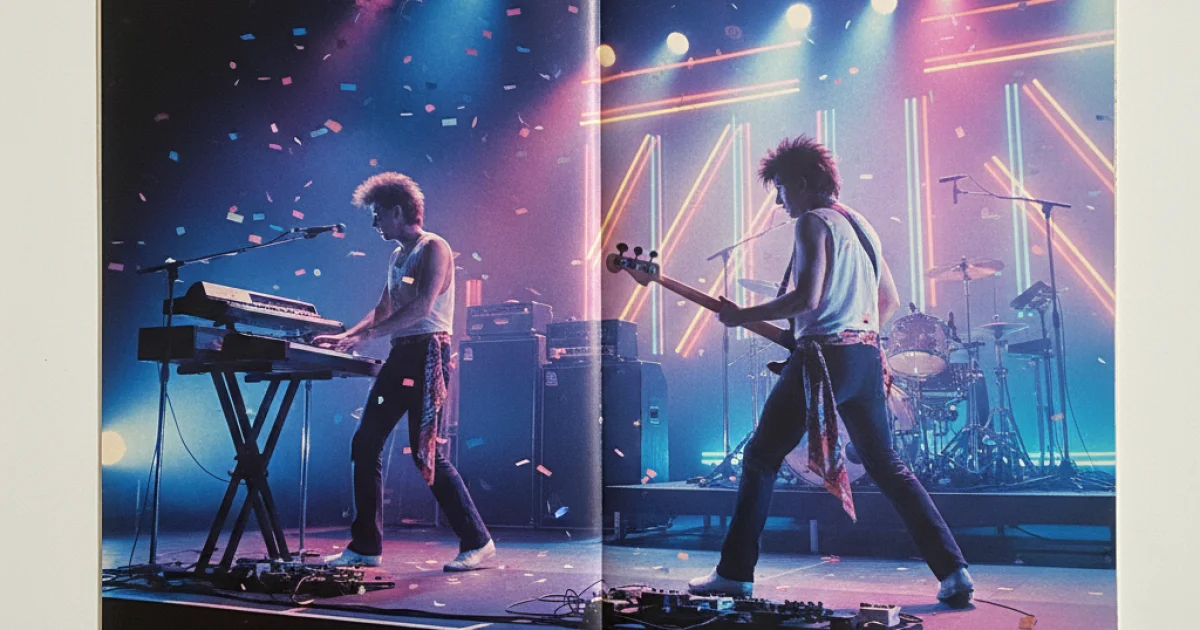
The Righeira duo consisted of two Italians - Stefano Righi and Stefano Rota. Both from Turin, both musicians, and their stage image was deliberately built on a "brotherly" style - matching outfits, similar hairdos, a shared bearing. But there was no biological kinship between them.
"Righeira" is a bent version of Righi's surname, which they picked as the duo's stage name. It's a typical era move - a slightly modified real name that sounds "international" and sticks.
The Casale Project
Key roles in Righeira's success were played by the producers - brothers Carlo and Vincenzo Casale. Unlike many Italo Disco teams, where the producer was a lone figure, here worked a team with family ties. The Casale brothers wrote material for Righeira, produced the records, handled promotion.
That division of roles worked well. Righi and Rota were the project's faces - young, energetic, photogenic. The Casales were the brains - experienced producers who knew how to make hits.
Vamos a la Playa: a Sensation
"Vamos a la playa" came out in 1983 and instantly became one of Europe's main summer hits. The track hit #1 in Italy, Spain, France, Germany, Austria, the Netherlands, Switzerland. In the British and even American charts the song got moderate success - rare for Italian Italo Disco.
The track's uniqueness is in its double meaning. On the surface it's a party, beach anthem - "Let's go to the beach, oh-oh-oh-oh!". But if you listen closely, the lyrics have strange images - radioactive wind, glowing sand, strange waves. Many interpreted the song as an allusion to nuclear disaster or the Cold War.
Cold War Subtext
Righeira themselves confirmed this reading in interviews. By their account, the song was a coded commentary on the threat of nuclear war, very real in 1983 (that's when tense negotiations over nuclear missiles in Europe were going on, and fear of war was real).
That gave the track extra depth. Behind the cheerful beach surface hid a dark social-political reflection. Listeners could take the track as a simple discotheque hit or as a conceptual work - and both were valid.
No Tengo Dinero
Righeira's next big hit was "No Tengo Dinero" ("I Have No Money"). The track came out in 1983 and was also a big commercial success. The formula was similar - Spanish-Italian phrases (though the duo was fully Italian), a memorable melody, a dance rhythm.
Using Spanish was a deliberate choice. It gave the duo an "exotic" tinge, made them distinguishable from purely Italian peers. Besides, Spanish was widespread enough in Europe that the lyrics were comprehensible to many listeners.
Innamoratissimo and the Rest
After the two main hits, Righeira released several other tracks - "Innamoratissimo," "Hey Mama," "Bambini Forever," "Tanzen Mit Righeira." Some had moderate success, others passed unnoticed. But the duo's classics stayed in the first two hits.
It's a typical problem for "summer" artists. When you hit the mood of a specific moment, it usually happens once or twice. Repeating the feeling of summer 1983 in subsequent years was impossible - the era was changing, moods were changing, the audience was changing.
The "Italian Playboys" Image
Righeira actively exploited the "Italian playboys" image in clips and on sleeves. White suits, open shirts, sunglasses, beach aesthetics. It was a straight sale of the "Italian style" stereotype that was popular in Europe at the time.
The image worked especially well for young people from Northern and Eastern Europe dreaming of a Mediterranean vacation. For them Righeira embodied everything they wanted to see in Italian guys - ease, style, fun.
Moving Into Other Genres
By the late '80s, Righeira changed direction. They began experimenting with different genres - from more rock-leaning tracks to experimental electronics. Some of these experiments were artistically interesting but commercially less successful.
It was a deliberate decision. Righi and Rota didn't want to become a "two-hit group." They aimed for creative development, even at the cost of mass popularity. A worthy choice, but a hard one in pop.
Breakup and Reunion
At different times Righeira split and came back together. Each member worked on solo projects, took part in other musical initiatives, tried himself outside the "brother duo" format. Then they reunited for retro shows or new recordings.
That flexibility is a typical trait of the Italian music industry. Projects don't necessarily break up forever. They can go dormant for several years, come back active, then slip into the shadows again. That rhythm gives artists more life than a "one-time" model.
Retro Life
With the revival of interest in Italo Disco in the 2010s, Righeira became active again. They take part in retro festivals, release new versions of old hits, sometimes record new material. At nostalgic events they're received as important guests.
"Vamos a la playa" remains their main number at concerts. The track has such magnetic force that a show without it would feel incomplete. The public comes specifically for this anthem, and the artists play it with pleasure.
Popularity in the East
Like many Italo Disco artists, Righeira were especially popular in the Eastern Bloc. For the post-Soviet public, "Vamos a la playa" is part of the soundtrack of summer holidays, the discotheques of youth, the general feel of the '80s. The duo's concerts in Russia, Poland, Czechia still draw good crowds.
Cultural Legacy
"Vamos a la playa" outgrew just being a pop hit. It became a cultural phenomenon - cited in films, used in advertising, recognized from the first notes. For many people it's a symbol of summer, vacation, carefree ease.
It's a rare achievement for a pop song - to outgrow its genre and era, to become part of broad cultural memory. Righeira managed it with a single track, which confirms the strength of their hit.
A Place in History
Righeira is an important example of how Italo Disco could work at an international level. They used universal themes - beach, summer, fun - that everyone understood. They added exoticism through Spanish. They sold the "Italian way of life," which was appealing across Europe.
The result - one of the decade's most recognizable tracks and a firm place in the genre's history.
According to Spotify, "Vamos a la playa" had collected over 80 million streams by 2024, and about 40% of listens fall on June-August - that is, the track 40 years on keeps a strictly seasonal nature. A rare case where a pop song works not as constant background but arrives with summer and leaves with it - roughly the way it arrived and left on Rimini dance floors in 1983.