
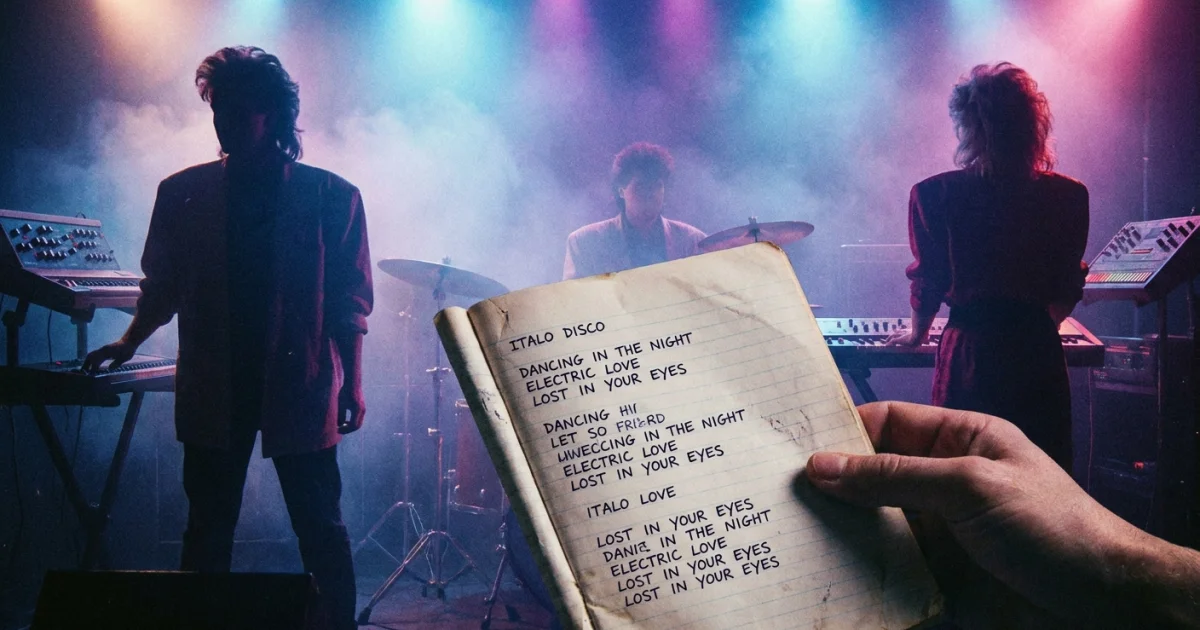
"I like Chopin," "Tarzan boy," "Dolce vita," "People from Ibiza" - Italo Disco lyrics have a very particular character. They're simple, often naïve, sometimes with obvious mistakes in English. For lovers of "serious" poetry, that's grounds for irony. For everyone else, it's part of the genre's charm. Here's why it works the way it does.
English Was Not the First Language
The main reason for the simple lyrics in Italo Disco is that they were written by Italians, for whom English was a second (and often a third or fourth) language. '80s Italian producers and lyricists had English at a level adequate for everyday conversation but not for poetic flourishes.
In that they were no exception. Most European artists working the international market had similar limits. But in Italo Disco the trait showed up especially clearly - and ended up part of the signature style.
A Strategy of Simplicity
Italian producers figured out fast - if you can't write complex lyrics, write simple ones. And turn it into an advantage, not a shortcoming. A simple lyric is easier to remember, you can sing along with minimal English, it works in international markets.
That set the standard - short phrases, simple words, repeating chorus lines. "I want your love," "Tonight is magic," "Dance with me" - constructions that listeners in Italy, Germany, Poland, Russia, anywhere could understand.
Accent as Signature
The pronunciation of Italian singers in English also had recognizable features. Soft consonants (an Italian "l" sounds softer than an English one), a rolled "r," signature vowels. All of that built a recognizable "Italo Disco accent," which became part of the identifiable style.
Some producers deliberately didn't push their artists to improve pronunciation - they understood the accent itself was part of the charm. A perfect British or American English in Italo Disco would have sounded wrong - out of step with the style.
Themes: Love and More Love
Thematically, Italo Disco lyrics circle a narrow set of subjects:
- Love - in various states: happy, sad, lost, new. The genre's main theme.
- Night and dancing - clubs, discotheques, nightlife.
- Romance and glamour - the good life, travel, summer holidays.
- Melancholy and loneliness - especially in more "serious" tracks.
Social, political, philosophical themes are almost absent from the genre. This is entertainment music, and its lyrics match the brief. Attempts to raise "serious" topics usually sounded unnatural and didn't get much audience support.
Repetition and Hooks
Italo Disco lyrics follow a clear logic. The main phrase or hook - the element that needs to stick on first listen - gets repeated many times. "I like Chopin" in Gazebo's track of the same name is repeated dozens of times. "Tarzan boy" in Baltimora is the same.
It's a professional approach. If a lyric has one central phrase, it needs to lodge in the listener's head. So you repeat it - in the chorus, in the backing vocals, in the refrain. Repetition builds memorability, which is critical for commercial success.
Strange Lines
Italo Disco lyrics include phrases that sound strange to an English native speaker. Sometimes grammar errors. Sometimes unusual word combinations. Sometimes straight calques from Italian.
Examples:
- "Cherry, cherry lady" (Modern Talking) - an unusual doubling of the adjective.
- "I like Chopin, love me now and again" (Gazebo) - a strange use of "now and again."
- "Tarzan boy" - an attempt to render the Italian "ragazzo" in English.
All these oddities are part of the genre's charm. They remind the listener that these are Italians singing in English, and there's a specific magic in that. Fix all the "errors" and the uniqueness disappears.
Pseudo-Poetry
Some Italo Disco lyrics tried to sound poetic, but with limited English the result was funny. Phrases like "In the night, in the dream, I can see your face" sound like a schoolkid's exercise - and yet they work in their musical context.
It's striking that these "pseudo-poetic" lines often move listeners as much as real poetry does. The reason is simple - in pop music, emotional impact matters more than literary merit. If a phrase lands the mood of the track, its imperfection doesn't interfere.
Lyrics in Italian
Sometimes Italo Disco artists recorded tracks in Italian. Most often those were parallel versions of international hits - for the Italian market. These versions sounded completely different: more poetic, freer, without the constraint of a foreign language.
It's interesting to compare the English and Italian versions of Righeira's "Vamos a la playa", for example. The Spanish original (which isn't Italian, but isn't English either) gives one feel; English translations give another. The lyric operates on different levels for different audiences.
Influence on Eurodance
The tradition of simple English lyrics with an accent passed from Italo Disco to '90s Eurodance. Hits like Haddaway's "What Is Love," Corona's "The Rhythm of the Night," Snap!'s "Rhythm Is a Dancer" all inherit the same lexical simplicity. By then it was the standard for European dance music.
In the 2000s and 2010s the tradition continued - most European dance hits still have simple, memorable lyrics. It's a formula that works, and nobody wants to change it.
The Charm of Imperfection
There's something very human about the simple, imperfect lyrics of Italo Disco. These aren't the works of professional poets, polished by editors. They're sincere attempts by Italian musicians to express emotion in a foreign language - and that sincerity breaks through all the imperfections.
The contrast with the current pop mainstream is obvious here. The Weeknd's "Blinding Lights" credits four writers and two producers; Sabrina Carpenter's "Espresso" lists six co-writers. That kind of collective hit-building guarantees professionalism, but it strips out the oddities and errors that keep a lyric alive. Italo Disco was written the opposite way: one or two people, bad English, tight deadlines, no focus groups.
So the next time you listen to "I like Chopin" and smile at the naïveté of the phrase - know that it's a side effect of an entirely different production model. And it's precisely those "errors" that still work forty years later, while the polished phrases of six-writer teams often vanish after their first rotation.