In September 1982 Prince released the double album 1999. On the cover - a number that would hang in the cultural air as dread for the next 17 years. The single “1999” wasn't an instant hit: in 1982 it peaked at only #44 Billboard. But it was reissued in 1983 and climbed to #12, and in 1999 - the year of apocalyptic anticipation itself - it returned to the charts, got crowned “the millennium soundtrack”, and crossed 8 million copies sold.
An album recorded by one man - with three voices
Prince recorded 1999 alone at his Kiowa Trail Home Studio in Chanhassen, Minnesota. Every instrument, every program, every vocal part - Prince. But the song “1999” has three vocalists: Prince, Lisa Coleman, and Dez Dickerson. It's the only track on the album where Prince handed the lead vocal to someone else.
Structure: Dickerson sings verse one, Coleman verse two, Prince verse three. An unusual move in 1982 - typically one song belongs to one voice. Prince told the Detroit Free Press in 1982: “I wanted the song to sound like three people talking on the night before the world ends. Each of them voicing their own fear”.
Lyric: apocalypse as a dance
“1999” is a song about nuclear war. In 1982 that was a real anxiety: in March 1982 Reagan expanded the US nuclear arsenal, and in September that year the USSR ran a record number of tests. “War is all around us” - Prince sings in the first chorus. “Let's party like it's 1999” is a challenge: if the world is going to end, we might as well dance through it.
“I was thinking about Nostradamus, about preachers, about the mushroom cloud. I was writing a song about people who know they have a little time left and decide to dance.”
- Prince, Rolling Stone, December 1982
Sound anatomy: three drum machines in one track
The song's key technical achievement is using three drum machines simultaneously. Prince was experimenting with layered rhythm on this album:
- LinnDrum LM-1 - main kick and snare
- Oberheim DMX - hi-hat and extra tambourine percussion
- Roland TR-808 - bass drum in the low octave, functioning like a sub-bass
On the verses only the LinnDrum and TR-808 play. On the chorus the Oberheim DMX joins and density spikes. This layered rhythm technique became a hip-hop standard in the late 80s - especially via Prince disciples Jimmy Jam and Terry Lewis on the Janet Jackson albums.
The main melodic line is on the Oberheim OB-Xa. Prince uses the “organ pad” preset, lightly modified filter envelope for sharper attack. Bass - on the LinnBass (the synthetic bass of the LinnDrum LM-2), eighth notes.
- Key: F# major, no modulations
- BPM: 120
- Length: 6:15 (album), 3:37 (single edit)
- Producer: Prince
- Album: 1999 (27 October 1982, Warner Bros.)
- Worldwide: 8+ million single copies plus 7 million albums
The video and MTV
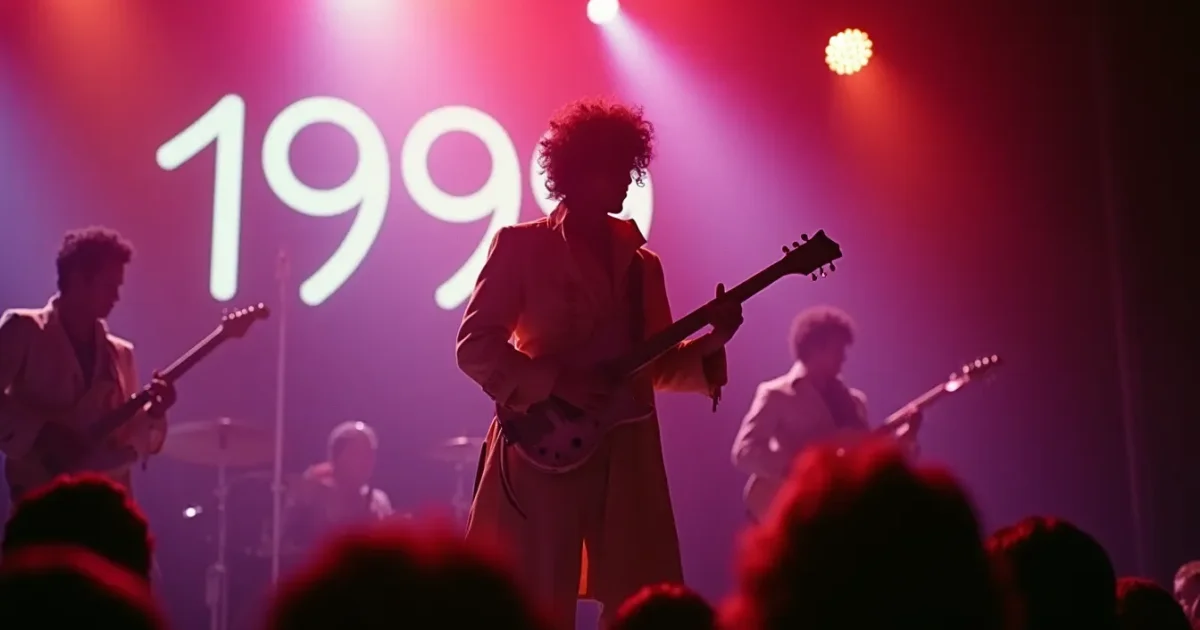
Directed by Bruce Gowers, director of Queen's “Bohemian Rhapsody” clip (1975). Budget $40,000. Shot on the Masonic Temple stage in Detroit in October 1982. Prince performs with The Revolution (Lisa, Dez, Bobby Z, BrownMark) live - positioning as a “concert clip”, innovative for MTV at the time.
In the first half of 1982 MTV was effectively ignoring African-American artists. Madonna, Duran Duran, Men at Work were in rotation; Rick James, Michael Jackson (pre-“Thriller”), Prince - rarely. The “1999” clip was one of the first Black-artist videos to enter heavy MTV rotation - in January 1983. That was the breakthrough directly preceding “Thriller”.
The 1999 return
The song's biggest cultural footprint arrived in 1999 itself. In the lead-up to the millennium, media everywhere used it on New Year's broadcasts. Prince had just released New Power Soul (1998) and reportedly declined licensing royalties for “1999” in commercials.
On 31 December 1999 at 8pm the world's major radio stations all started playing “1999” simultaneously. According to the BBC, the song was played over 2 million times in the New Year's Eve 1999/2000 period - likely a one-song record in 24 hours. By the time Prince died on 21 April 2016, “1999” had grown from 800,000 copies in 1982 to 8 million worldwide in 17 years.
Numbers and audio
An interesting detail about the first verse: before the song begins, a voice says: “Don't worry, I won't hurt you. I only want you to have some fun”. That's Prince's voice run through an Eventide H949 harmonizer pitched down an octave. The sound deliberately mimics “a voice from outside the world” - someone soothing you before a catastrophe.
Prince reused the same trick later on “Purple Rain” (1984) in the instrumental intros. The “low, distorted voice as signature” thread starts here, on “1999”.
Legacy: a phrase that entered the language
“Let's party like it's 1999” had entered conversational English by the late 80s. By 2000 it was a cliché - Joe Biden used it in a 1995 campaign speech, Barack Obama in 2008, Donald Trump in 2016. In 2020 the Oxford English Dictionary placed it at #8 on its list of “most-quoted American pop music phrases of the 20th century”.
Late in life Prince grew tired of the song. He told Billboard in 2015: “I'm sick of this song. Everyone expects me to sing it at every show. I've sung it for 33 years. Enough, maybe?”. Still, every Prince concert from 1983 to 2016 had „1999" in the set. At his final show (14 April 2016, Atlanta) - it was on the list.
What to listen to next
For the arc of the Minneapolis Sound era: “1999” (1982) → “Purple Rain” (1984) → “Kiss” (1986). Three stages of Prince: apocalyptic, romantic, minimalist. Same toolbox of Yamaha DX7 + LinnDrum + Oberheim through all three.
To hear how the layered drum machine technique evolved in the late 80s, try Janet Jackson “Nasty” (1986) and “Rhythm Nation” (1989) - both produced by Jimmy Jam and Terry Lewis, ex-Prince band members. Same layered rhythm engine, scaled up.