
In October 1986 Bon Jovi released the single “Livin' on a Prayer”. By February 1987 it held #1 Billboard Hot 100 for four consecutive weeks. Slippery When Wet, the album it came from, sold 28 million copies in the US and became the best-selling rock album of the 1980s. The irony: Jon Bon Jovi initially didn't want to include “Livin' on a Prayer” on the album - he thought it was weak. New Jersey teenagers saved it.
Tommy and Gina's story
“Livin' on a Prayer” was co-written by Jon Bon Jovi, Richie Sambora (lead guitar), and Desmond Child (a professional pop writer whose CV includes Aerosmith and KISS). The lyric follows Tommy and Gina, a couple fighting poverty: Tommy used to work on the docks until he was laid off (“Tommy used to work on the docks”); Gina works the diner all day.
The names Tommy and Gina in 1986 were a deliberate mainstream gesture. Child told Billboard in 2010: “We wanted to give the song an Italian-American family so the listener from New Jersey, Philadelphia, Rhode Island would recognize themselves. „Tommy" and „Gina" are the most frequent Italian-American names”. The song was written specifically for the US East Coast working class.
Tommy and Gina kept reappearing on subsequent Bon Jovi albums: “It's My Life” (2000), “Who Says You Can't Go Home” (2006), “These Days” (1995). Three decades of Bon Jovi's catalog keep coming back to them. In a 2017 Esquire interview Jon admitted: “Tommy and Gina are actually my neighbours from Sayreville, New Jersey. I only changed the names”.
Recording and Sambora's talk box
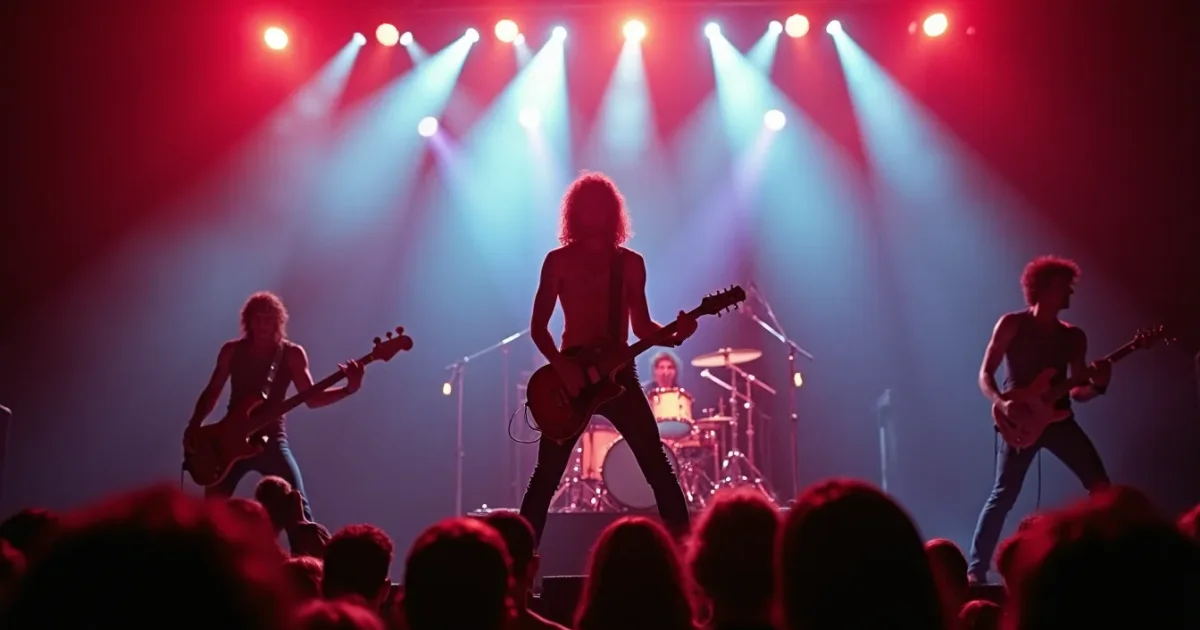
The album Slippery When Wet was recorded at Little Mountain Sound Studios in Vancouver, Canada, from May to June 1986. Producer - Bruce Fairbairn, later of AC/DC and Aerosmith. Engineer - Bob Rock (yes, the future Metallica and Mötley Crüe producer).
The song's most recognizable sound is the intro phrase played by Richie Sambora through a Heil Talk Box. A talk box is a device that sends the guitar's sound through a plastic tube into the guitarist's mouth. Lip movement modulates the signal, producing the effect of a “singing guitar”. Sambora played a Kramer Baretta through a Mesa/Boogie amp.
On the intro Sambora mouths “ooh, we've got to hold on” - and the talk box turns that into a guitar “singing” the same phrase. Trevor Horn used a similar trick on Frankie Goes to Hollywood's “Relax”, but Sambora made the technique the single's signature.
“I wrote the talk box intro in the car, on the way to the session. I hit a red light, opened my mouth and spoke as if I had a trombone. The sound in my head was: „ooh, we've got to hold on". I pulled over and recorded it on a dictaphone.”
- Richie Sambora, Guitar World, 2006
The final-chorus key change
“Livin' on a Prayer” is one of the best-known songs featuring the one-semitone upward modulation on the last chorus. The song sits in E minor for most of its length, then at 3:35 Jon pushes his vocal up a semitone to F minor. Sambora restates the guitar hook in F minor; the whole instrumental slides up.
Psychologically, the listener feels “another push”, another burst of energy. Key changes were a standard 80s pop move (see “Take On Me” a-ha); Bon Jovi went particularly blunt with it here. A 2012 Radio Times poll crowned “Livin' on a Prayer” the most famous key change in rock history. 37% of respondents recognized the modulation on first listen.
- Key: E minor → F minor (semitone modulation)
- BPM: 123
- Length: 4:11 (album), 3:56 (single)
- Album: Slippery When Wet (18 August 1986)
- US sales: 3 million single copies (Platinum)
- Worldwide: 28 million albums
New Jersey teenagers save the song
In June 1986 the album was nearly done. Jon Bon Jovi and Sambora assembled a panel of 12 teenagers from local Sayreville schools and flew them to Vancouver specifically for this. The Bon Jovi team played them the 14 candidate tracks and asked them to vote.
“Livin' on a Prayer” came in 12th out of 14. Jon wanted to cut it. Sambora pushed back: “You don't hear it because you know every detail. Play it again and ask them to sing the chorus”. On the second listen all 12 teens were singing along to the chorus by the end.
Sambora convinced Jon to keep the track. One condition: a rewrite. Desmond Child rewrote the bridge; Bruce Fairbairn added a live drum fill. That became a pivotal decision: without Sambora “Livin' on a Prayer” wouldn't have made the album, and Bon Jovi might never have released their defining hit.
Chart history
Released 31 October 1986. November - top-40. January 1987 - #1 Billboard Hot 100, four weeks. UK peak #4. #1 in Canada, Australia, New Zealand. Germany - #10.
The album Slippery When Wet hit #1 Billboard 200 and held for eight weeks. It was the best-selling US album of 1987. Across 1986-87 Bon Jovi played to a combined 3.1 million concert attendees.
“Livin' on a Prayer” and Glee, Rock Band, TikTok
Like “Don't Stop Believin'”, “Livin' on a Prayer” got a second life in the 2000s. In 2007 Rock Band made it a flagship track. In 2009 it closed the season 2 finale of Glee. In 2011 it powered the American Idol season 10 finale. By 2024 - 2.4 billion Spotify streams.
The song is especially durable on TikTok: millions of videos use it over clips about “pushing through work”, “holding on at the edge”, “barely making rent”. In 2023 American economists used it in anti-inflation messaging (!).
What to listen to next
For the American rock 1986 context: Bon Jovi “Livin' on a Prayer” → Journey “Don't Stop Believin'” (1981) → Aerosmith “Dream On” (1973). Three generations of “male rock ballad with a key change and an emotional climactic chorus”.
To see Desmond Child as the poprock switch-engineer of the 80s, play “Livin' on a Prayer” → Aerosmith “Dude (Looks Like a Lady)” (1987, Child co-write) → Cher “If I Could Turn Back Time” (1989, Child co-write). One man, three iconic rock hits in three years.