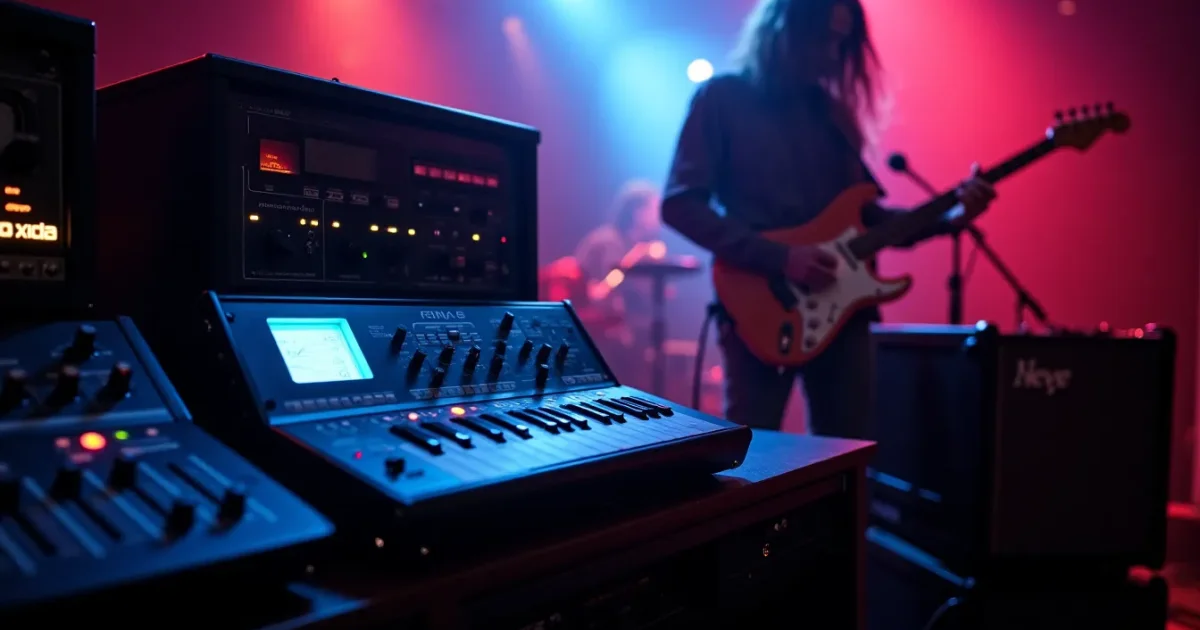
In 1981 the British company AMS (Advanced Music Systems) released the RMX16, the first microprocessor-controlled digital reverb that sounded so good everyone wanted it. Before the RMX16 digital reverb was expensive and often "plastic"; afterwards reverb became a recording instrument. The NonLin preset became especially famous - a short, dense, "gated" reverb that became the sonic signature of the 1980s. Trevor Horn, Phil Collins, Peter Gabriel, Metallica and many others worked with the RMX16. Here is why the unit matters.
What digital reverb is and why it matters
Reverb simulates the reflection of sound from the walls of a room. Natural reverb is the acoustics of a concert hall or studio. In recording, tape echoes, spring reverbs and plate reverbs were used earlier. Digital reverb appeared in the 1970s, but early models were bulky, expensive and often sounded "metallic".
The AMS RMX16 used a digital signal processor (DSP) and feedback delays to model space. Unlike analogue devices, it allowed precise control of decay time, pre-delay, frequency filtering and preset storage. This made it essential in professional studios. The RMX16 sound is often described as both clean and coloured: it adds space but leaves an imprint that listeners can recognise.

How the AMS RMX16 is built
The RMX16 is a 2U rackmount unit with a distinctive blue display. Inside are a processor, A/D and D/A converters, preset memory and algorithms. The main programs:
- Room - room simulation.
- Room B - alternative room colour.
- Plate - plate reverb simulation.
- Hall - concert hall.
- Ambience - short "air" reverb.
- NonLin - non-linear / gated reverb with a sharp cutoff.
Parameters were adjusted with buttons and an encoder: input/output gain, decay time, predelay, high-frequency damping, low-frequency cut. The RMX16 offered resolution and low noise sufficient for professional recording of its time. The modern RMX16 500, released by AMS Neve in 2020, uses 32-bit DSP and 24-bit/48 kHz converters with a 112 dB dynamic range.
NonLin - the sound of an era
The most famous RMX16 preset is NonLin. Instead of decaying smoothly to silence, the algorithm simulates a noise gate: the reverb cuts off sharply after a short time. The result is dense, explosive, with a high density of early reflections. NonLin was ideal for snare drums, claps and percussive eighth notes: the hit sounds "in a big space" but does not blur. The preset is built on a short decay time, after which a gate slices off the tail, creating the effect of a huge room in which the microphones have suddenly been muted.
This sound can be heard on countless 1980s records, from Phil Collins and Genesis to Frankie Goes to Hollywood and Art of Noise. Later NonLin became a cliché of the 80s and was often mocked in the 1990s, but in the 2000s it returned as a retro aesthetic.
It is important to understand why NonLin works so well on drums. A normal hall or plate blurs the hit in time and after a few milliseconds it loses its attack. NonLin, by contrast, keeps the attacking transient and adds only a short "cloud" around it. So a snare sounds simultaneously close and huge: the microphone captured the direct hit while the reverb created the illusion of a large room that is suddenly cut off.
Who used the RMX16 and how
Producer Trevor Horn used the RMX16 on records by Frankie Goes to Hollywood, Art of Noise and Propaganda - the most hi-tech British productions of the era. Peter Gabriel used it on the album So (1986). Metallica used it on drums for ...And Justice for All. In the 1990s the unit remained in studios: Portishead used it for a vintage sound. In the 2000s and 2010s the RMX16 appeared on records by indie and electronic artists who were deliberately looking for an "80s fingerprint" - from Lady Gaga to retro synthwave projects. This recognisability turned the RMX16 into a kind of brand: if a sound resembles NonLin, the listener immediately associates the recording with the era of big studios and analogue consoles.
The RMX16 was popular not only in pop and rock but also in film music: its clean digital reverb suits orchestral and electronic soundtracks. The Ambience preset became the standard for adding "air" to vocals without an obvious reverb tail.
The history of AMS and why the unit sounds the way it does
AMS (Advanced Music Systems) appeared in England in the 1970s as a maker of studio electronics. The company produced digital delays, flangers and other effects. The RMX16 was its first full digital reverb. AMS engineers deliberately chose compromise over perfect modelling of a real room: they made a unit that sounded "the way a producer wants it to". NonLin is a direct result of this approach - reverb as effect, not as acoustics.
In the 1990s AMS merged with Neve and the brand became AMS Neve. The company continued making effects and mixing consoles, but the RMX16 remained its most famous product. The 2020 reissue confirmed that the sound of this unit is still in demand, despite decades of digital evolution.
Connection to Italo Disco and Disco Magic
In 1980s Italo disco reverb played a key role. Vocalists often sang with heavy reverb and delay; synthesizer pads floated in space. Although many Italian studios used more affordable Lexicon, Yamaha or Roland units, it was the AMS RMX16 that set the sonic canon of the 1980s that modern retro projects chase.
Disco Magic & valex77, making Italo Disco / Eurodance covers and originals, often reach for the NonLin and Ambience sound: short, dense reverb on claps, "air" on vocals, plate reverb on synth pads. Understanding the RMX16 helps choose plugins consciously (UAD AMS RMX16, Arturia Rev PLATE-140, Valhalla) and avoid overdoing the "80s effect".
Modern revival
In 2020 AMS Neve released the RMX16 500, a 500-series version with 32-bit DSP and 24-bit/48 kHz converters. This is not simply a retro reissue: the modern version keeps the algorithms and character of the original while adding a convenient interface, 100 user presets and a built-in wet/dry blend. For studios building 500-series racks, the RMX16 500 became a logical purchase: the same sound in a compact format.
Interestingly, the RMX16 sounds different in different contexts. On fast dance tracks NonLin adds aggression and density. On slow ballads Ambience makes vocals airy without pushing them away from the listener. On synthesizer instrumentals Plate and Hall create space without interfering with the clarity of arpeggios. This versatility is what made the RMX16 the main reverb of the era: one unit covered most album-recording tasks. Later the UAD AMS RMX16 plugin accurately emulated the original. Versions from other developers also exist. The RMX16 has enjoyed an analogue-style revival: producers return to its sound because 1980s digital reverb differs from modern convolution and algorithmic reverbs - it is focused, dense and coloured.
How to get the RMX16 sound today
The most accurate option is the UAD AMS RMX16 plugin, which models the original DSP, filters and presets. More affordable alternatives include Arturia Rev PLATE-140 (for plate reverb), Valhalla Supermassive / VintageVerb (for 1980s ambience) and Relab LX480 (for Lexicon-style). To create NonLin manually, take a short plate or room reverb and process it with a noise gate set so the tail is cut after 100-200 ms. The result is not an exact copy but a recognisable effect.
RMX16 vs other reverbs of the era
Compare it with competitors. The Lexicon 224 (1978) was the first commercial digital reverb, softer and more natural, beloved for vocals. Yamaha REV1/REV7 were affordable and popular in home studios but less prestigious. Roland SRV-2000 was a Japanese alternative often found in European studios. EMT 250 was an early digital reverb from the classic plate company. The AMS RMX16 stood out for versatility: one unit replaced plate, hall and non-linear.
What to listen to and try
To explore the RMX16 sound try Phil Collins "In the Air Tonight" (NonLin on the drum fill), Frankie Goes to Hollywood "Relax", Peter Gabriel "Sledgehammer", Art of Noise "Close (to the Edit)".
Practical tips for using RMX16-style reverb
If you are making a cover or original in Italo Disco / Eurodance style, start with Ambience on vocals: short pre-delay (20-40 ms) and minimal decay. On claps and snare use NonLin or its imitation: reverb time 100-200 ms, then a gate. On synth pads use Plate or Hall with high-frequency damping so the pad does not conflict with vocals. Bass usually needs no reverb, but a very short room can add "depth".
The main beginner mistake is too much reverb. The RMX16 sounds "80s" precisely because it was used sparingly: one preset on vocals, another on drums, a third on pads. Drowning the whole mix in reverb turns the retro sound into a soap opera. Less but more precise is better.
To understand reverb in the context of synthesizer music, read about the synthesizer and drum machine, the PPG Wave 2.3 and French synth-pop.
Bottom line: the AMS RMX16 is not just a reverb but one of the sonic symbols of the 1980s. Its NonLin and Ambience presets defined how drums, vocals and synthesizers sounded in the digital era and still influence retro-electronics, Italo Disco and modern sound design. For Disco Magic & valex77 the RMX16 is not a museum exhibit but a working tool: its principles transfer easily into modern plugins and apply directly to covers and originals. Knowing the difference between plate, hall, ambience and non-linear is part of professional sound design for any retro project.