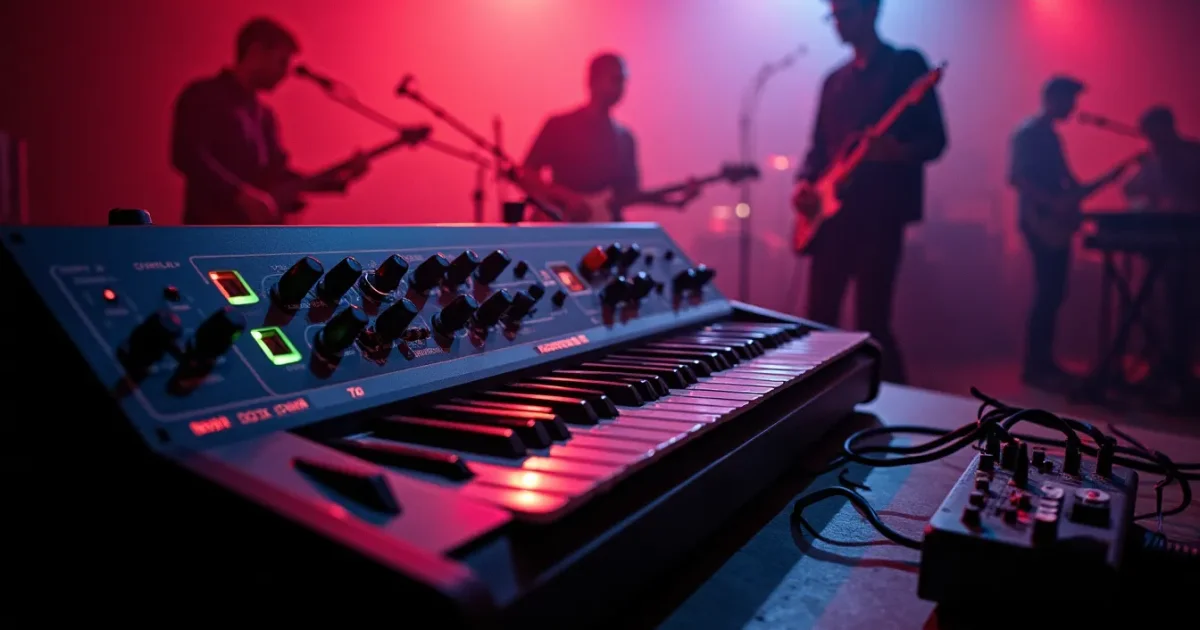
1983. Stefano Micheli of My Mine programs an arpeggio on a 16-step grid - and "Hypnotic Tango" finds its signature sound. Pierluigi Giombini does the same for "I Like Chopin" by Gazebo and "Dolce Vita" by Ryan Paris. The arpeggiator - a tool that takes a chord and turns it into a running sequence of notes - became the main engine of Italo disco. Without the arpeggiator the genre does not exist: it creates the "movement" that distinguishes Italo disco from ordinary disco.
Arpeggiator in Italo Disco: 7 patterns that create movement
An arpeggiator (arp) is a synthesiser function that takes a held chord and plays its notes sequentially - up, down, up-down or randomly. In Italo disco the arpeggiator is used not as decoration but as the main melodic element: a riff that runs through the entire track and does not let the listener go. Let us break down seven patterns and the synthesisers that created them.
Synthesisers with arpeggiators in Italo disco
Not every synthesiser had an arpeggiator. Of the machines used in Italian studios in 1983-1986, those with arps included:
- Roland Jupiter-8 (1981): modes UP, DOWN, UP/DOWN, RND. Tempo sync via CV/gate. One of the best arpeggiators of the decade - smooth, precise, with adjustable range.
- Sequential Prophet-5 (1978): modes UP, DOWN, UP/DOWN. Tempo sync via external clock.
- Korg Poly-61 (1982): UP, DOWN, UP/DOWN. Used in more budget productions.
- Yamaha DX7 (1983): no arpeggiator - but producers programmed arpeggios manually on a sequencer.
- Sequential Prophet VS (1985): vector synthesis with arpeggiator - used in late Italo disco (Fancy "Flames of Love", 1988).
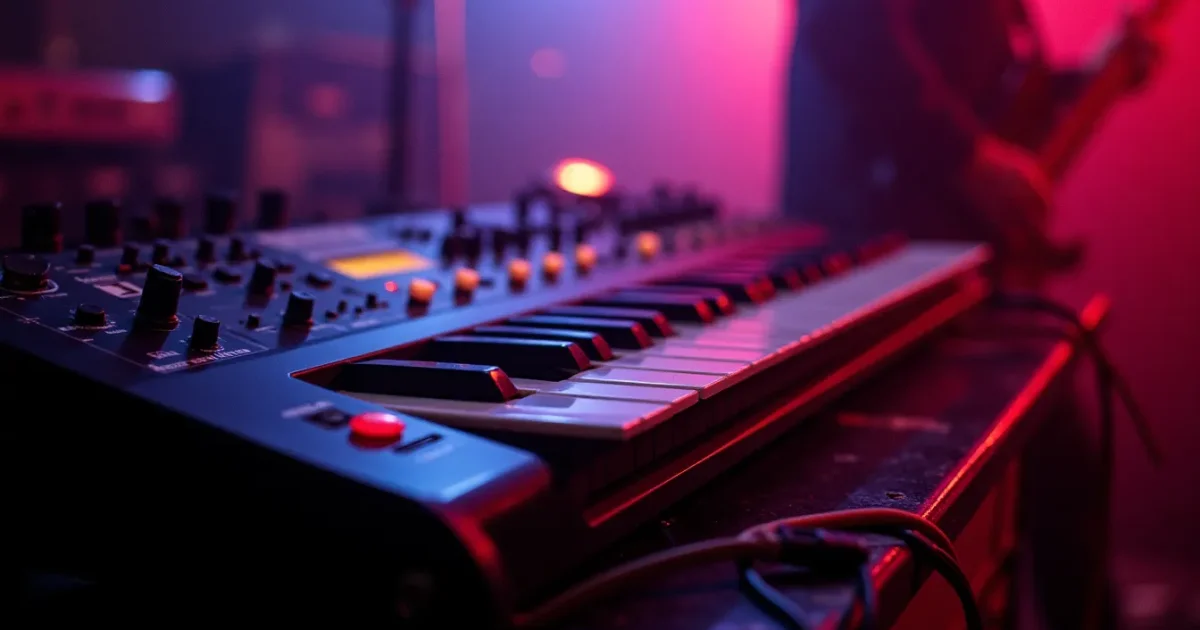
Pattern 1: UP - ascending arpeggio (Jupiter-8)
An ascending arpeggio can use the root, third, fifth and octave, then repeat. This is a pattern exercise rather than an exact transcription of a particular recording.
Pattern 2: DOWN - descending arpeggio (Prophet-5)
The chord plays top to bottom: octave, fifth, third, root. Gives a sense of "descent" - more melancholic than UP. Reference: "I Like Chopin" by Gazebo (1983) - descending arpeggio on a Prophet-5, creating the autumn melancholy of the track.
Pattern 3: UP/DOWN - zigzag (Jupiter-8)
The chord plays up and down: root, third, fifth, octave, fifth, third, root. Gives more notes per cycle - a sense of continuous movement. Reference: "Dolce Vita" by Ryan Paris (1983) - ascending-descending arpeggio, producer Pierluigi Giombini. 5 million copies sold - proof that this pattern works.
Pattern 4: Sequencer arpeggio (manual)
Not all arpeggios in Italo disco were hardware-based. Many producers programmed arpeggios on a sequencer - manually, step by step. This allowed patterns that the hardware arpeggiator could not: irregular rhythms, accented notes, variable lengths. Reference: "Hypnotic Tango" by My Mine (1983) - sequencer arpeggio programmed by Danilo Rosati.
Pattern 5: Bass arpeggio (Moog Prodigy)
The bassline in Italo disco is often also an arpeggio, but in the lower register. Eighth notes on a Moog Prodigy or Roland SH-101: root, fifth, root, octave. Not a "melodic" arpeggio but a rhythmic one - it holds the movement under the vocals. Reference: "Self Control" by Raf (1984) - bass arpeggio under the synth hook.
Detail: "Self Control" by Raf - arrangement by Celso Valli, #1 in Italy and Switzerland. The track is an example of "smooth" Italo disco where the arpeggiator works not as a hook but as a foundation.
Pattern 6: Vector arpeggio (Prophet VS, late Italo)
The Sequential Prophet VS (1985) - a vector synthesiser that mixed four oscillators. Its arpeggiator - UP/DOWN with variable timbre, because each note in the arpeggio had a different oscillator mix. Reference: "Flames of Love" by Fancy (1988) - late Italo disco with Prophet VS. The track shows how the arpeggiator evolved: from simple UP on the Jupiter-8 to vector mixing on the Prophet VS.
Pattern 7: Octave arpeggio (double octave)
The chord plays across two octaves: root, third, fifth, octave, third (an octave up), fifth (an octave up). Gives an "expansion" effect - the arpeggio sounds wider and more "cosmic." Reference: "Magic Fly" by Space (1977) - early space disco arpeggio that foreshadowed Italo disco.
How to sync the arpeggiator with a drum machine
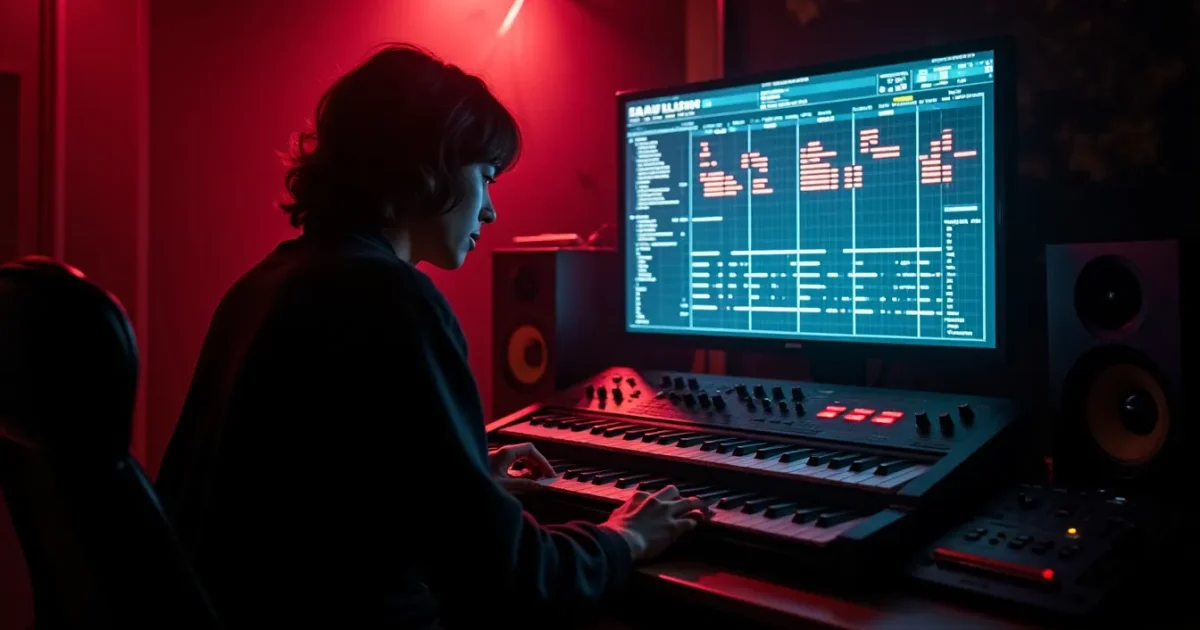
In 1983 synchronising an arpeggiator with a drum machine was non-trivial. The Jupiter-8 used CV/gate - an analogue protocol that transmitted tempo via voltage. The TR-808 had DIN sync - a different protocol. Synchronisation required a converter (such as the Roland SBX-80) or MIDI - but MIDI only appeared in 1983, and not all machines supported it.
By 1985 MIDI had become the standard, and synchronisation simplified: the Jupiter-6 (successor to the Jupiter-8 with MIDI) could sync its arpeggiator to a TR-707 via MIDI clock. This opened new possibilities: the arpeggiator could run at the same tempo as the drum machine without desyncing. More on studio technique - in the guide for beginner producers.
Rate, sync and tempo: how to set the arpeggiator
Rate - the speed of the arpeggiator, the main parameter after the mode (UP/DOWN/RND). In Italo disco the rate usually corresponds to sixteenth notes at 120-130 BPM: each arpeggio note sounds on each sixteenth step of a 4/4 bar. At 125 BPM that is roughly 8.3 notes per second. If the rate is too fast the arpeggio sounds like "buzzing"; if too slow - like ordinary accompaniment. Sixteenths are the golden mean, the standard of the genre.
Octave range - the span of the arpeggiator. The Jupiter-8 allowed selecting 1, 2 or 4 octaves. In Italo disco 2 octaves were most common: the chord plays across two octaves, giving enough "expansion" without losing recognisability. 4 octaves - for space disco and cosmic passages. 1 octave - for bass arpeggios.
Hold - a function that lets you release the key while the arpeggio keeps playing. On the Jupiter-8 hold worked through a sustain pedal: the producer pressed the pedal, played a chord, released their hands - and the arpeggio ran for the entire track. This was critical for live performance, but in the studio a sequencer was used: the arpeggio was programmed once and looped.
Evolution: from hardware to software arpeggiators
By the late 80s hardware arpeggiators gave way to software. The Yamaha DX7 had no arpeggiator - but its FM synthesis allowed creating "pseudo-arpeggios" through algorithmic patches. The Roland D-50 (1987) had a software arpeggiator with MIDI sync. The Korg M1 (1988) - a built-in arpeggiator in workstation format.
By 2000 software arpeggiators (in ReFX Nexus, Sylenth1, Massive) had dozens of modes and hundreds of presets. But producers working in the Italo disco style still returned to simple modes: UP on the Jupiter-8, DOWN on the Prophet-5. The limitation of the genre is not in technology but in choice: three modes, five synthesisers, one sound.
Arpeggio and bassline: how they interact
In Italo disco the arpeggio and bassline work in different registers but at the same tempo. The arpeggio - upper register, the bass - lower. Both in sixteenths or eighths. When both play simultaneously, a "wall of sound" is created - a dense, moving background over which the vocal sits.
Sometimes the arpeggio and bass play the same notes but in different octaves - this is called "doubling." In other cases the bass plays a simplified version of the arpeggio: only the root and fifth, while the arpeggio runs the full chord. This technique - "bass pedals" - gives harmonic stability while the arpeggio creates movement above.
Seven patterns, five synthesisers, one genre
The arpeggiator is not a "feature" of Italo disco but its structural element. Without the arpeggio the track stands still; with the arpeggio it moves. Seven patterns - from simple UP on the Jupiter-8 to vector on the Prophet VS - are seven ways to create movement from stasis. Every Italo disco producer knew: if the track does not "pump," add an arpeggio. If it pumps too hard - turn down the rate. The arpeggiator was both a tool and a remedy.
Today, when software synthesisers have arpeggiators with dozens of modes, it seems strange that an entire genre was built on five synthesisers and three modes (UP, DOWN, UP/DOWN). But the limitation is what made the genre recognisable: ascending arpeggio on a Jupiter-8 - that is Italo disco. Not because another pattern did not work - but because this one worked best.