
1985. Roland releases the TR-707 Rhythm Composer - the company's first drum machine with exclusively PCM samples. 8-bit sound, plastic body, LCD screen without backlight. A machine initially seen as a cheap alternative to the LinnDrum became the rhythmic foundation of early house, late-period Italo disco and Arabic pop music. Thirty years later the TR-707's samples are back in fashion.
Roland TR-707: why the plastic sound became fashionable again
The TR-707 came out in 1985 as a replacement for the TR-909 on the mass market. The TR-909 (1983) was hybrid: analogue kick and snare, sampled hi-hats. The TR-707 was fully digital: all sounds were 8-bit PCM samples. This meant no tunable pitch on the kick, no synth panel, no "analogue warmth." Critics received the machine coolly: the sound seemed "plastic," "cheap," "not alive."
But the TR-707 had two advantages that outweighed the drawbacks: MIDI and individual outputs. The TR-707 had MIDI In/Out and DIN sync - two synchronisation protocols at once. This meant the machine could work with both modern MIDI gear and vintage Roland equipment. Individual outputs for each instrument group allowed multitrack recording: kick, snare, hats, toms - on separate tracks.
Technical specifications
- Release year: 1985
- Type: fully sample-based (PCM)
- Bit depth: 8-bit (crash/ride - 6-bit)
- Polyphony: 10 notes
- Sounds: two kicks, two snares, three toms, rimshot, cowbell, clap, crash, ride, hi-hat (open/closed), tambourine, handclap
- Patterns: 64 programmable, 4 songs
- Control: 16 step buttons, step-write and tap-write
- Sync: MIDI In/Out, DIN sync, Trig Out
- Outputs: individual for each instrument group
- Size: smaller and lighter than the TR-909
Detail: the sounds of the TR-707 cannot be tuned (no tunable pitch). This limitation, which on the TR-909 was an advantage - the 909 kick could be tuned to the track, the 707 kick is fixed. But the fixed 707 kick had a characteristic "plastic" tone that twenty years later became fashionable precisely because of its unconventionality.
TR-727: the Latin twin
In the same 1985 Roland released the TR-727 - an architecturally identical machine with Latin percussion samples instead of standard drums. The TR-727 shared the body, interface and sequencer with the TR-707, but the sounds were different: conga, timbale, cabasa, guiro, samba whistle. The TR-727 was used in Latin disco and early house music. The TR-505 (1986) contained a subset of samples from both machines - a budget compromise.
Roland TR-707 vs Yamaha RX5
The TR-707 was released in competition with the Yamaha RX series. Yamaha RX11 - high-end, Yamaha RX15 - entry-level. Roland positioned the TR-707 against the RX11 but at the RX15 price. The Yamaha RX5 offered more flexible sample editing and tunable pitch, which the TR-707 lacked. But the TR-707's MIDI + DIN sync + individual outputs outweighed the RX5's editing flexibility. In studios with vintage Roland gear, the TR-707 was the obvious choice: DIN sync allowed synchronisation with TB-303 and TR-808 without MIDI converters.
TR-707 in house music
The TR-707 became the standard of early house - Chicago (1985-1987) and Detroit (1987-1989). The reason was availability: by 1985 the TR-909 was already out of production, and the TR-707 was its cheap replacement. Chicago DJs - Marshall Jefferson, Mr. Fingers (Larry Heard) - programmed patterns on the TR-707, using MIDI sync with sequencers.
Key tracks:
- "Mystery of Love" by Mr. Fingers (1985) - often called the first "deep house" track. TR-707, Roland Juno-106, minimal pattern.
- "Move Your Body" by Marshall Jefferson (1986) - "house music anthem." TR-707, piano riff, vocals.
- "Washing Machine" by Mr. Fingers (1986) - instrumental house on the TR-707.
The TR-707 in these tracks is not a "909 replacement" but an independent voice. The 8-bit samples gave a sound that was cleaner and more "plastic" than the analogue 909 - and that plasticity became the aesthetic of deep house. More on the TR-909 - in the 909 breakdown.
TR-707 in Italo disco
In Italo disco the TR-707 appeared in 1985-1986, when the genre was in decline. By this point producers were using both TR-808, LinnDrum, and TR-707 - sometimes in one track. The TR-707 gave a "cleaner" sound than the 808: kick without sinusoidal boom, snare without analogue snap. In late Italo disco releases of 1985-1987 the TR-707 was often used for hats and claps, while the kick was programmed on the TR-808 - a hybrid approach that gave "the best of both worlds." More on the TR-808 - in a separate breakdown.
TR-707 in Arabic pop music
An unexpected chapter in the TR-707's history is its role in Arabic pop music (al jeel). From the 1980s the TR-707 became standard in Egyptian and Lebanese studios: 8-bit samples fit well with Arabic rhythmic patterns, and MIDI sync allowed work with sequencers. The TR-707 in al jeel is an example of how European studio technology found application beyond its target markets.
Interface and programming
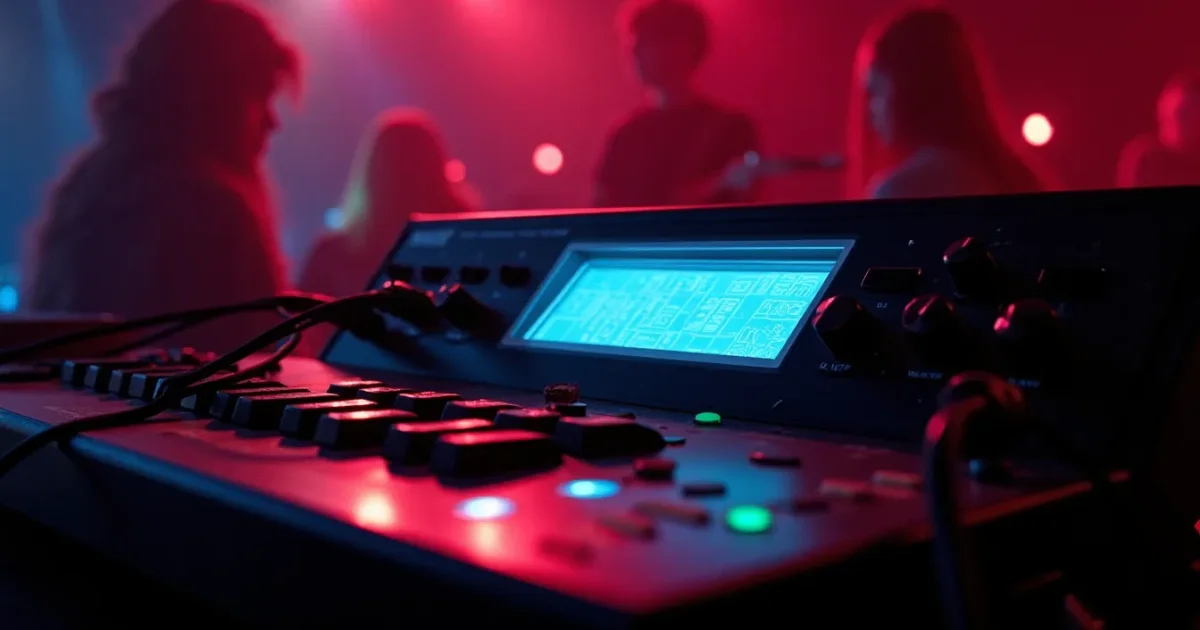
The TR-707 has 16 step buttons - one for each sixteenth step of a 4/4 bar. Programming is in step-write mode: the producer selects a sound (kick, snare, hi-hat etc.) and presses the button for each step where the sound should play. The LCD screen shows the pattern number, tempo, bar number and MIDI channel. The screen has no backlight, which made working in a dark studio inconvenient.
Four levels of shuffle - the only way to add "groove" without manually editing timings. Shuffle shifts every second sixteenth step, creating a swing feel. Flam - a "drag" effect where two hits sound almost simultaneously - can be applied to any step. These features were borrowed from the TR-909, but without the 909's tunable pitch and accent parameters - programming flexibility was lower.
64 patterns can be combined into 4 songs - sequences of patterns for live performance or automatic playback. This allowed programming the entire track on the machine and playing it without a sequencer - an approach used in early house production before computers became the standard.
Why the TR-707 did not become a cult machine
The TR-808 and TR-909 became cult machines because they defined genres: the 808 - hip-hop and Italo disco, the 909 - house and techno. The TR-707 did not define a genre - it was an instrument in a genre that already existed. Deep house was born not because of the TR-707 but thanks to Mr. Fingers and Marshall Jefferson, who chose an affordable machine. The machine was the means, not the cause.
Cult status comes to machines that create a new sound. The TR-808 created a sinusoidal kick that no live drummer had. The TR-909 created a tunable analogue kick that became the foundation of techno. The TR-707 created nothing new - it gave 8-bit samples that sounded like 8-bit samples. But that "non-newness" thirty years later became an aesthetic: when everything sounds "clean" and "real," the plastic 8-bit sound is counterculture.
The return: Aira TR-8 and modern fashion
In 2014 Roland added the TR-707 and TR-727 sound sets to its Aira TR-8 digital drum machine. This was an acknowledgment: the 8-bit samples from 1985, which critics considered "plastic" and "cheap," had thirty years later become an object of nostalgia and a fashionable sound. Lo-fi house, synthwave and modern Italo producers all use TR-707 samples, because their "plasticity" became an aesthetic advantage: a sound that does not try to be "real" and therefore sounds more honest.
LSI phrases that lead to this breakdown: roland tr 707 vs yamaha rx5, roland tr 707 sample pack, roland tr 707 wav, tr 707 roland. All these queries are about access to the sound of a machine that thirty years later remains in demand.
Roland TR-707 Wikipedia: what you need to know
The TR-707 is not a "great" drum machine in the sense of the TR-808 or TR-909. It did not create a genre, did not define an era, did not change the production method. But it was in the right place at the right time: 1985, Chicago, the birth of house. A machine made as a replacement became the voice of a new genre. And thirty years later its plastic sound is fashionable, because fashion returned to what was "cheap" in 1985.
The TR-707 is a lesson that "quality" of sound is not an absolute value but a cultural one. 8-bit samples that seemed a limitation in 1985 became an aesthetic in 2015. The plastic sound that critics rejected became the voice of deep house, al jeel and lo-fi. The machine did not change - the perception did.