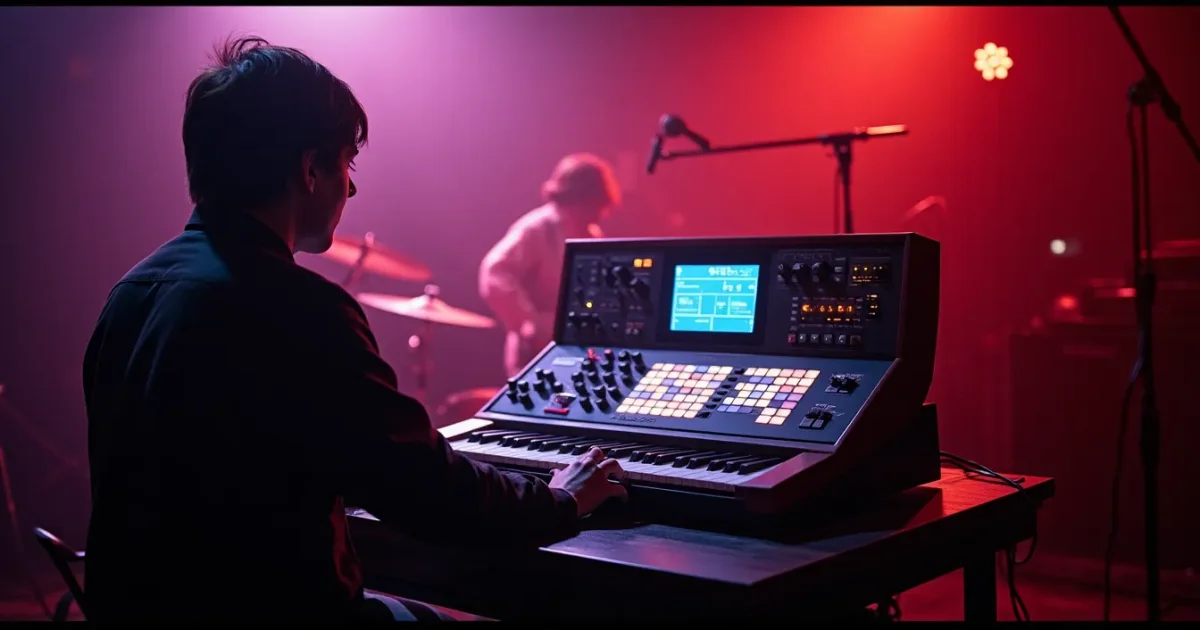
1983. Italo disco production relies on four drum machines: Roland TR-808, LinnDrum, Oberheim DMX and Roland TR-707. Four machines, four sounds, four approaches to rhythm. Tempo - 110-120 BPM at the start of the genre, 125-135 by 1985. Every track begins with a pattern: 16 steps, kick on every beat, clap on 2 and 4, hi-hat in eighths. Let us break down eight rhythmic patterns that defined the sound of Italo disco, synth-pop and Eurodance.
80s drum machine rhythms: 8 patterns
The drum machine in the 80s was not an accessory but the heart of the track. Unlike a live drummer who could lose the tempo, the machine held metronomic precision: 128 BPM for six minutes without a single error. That precision is what made club mixing and DJ culture possible. Without it there would have been no extended mix, no house, no techno.
Pattern 1: Italo disco classic (TR-808, 118 BPM)
The foundation of Italo disco. Kick on every beat (four-on-the-floor), clap on 2 and 4, open hi-hat on the "and" of each beat, closed hi-hat on the main beats. Bassline in eighth notes over the kick. Tempo - 110-120 BPM. References: "Don't Cry Tonight" by Savage (1983), "Dolce Vita" by Ryan Paris (1983).
Step grid (16 steps, where x = hit, - = silence):
- Kick: x---x---x---x---
- Clap: ----x-------x---
- OH: -x-x-x-x-x-x-x-x-
- CH: x-x-x-x-x-x-x-x-x-
Pattern 2: Italo disco fast (LinnDrum, 128 BPM)
By 1984 the tempo rises. LinnDrum gave a more "live" sampled sound: kick with attack, snare with reverb. Same four-on-the-floor, but with an added tom fill at the end of every 8 bars. Tempo - 125-135 BPM. References: "Self Control" by Raf (1984), "You Spin Me Round" by Dead or Alive (1984, producers Stock Aitken Waterman).
Pattern 3: Synth-pop cold (Roland TR-808, 120 BPM)
Synth-pop used drum machines differently: not for dance but for machine coldness. Kick not on every beat but on 1 and 3. Snare on 2 and 4. Hi-hat in sixteenths for a "motor" effect. Minimal fills, maximum repetition. References: "Are 'Friends' Electric?" by Tubeway Army (1979, Polymoog + drum machine), "Don't You Want Me" by Human League (1981, Roland CR-78).
Pattern 4: Eurodisco four-on-the-floor (TR-808/LinnDrum, 120-126 BPM)
Eurodisco - the bridge between Italo disco and Eurodance. Kick on every beat, clap on 2 and 4, but with added rimshot on 16th notes for rhythmic density. Bass in eighths, melody in sixteenths. Tempo - 120-126 BPM. References: "I Like Chopin" by Gazebo (1983), "Around My Dream" by Silver Pozzoli (1985).
Pattern 5: Hi-NRG (Oberheim DMX, 140 BPM)
Hi-NRG - a subgenre with a tempo of 140+ BPM, popular in the UK and US. Kick on every beat, snare on 2 and 4, open hi-hat on every beat - maximum density. Bass in sixteenths. References: "You Spin Me Round" by Dead or Alive (1984), productions by Stock Aitken Waterman, Bobby Orlando.
Detail: the Oberheim DMX was the first drum machine with samples of real drums. The DMX gave a "live" sound that the LinnDrum made popular, but in a harder, less processed form. The DMX was used in hip-hop, new wave and hi-NRG.
Pattern 6: Eurodance (Roland TR-909, 140 BPM)
90s Eurodance inherited the formula from hi-NRG, but on the TR-909. Kick on every beat with powerful low-end, clap on 2 and 4, open hi-hat on the off-beat (between beats). Tempo - 130-140 BPM. References: "What Is Love" by Haddaway (1993), "Rhythm Is a Dancer" by Snap! (1992). More on Eurodance rhythms - in the rhythm patterns breakdown.
Pattern 7: House (Roland TR-707/TR-909, 120-128 BPM)
House music was born in Chicago in 1985-1986, using the TR-707 and TR-909. Kick on every beat, clap on 2 and 4, open hi-hat on the off-beat - the basic house pattern. Tempo - 120-128 BPM. References: "Mystery of Love" by Mr. Fingers (1985, TR-707), "Move Your Body" by Marshall Jefferson (1986, TR-707). House took the Italo disco formula and made it more minimal: fewer notes, more space.
Pattern 8: Space disco (Roland CR-78/TR-808, 110-120 BPM)
Space disco of 1977-1979 used earlier drum machines: Roland CR-78 (1978, first programmable), Korg KR-55. The pattern was less four-on-the-floor, more syncopated: kick on 1 and 3, snare on 2 and 4, with additional syncopation on 16th notes. Tempo - 110-120 BPM. References: "Magic Fly" by Space (1977), "Star Wars Theme" by Meco (1977).
Tempo evolution: from 110 to 140
The tempo of dance music rose throughout the decade. Space disco (1977): 110-120 BPM. Early Italo disco (1982-1983): 115-122 BPM. Late Italo disco (1984-1986): 122-130 BPM. Eurodisco (1985-1989): 120-126 BPM. Hi-NRG (1984-1986): 138-145 BPM. Eurodance (1992-1997): 130-140 BPM.
The tempo increase was tied to technology: the faster the drum machine, the more accurate its sequencer. Roland TR-808 (1980) - max 150 BPM. LinnDrum (1982) - max 200 BPM. TR-909 (1983) - max 300 BPM. But producers rarely used maximum tempos - a track needed to be danceable, not a sprint.
How patterns were programmed
80s drum machines were programmed in two ways: step-write and tap-write. Step-write - step-by-step input: the producer presses a button for each step of the 16-step grid, choosing which sound plays on which step. Tap-write - real-time recording: the producer plays the machine's pads and it records the hits into the grid.
Most Italo disco producers used step-write: precision mattered more than expression. The pattern was recorded once and looped for the entire track. Variations - fills at the end of every 8 or 16 bars - were programmed separately and inserted manually.
Sidechain and rhythm dynamics
By the mid-80s producers discovered the technique of sidechain compression: the kick triggers a compressor on the bass, and the bass "ducks" at the moment of the kick hit, then returns. The effect - a "pumping" bass that breathes in time with the kick. Sidechain became standard in house music by 1988 and moved into 90s Eurodance. Without sidechain the kick and bass competed for low frequencies; with sidechain they worked as a single mechanism.
In Italo disco sidechain was rarely used - the genre preferred eighth-note bass that did not coincide with the kick in phase. But in late Italo disco and early house sidechain already appeared: "Move Your Body" by Marshall Jefferson (1986) - an example of a track where the bass "breathes" behind the kick.
From hardware to plugins
By the late 80s hardware drum machines began giving way to software. The Akai MPC60 (1988) - a sampler-sequencer that combined a drum machine and a sampler in one unit. By 1995 Cubase and Logic Audio worked with audio on a computer, and producers transferred patterns from the TR-808 to software sequencers. By 2000 ReFX Nexus and other plugins provided TR-808, TR-909 and LinnDrum samples in digital format.
But hardware drum machines did not disappear. Collectors and studios continue to use original TR-808s (secondary market price - $3,000-5,000), LinnDrums ($2,000-3,000) and TR-909s ($2,000-4,000). Hardware sound is not "better" than software, but it is different: analogue circuits add harmonics that digital emulations do not fully reproduce.
Drum machines as a genre-defining factor
The choice of drum machine determined the genre. A producer who bought a TR-808 made Italo disco or hip-hop. A producer with a LinnDrum - synth-pop or pop-rock. A producer with an Oberheim DMX - new wave or early hip-hop. A producer with a TR-909 - house or techno. A TR-707 - early house or late-period Italo disco. The machine dictated not only the sound but the approach to programming: the 808 - step-write with an analogue synth panel, the LinnDrum - samples with fixed length, the 909 - tunable pitch and accent.
When a producer chose a drum machine, they chose a genre. It was not aesthetics - it was economics: a machine cost $1,000-2,000, and it had to be used on every track to justify the investment. The drum machine defined the sound of production for years to come.
Why 80s drum machines are recognised by a single hit
Each drum machine had a characteristic sound that cannot be mistaken. TR-808 - kick with a sinusoidal boom, snare with a short snap. LinnDrum - samples of live drums with reverb. Oberheim DMX - hard samples with pronounced attack. TR-707 - 8-bit PCM samples, clean and plastic. TR-909 - analogue kick with tunable pitch, sampled snare and hi-hat.
These sounds are the DNA of their genres. Hearing a TR-808 means hearing Italo disco or early hip-hop. Hearing a TR-909 means hearing house or techno. LinnDrum - synth-pop or 80s pop-rock. The drum machine was not just an instrument - it was a genre-defining factor.
Eight patterns, six machines, ten years of evolution. From 110 BPM space disco to 140 BPM Eurodance - 80s drum machines built the rhythmic foundation of all European dance music. Without these machines there would have been no clubs, no DJs, no house. Every button on the 16-step grid was a decision that defined how dancefloors sounded and still sound.
A first sixteen-step beat is built from scratch in the guide to using a drum machine.