
On 13 March 1981, Kim Carnes released “Bette Davis Eyes” - a cover of a 1974 song written by Jackie DeShannon and Donna Weiss. Billboard Hot 100 #1 for nine straight weeks - the longest #1 of the year, beating “Endless Love” (Diana Ross & Lionel Richie) by six weeks. It swept the 1982 Grammys with Record of the Year AND Song of the Year - a rare double. Bette Davis herself, 73, sent Carnes a handwritten thank-you with the line: “You have made me a part of my grandson's modernity”.
The 1974 version: Jackie DeShannon
The original “Bette Davis Eyes” was written by Jackie DeShannon (author of “Put a Little Love in Your Heart”) and Donna Weiss in 1974. DeShannon cut it for New Arrangement. Her version is a soft pop ballad in the Carole King mould, with piano and strings. It flopped commercially: no chart position, no movement beyond the album track.
Donna Weiss spent seven years pitching it to other artists. Ronnie Hawkins passed in 1975. Linda Ronstadt cut a demo in 1977 but didn't release it. Barbra Streisand considered it in 1979 and also passed - “weird melody”.
A small detail: across seven years, Jackie DeShannon never got a single cover request. She thought the song was dead.

Kim Carnes rebuilds the structure
Kim Carnes (37 at the time of recording) received the “Bette Davis Eyes” demo in October 1980 from producer Val Garay. Carnes was sure the song could be a hit - but only after a total rebuild.
What Carnes and Garay changed: key from A major to A minor, tempo from 85 to 98 BPM, arrangement from piano ballad to synth rock. Strings dropped. Piano dropped. Roland Jupiter-8 and Linn LM-1 in.
The crucial thing was Carnes's rough vocal delivery, which she called “whisper-growl”. It wasn't a cold, as the press speculated at the time; Carnes consciously worked in the low end of her range to create a “smoky-room” effect.
“I listened to the DeShannon original ten times in a row. A beautiful song - but it didn't speak to me. I needed to make it mine, and that meant breaking its structure entirely. When I brought the finished version to EMI, they were shocked at first. Then scared. Then they released it”.
- Kim Carnes, Billboard interview, 1981
Recording: The Record Plant, December 1980
Recording took place at The Record Plant on 3rd Street in Los Angeles. Producer - Val Garay, engineer - Niko Bolas. Time - December 1980, about two weeks.
Session players: Josh Leo (guitar), Craig Krampf (drums, live + Linn LM-1 programming), Bill Cuomo (all synths - Jupiter-8, Oberheim OB-Xa, Yamaha CP-80 Fender Rhodes). Cuomo would go on to produce Carnes's next four albums.
The iconic synth riff - the “ti-ri-di-di-da, di-di-di-di-da” hook - was improvised by Bill Cuomo in 10 minutes in the studio. Carnes heard it and said: “Keep that, that's the hook”. It became one of the most recognisable synth lines of the early 80s.
Anatomy of the sound
- Key: A minor (verse), modulating to C major on the bridge
- BPM: 98
- Length: 3:48
- Lead synth hook: Roland Jupiter-8, Bill Cuomo
- Pad/strings: Oberheim OB-Xa
- Fender Rhodes: Yamaha CP-80
- Drum machine: Linn LM-1 (kick, snare), Krampf live kit for fills
- Bass: Don Grolnick, Fender Jazz Bass
- Vocals: Kim Carnes, Shure SM58 (not a studio condenser - Carnes insisted on a live mic for directness), double-tracked on the chorus
- Producer: Val Garay
- Studio: The Record Plant, Los Angeles, December 1980
- Single release: 13 March 1981, EMI America
Nine weeks at #1: the longest of 1981
“Bette Davis Eyes” moved up the Billboard Hot 100 slowly: #42 in April, #17 in May, #1 on 16 May 1981. It stayed at #1 a total of nine weeks (with a one-week break in July, when Air Supply's “The One That You Love” briefly knocked it off).
It was the year's longest US #1. Billboard named “Bette Davis Eyes” the best-selling single of 1981 in the United States - 4 million copies. Canada: #1 for five weeks. Australia: #3. UK: only #10 (British audiences have always taken badly to American synth rock).
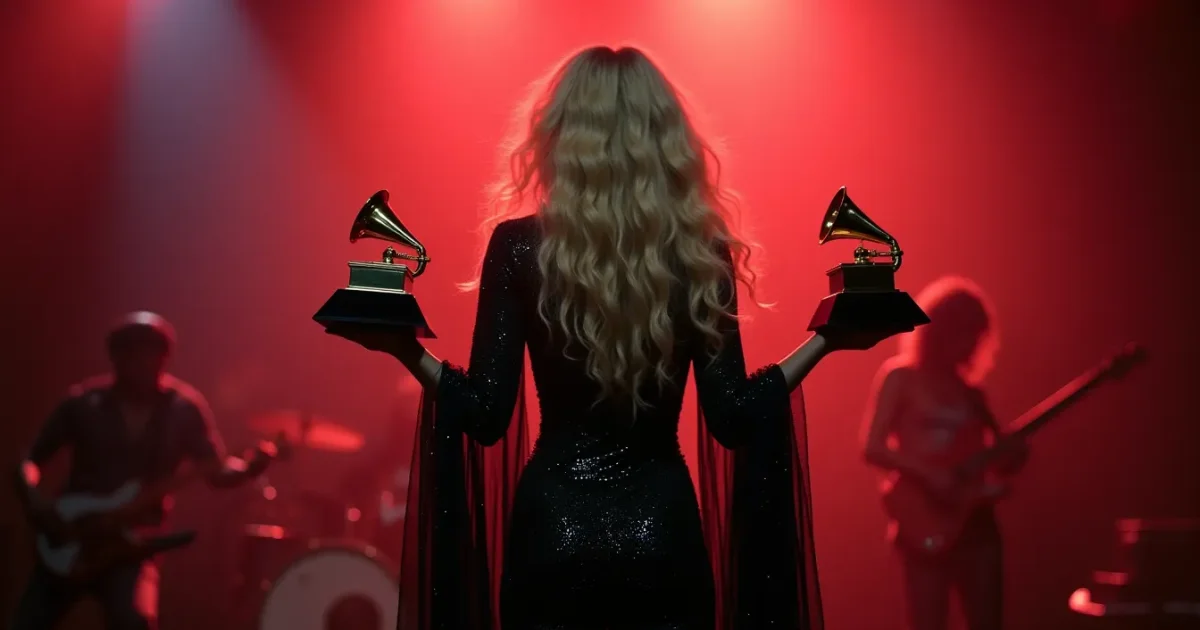
The 1982 Grammys delivered a double: Record of the Year (for the recording) and Song of the Year (for DeShannon & Weiss's writing). One of only five occasions in Grammy history when a single song has taken both trophies at once.
A letter from Bette Davis
In October 1981, when “Bette Davis Eyes” had been #1 for four months, the actress Bette Davis herself (73 years old) sent Kim Carnes a handwritten letter. In it she wrote: “This song has made me a part of my grandson's modernity. For the first time in ten years, my grandson is not embarrassed that his grandmother is an actress”.
Davis also sent Carnes and DeShannon bouquets of red roses and two bottles of champagne each. Carnes later admitted: “I cried reading the letter. It was recognition from the legend I worshipped my entire life”.
What to listen for next
The 1981 synth pivot: “Bette Davis Eyes” (1981) → “Tainted Love” Soft Cell (1981) → “Physical” Olivia Newton-John (1981). Three hits that redefined the early-80s pop sound.
Linn LM-1 in the mainstream 1981-1983: “Bette Davis Eyes” (1981) → “Billie Jean” MJ (1983) → “1999” Prince (1982). Three tracks that made Linn LM-1 the defining drum machine of the early 80s.