

On 13 June 1983, Herbie Hancock released “Rockit” - the first single from Future Shock. Billboard Hot 100 #71, but Billboard Dance Club Songs #1 and UK Dance #1. The first jazz-fusion track with hip-hop elements to become a mainstream hit. Five Grammys at the 1984 ceremony - a record for an electronic track at that time. Scratching by Grandmixer DST (real name Derek Howells) cut at 1 TON Records in New York. The Godley & Creme video with singing mannequins became one of the first tracks by a Black artist in MTV's heavy rotation, cracking open a racial barrier at the channel.
Herbie Hancock before “Rockit”: 15 years of jazz
By 1983 Herbie Hancock (age 43) had a 15-year jazz career: Miles Davis's quintet (1963-1968), solo albums on Blue Note, and the jazz-fusion act Headhunters (1973 - 4 million copies). But by 1980 Hancock was creatively blocked.
In spring 1983 he was in New York and walked into The Roxy during a hip-hop set with live scratching. The DJ was Grandmixer DST. Hancock was floored: “I understood this was a new musical instrument - the turntable as an instrument”.
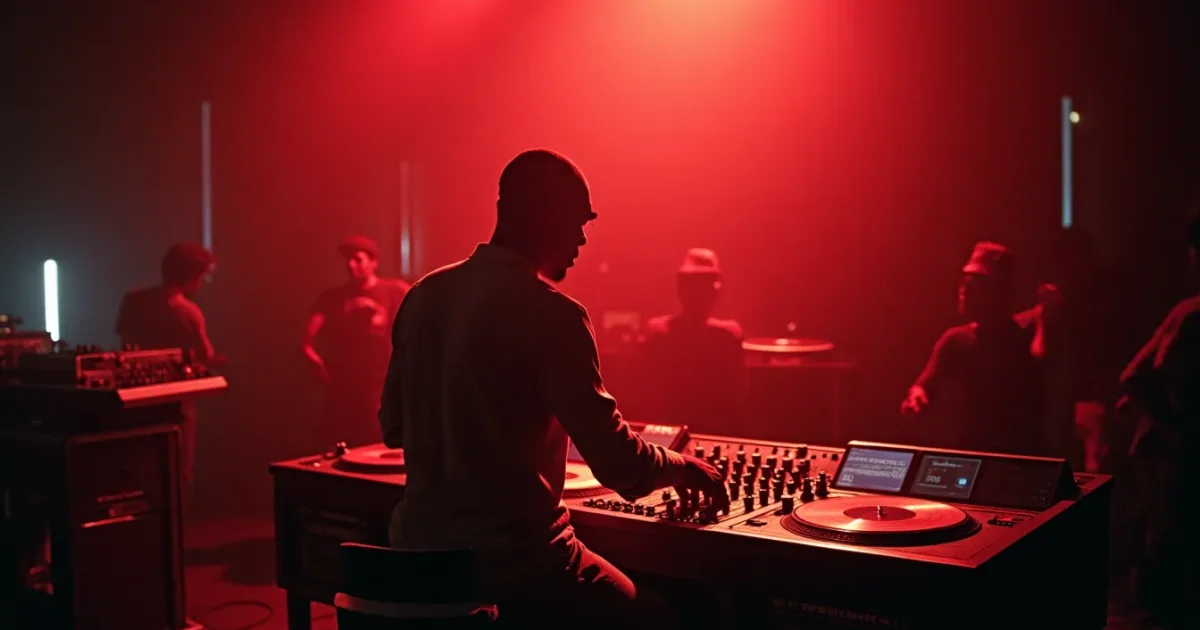
Recording: 1 TON Records, New York, April 1983
Recording took place at 1 TON Records in Manhattan, April 1983. Producers - Material (a trio of Bill Laswell, Michael Beinhorn, and Martin Bisi). Line-up: Hancock (Fairlight CMI, ARP 2600, Rhodes), Bill Laswell (bass), Grandmixer DST (turntables).
Grandmixer DST (22 at the time) brought in his own two Technics SL-1200s and a crate of vinyl. The signature scratch is a sample of Fab 5 Freddy's “Change the Beat”, manipulated at different speeds. The session ran six hours; DST did dozens of takes, and Hancock and Laswell picked the best fragments for the final mix.
The bassline is Yamaha DX1 through a guitar amp (an Ampeg SVT). Hancock wanted “a punk sound, not a jazz one”, and deliberately overdrove the DX1.
“When I first heard DST do his scratch thing I realised - this is a new instrument. I'd been playing piano for 20 years, but this kid was pulling things out of a record that I would never have pulled out of a keyboard”.
- Herbie Hancock, DownBeat interview, 1984
Anatomy of the sound
- Key: F minor, minor-blues progression i-iv-♭VII-i
- BPM: 124
- Length: 5:28 (album), 3:41 (radio edit)
- Lead instrument: Fairlight CMI Series II - Hancock
- Keys: ARP 2600 + Yamaha DX1 (bassline)
- Electric piano: Fender Rhodes Mark II - Hancock
- Scratching: Grandmixer DST, two Technics SL-1200s, Fab 5 Freddy “Change the Beat” sample
- Bass: Bill Laswell, Fender Jazz Bass + DX1 overdub
- Drum machines: LinnDrum + Roland TR-808 (claps)
- Producer: Material (Laswell / Beinhorn / Bisi)
- Studio: 1 TON Records, New York, April 1983
- Single release: 13 June 1983, Columbia
Godley & Creme and the mannequins: the video that broke MTV
The “Rockit” video was directed by Godley & Creme (Kevin Godley and Lol Creme, formerly of 10cc) in May 1983 in London over three days. Budget - $55,000. The central image is singing mannequins built by sculptor Jim Whiting. Whiting constructed seven kinetic mannequins driven by motor rigs, moving legs, arms and heads in sync with the rhythm.
Hancock appears in the video only once - on a TV screen in the corner, playing the Fairlight. That was by design: Godley & Creme wanted attention on the instruments and mannequins, not on the artist.
In 1983 MTV barely showed Black artists. Before Michael Jackson's “Billie Jean” (March 1983), the channel aired less than 5% Black music. “Rockit” became only the second track by a Black artist in MTV heavy rotation, after MJ. The video won 5 MTV Video Music Awards in 1984 - the year's record.
5 Grammys: a record for an electronic track
At the 26th Grammy Awards (28 February 1984), “Rockit” took five trophies:
- Best R&B Instrumental Performance
- Best Rock Instrumental Performance
- Best Engineered Recording - Non-Classical (Martin Bisi)
- Best Art Direction on Photography - Album
- Best Instrumental Composition
Five Grammys for a single electronic track - a record until 2008, when Daft Punk's “Around the World” won four. Hancock also became the first Black artist to win in the Best Rock Instrumental Performance category.
Scratching enters the mainstream
Before “Rockit”, scratching was only known inside the Bronx and Queens hip-hop scene. By the end of 1983, following “Rockit”, scratch samples started showing up in mainstream tracks: Culture Club “Church of the Poison Mind” (August 1983), Run DMC “It's Like That” (March 1983), Malcolm McLaren “Buffalo Gals” (1982, but newly popular after “Rockit”).
A small detail: Grandmixer DST never received royalty points on “Rockit”. His session fee was $250. After the Grammy sweep he tried to sue Hancock for a royalty share; Hancock said in an interview that “that part was unfair”, and in 1987 paid DST $50,000 out of court.
Chart history: a strange success
“Rockit” only reached #71 on Billboard Hot 100. But it hit #1 Dance Club Songs for three weeks. UK Singles Chart: #8 - Hancock's first and only UK top-10. The Future Shock album went platinum in the US (1 million copies) and Gold in the UK (300,000).
Commercially it wasn't a blockbuster, but culturally it redefined the intersection of jazz, electronica and hip-hop for the next 20 years. The track was sampled on dozens of hip-hop tracks between 1985 and 1995.

What to listen for next
Fairlight CMI in the mainstream in 1983: “Rockit” → Fairlight CMI - the 1979 sampler revolution → “Owner of a Lonely Heart” Yes (1983). Three tracks using the Fairlight as a central instrument.
Scratching enters pop music: “Rockit” (1983) → “Buffalo Stance” Neneh Cherry (1988) → “Pump Up the Volume” M|A|R|R|S (1987). Three stages - from avant-garde to dance mainstream.