

1990s. From Italo Disco grew two popular genres: Eurodance and Eurobeat. Both are fast, both are synthetic, both descend from 1980s Italian dance music. But in practice they are different things. The main keyword is Eurodance and Eurobeat differences, and this article breaks down how the two genres differ in sound, geography, market and culture of consumption.
Confusion between Eurodance and Eurobeat still occurs even among electronic music fans. Both genres use similar instruments, both came out of the European dance scene, both sound "nineties." But if you listen to even ten typical tracks of each, the difference becomes obvious. Our task is to give criteria for distinguishing the genres without arguing.
Common source: Italo Disco
Both genres took from Italo Disco synthesizers, drum machines, English vocals with a European accent and the structure "verse-chorus-bridge-chorus." Late 1980s Italo Disco was already speeding up and simplifying, creating ground for a split. One branch moved toward radio hits and clubs of Europe - this became Eurodance. The other kept its Italian origins and accelerated to an almost athletic tempo - this became Eurobeat.
Eurodance: radio and clubs of Europe
Eurodance appeared in the early 1990s in Germany, the Netherlands and Belgium. Its distinguishing features:
- BPM 120-140, usually around 130
- structure: melodic female vocal + male rap verse
- bright, "plastic" synthesizers
- orientation toward radio, charts and mass discotheques
- clear song form with a memorable chorus
Key names: Snap!, Culture Beat, 2 Unlimited, La Bouche, Haddaway, Corona. Songs like "Rhythm Is a Dancer," "Mr. Vain," "What Is Love" and "Scatman" became international hits and still work at retro parties.
Eurodance is pop music in a dance package. It had to please a broad audience, so it has lots of vocals, melody and minimal avant-garde. Eurodance producers borrowed from Italo Disco the idea of a repeating hook but simplified it to the level of the radio listener.
A typical Eurodance track is built like this: short intro, first verse with rap, chorus with female vocals, second verse, second chorus, breakdown and final chorus. This scheme was so effective that it defined the sound of European charts for a whole decade.
Eurobeat: Italian speed
Eurobeat developed from late Italo Disco, mostly in Italy. Its traits:
- BPM 150-170, often fixed at 160
- vocals with a strong Italian accent, almost always melodic
- emphasis on energy and speed rather than song drama
- Japanese market and parapara dance culture
- album series Super Eurobeat and label A-Beat-C
Key names: Dave Rodgers, Aleph, Mega NRG Man, Norma Sheffield, Lolita. Many of them were Italian producers and vocalists continuing to record under aliases.
If Eurodance aimed at radio, Eurobeat aimed at physical energy. People listened to it in cars, during workouts and at parapara dance conventions in Japan. The Eurobeat track structure is simpler: intro, melodic vocal, chorus, instrumental break, repeat. There is no complex drama, but there is constant pressure.
A special feature of Eurobeat is the relative immutability of its sound. While Eurodance evolved from house to a more pop form, Eurobeat remained faithful to high tempo, bright synthesizers and Italian vocals for decades.
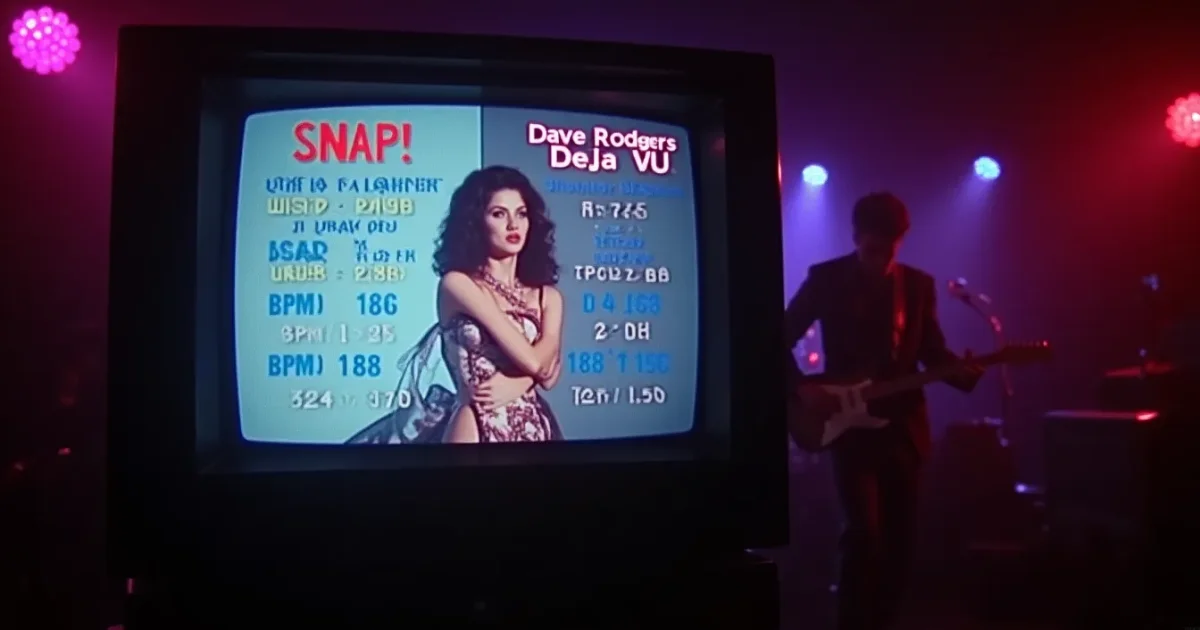
Three main differences
1. Tempo. Eurodance is usually 125-140 BPM. Eurobeat is 150-170 BPM. That is the difference between dancing and running. Even an untrained listener notices that Eurobeat demands greater physical speed.
2. Vocals. Eurodance often has two voices: a melodic female chorus and a male rap verse. Eurobeat vocals are mostly melodic, without rap, with a bright Italian accent. Male and female vocalists sing with equal emotion, without role division.
3. Market. Eurodance was an international radio hit in Europe and the USA. Eurobeat was especially popular in Japan, where a whole parapara subculture with choreography to Eurobeat tracks developed. In Europe Eurobeat remained niche, although it had loyal fans.
There is a fourth, less obvious difference: attitude to song form. Eurodance is built as a song with a beginning, climax and end. Eurobeat more often sounds like an energy cycle where the main thing is to maintain tempo and mood.
Geography and producer culture
Eurodance is more associated with Germany and the Netherlands: labels like Logic Records, Blow Up and Dance Pool released Snap!, Culture Beat and 2 Unlimited. Producers there grew up on Italo Disco and hi-NRG but wanted to make a more pop product. They took the Italian formula and gave it a radio format.
Eurobeat stayed closer to Italy. Labels A-Beat-C, Time Records and Delta continued the Italian tradition of studio projects: one composer records under many aliases, vocalists change and the style remains stable. This very closedness made Eurobeat less visible in the mainstream but more coherent as a genre.
It is important to understand that geographic associations are not hard rules. Italian producers made Eurodance, Germans made Eurobeat. But the general trend is this: Eurodance looked to Western European radio, Eurobeat to the Japanese and Italian markets.
Why the terms are confused
Confusion comes from the shared root and overlapping artists. Many Italian producers recorded Italo Disco, Eurobeat and Eurodance. For example, Giancarlo Pasquini of Aleph later worked in Eurobeat. Udo Niebergall and other German producers moved between hi-NRG and Eurodance.
Moreover, in the 1990s the terms were used loosely. In Japan "eurobeat" often meant all fast European dance music. In Europe "eurodance" was sometimes applied to any synthetic pop track. Only over the years did the boundaries become clearer, especially thanks to internet communities that began to distinguish genres by BPM and vocals.
Today confusion remains in streaming playlists and retro compilations, where tracks of different genres are mixed under one cover. Therefore it is useful to know the basic criteria for distinction rather than relying on marketing names.
How to listen and tell them apart
Simple test: if a song has a rap verse and a tempo around 130 BPM, it is probably Eurodance. If the tempo goes above 150 BPM, the vocal has an Italian accent and there is no rap, it is Eurobeat.
For practice take Snap! "Rhythm Is a Dancer" and Dave Rodgers "Deja Vu." The first is classic Eurodance: moderate tempo, melodic vocal, rap. The second is Eurobeat: high speed, athletic energy, Italian vocal.
Another way is to listen to the bass. In Eurodance the bass often plays a melodic role and works together with keyboards. In Eurobeat the bass is more assertive and repetitive, providing impulse for the high tempo.
Legacy: where did the genres go?
By the late 1990s interest in Eurodance in Europe fell, giving way to europop, teen pop and trance. Eurobeat declined in Europe but survived in Japan thanks to parapara and Super Eurobeat series. In the 2000s Eurobeat got a second life through the anime Initial D, where songs like "Running in the 90s" became internet memes.
Today both genres live in retro playlists and at nostalgic parties. For the Italo Disco lover they matter as direct continuators: Eurodance kept pop sensibility, Eurobeat kept speed and Italian identity.
Understanding the difference between Eurodance and Eurobeat helps navigate the Italo Disco legacy better. One genre showed where the Italian formula could go in mass radio, the other where it went in a niche but loyal audience. Both remain alive not as museums but as parts of modern retro culture.
If you are building a playlist and want to separate the genres, use a simple rule: Eurodance for dancing in company, Eurobeat for fast movement alone. Italo Disco stands between them as the source from which both directions grew.