
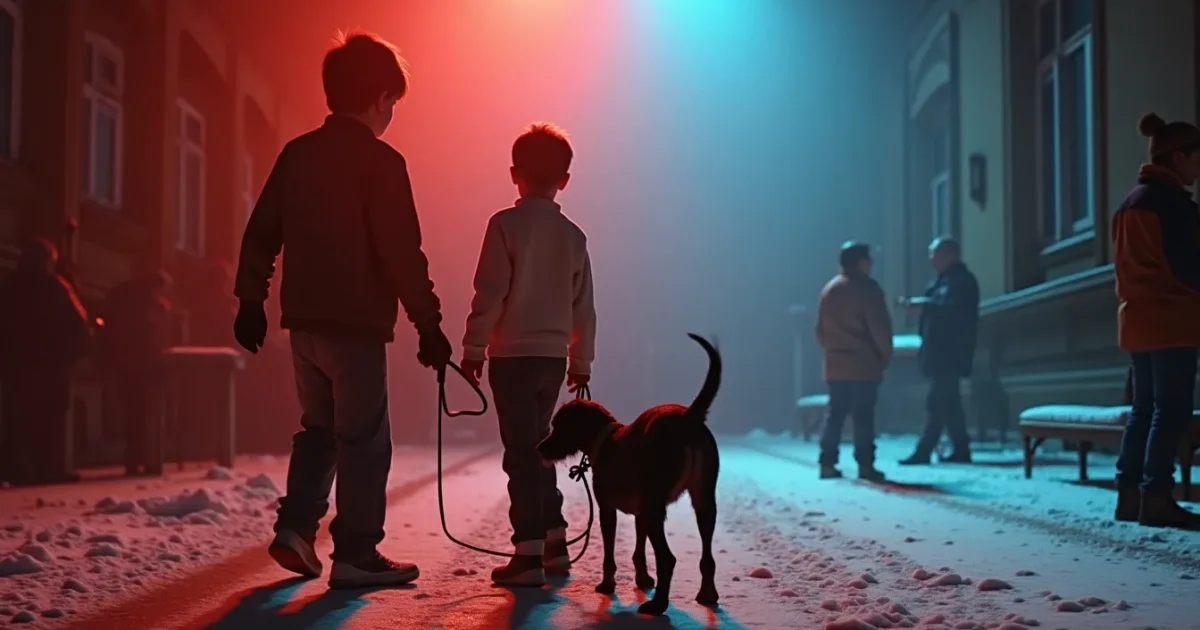
End of 1987. Oleg Gazmanov, a composer from Kaliningrad whose voice had suddenly disappeared, records "Lyusi" together with his six-year-old son Rodion. The author of both music and lyrics is the same person: Oleg Gazmanov. This needs to be fixed at once: in karaoke and on streaming services "Lyusi" is often credited to "Rodion Gazmanov" as the performer, but the song was written by the father, and they performed it together - as a duet of Oleg and Rodion Gazmanov. By the end of the following year the song would become a laureate of "Pesnya-88" and outpace the adult estrada in popular rotation.
Who wrote "Lyusi" - and who performs it
"Lyusi" is one of those rare cases where authorship needs no untangling: Oleg Gazmanov wrote both the music and the lyrics. The song was performed by father and son together, and it was precisely Rodion's childish delivery that made the song recognisable from the first seconds. Without a child's voice, "Lyusi" would have been just another entry in the adult estrada of 1987; with it, the song became a separate phenomenon that was remembered even by people who did not follow hit parades.
The song reached the final of "Pesnya-88" - the seventeenth television festival of estrada song in the "Song of the Year" series. In the festival's reference books it is listed as "Lyusi" (Oleg Gazmanov - Oleg Gazmanov, performers Oleg and Rodion Gazmanov). This means that in the "composer" field and in the "lyricist" field stands the same surname - an uncommon case for Soviet estrada of the late 1980s, but characteristic of Gazmanov: he would go on to write most of his hits himself, from music to text.
- Music and lyrics: Oleg Gazmanov
- Performers: Oleg and Rodion Gazmanov
- Recording: end of 1987
- TV premiere: "Utrennyaya Pochta" (the episode was hosted by Alla Pugacheva)
- Festival: laureate of "Pesnya-88"
Rodion Gazmanov in 1987: six years old and "Utrennyaya Pochta"
Rodion Olegovich Gazmanov was born on July 3, 1981 in Kaliningrad. By the time "Lyusi" was recorded he was six. In 1985 he had already joined the children's municipal ensemble "Payushchiye Goroshiny" ("Singing Peas") in Kaliningrad - the first song he sang on stage was "Yamaika" ("Jamaica"). That was not simply "a song for children": "Yamaika" is the same song that Oleg Gazmanov himself would later perform and that would enter the repertoire of the group "Eskadron." At five, Rodion started music school as a pianist. At six, the family moved from Kaliningrad to Moscow - and it was in Moscow, at the end of 1987, that his father brought him to record "Lyusi."
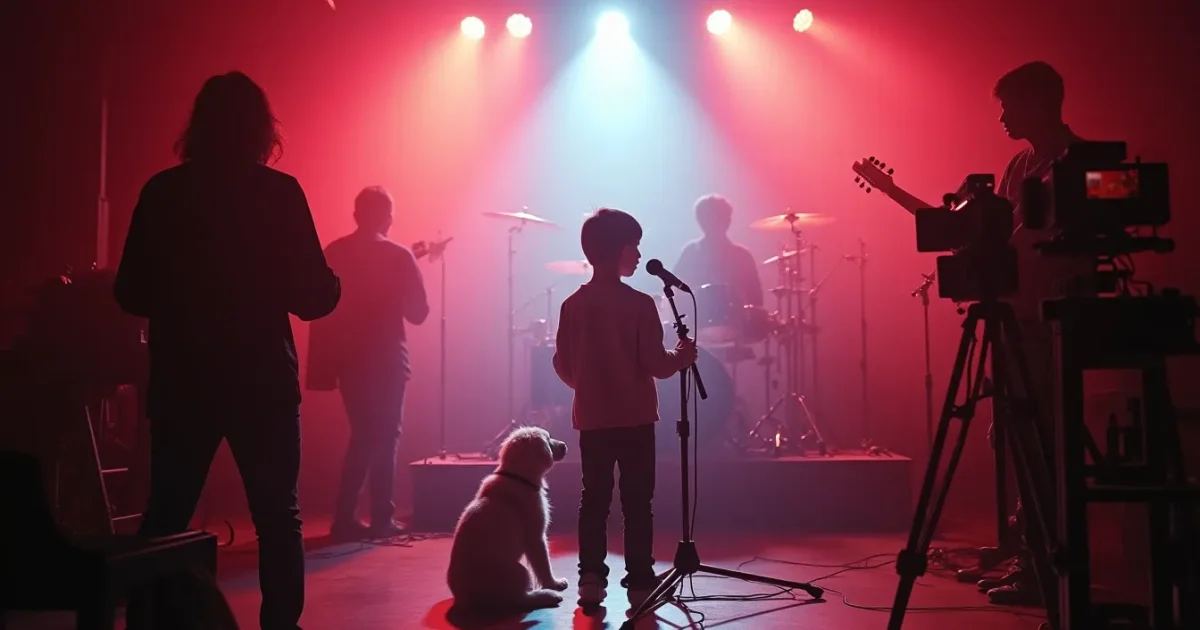
It was at this moment that Oleg Gazmanov lost his voice - a circumstance he would describe more than once in interviews. The bet on his son was not a whim but a forced move: the adult vocal was unavailable, the child's worked. At the end of 1987 Gazmanov managed to get the music video for "Lyusi" onto the playlist of the TV programme "Utrennyaya Pochta" ("Morning Mail"). One of the episodes was hosted by Alla Pugacheva, and it was she who put the clip on air.
The clip, the dog Corbi, and why it stuck
A black riesenschnauzer named Corbi
The "Lyusi" video featured a black riesenschnauzer named Corbi - the Gazmanovs' dog. Not a prop but a family pet, and its presence is what made the clip visually distinct from dozens of other estrada videos that year. A song about a yard dog, sung by a child, with a real dog from the performer's family in the frame: for a Soviet viewer in 1987 that was enough to make the clip memorable and to send it around on VHS cassettes.
Detail: in 1987 "Utrennyaya Pochta" was virtually the only regular programme where a children's clip could land in prime time - "Song of the Year" accepted such numbers, but once a year, while "Utrennyaya Pochta" rotated them for weeks.
"Lyusi" also has an English-language version: at one of Rodion Gazmanov's concerts it was performed together with him by Ralph Makenbach, an artist known for Russian-German projects. That means a song written in Moscow at the end of 1987 lived on into international duet versions - not because Gazmanov senior's text translates easily (it does not, not without losses), but because the melody is recognisable without the words.
Oleg Gazmanov before "Lyusi": a teacher from Kaliningrad
Oleg Mikhailovich Gazmanov was born on July 22, 1951 in Kaliningrad. Before becoming a composer and singer, he worked as an instructor at KVIMU - the Kaliningrad Military Engineering School. By 1983 he had moved to Moscow, and by that time he was already the author of music and lyrics for several songs that he had offered to well-known performers. "Lyusi" was his first real breakthrough - not as a performer, but as a composer whose song the whole country remembered. Before it, Gazmanov remained a "composer without a hit": the songs were there, the rotation was not.
In 1989 Gazmanov created the group, the song and the clip "Eskadron." A detail relevant to our subject: the first keyboard player of "Eskadron" was Galina Romanova, a singer who later became a member of the group "Kombinaciya". So "Lyusi" and "Modnitsa" are linked not only by the era but by a specific musician who moved from one project to the other. Without "Lyusi," "Eskadron" would hardly have received the same starting credit of trust: in 1989 Gazmanov arrived already as the author of an all-Union hit, not as an unknown teacher from Kaliningrad.
In 1991 Gazmanov's debut solo album "Eskadron" came out, with songs in a euro-disco style: "Putana," "Eskadron," "Esaul," "Moryachka" (a laureate of "Pesnya-91"). "Lyusi" was on this album - no longer as a children's number but as part of an adult catalogue. In 2001 Oleg Gazmanov was awarded the title of People's Artist of the Russian Federation. "Lyusi" stayed in his concert repertoire for decades - it was covered in a duet with his son and on the album "Pervy raund - 50 let" ("First Round - 50 Years") (2001), where the track "Lyusi" is credited as a joint O. Gazmanov and R. Gazmanov recording.
After: "Eskadron" and Rodion's adult career
After "Lyusi," Rodion Gazmanov did not become a professional child actor. At thirteen his voice began to break, and singing had to stop. He attended music school, which he dropped out of a year before graduation, then spent two years at the English college Buckswood Grange International School. From eighteen he worked as a bartender - his father stopped financing him - and later rose to manager at a nightclub.
In 2003 Rodion graduated from the Finance Academy under the Government of the Russian Federation with honours and the same year formed his own music group, "DNK." On May 28, 2013 he released his first solo album, "Protivofazy" ("Antiphases") - thirteen songs. In 2015 he passed the blind audition in the fourth season of the TV project "Golos" ("The Voice") on Channel One and joined the team of Grigory Leps. Rodion's adult musical career is no longer "Lyusi": a different repertoire, a different audience, a different sound. But "Lyusi" stayed in his discography across three releases: the 1989 single, the 1991 album "Eskadron," and the 2001 compilation "Pervy raund - 50 let," where the track is credited to both O. Gazmanov and R. Gazmanov.

What you hear in "Lyusi" and why the song holds
Harmonically, "Lyusi" is a simple major-key song with a short verse and a repeating chorus that is easy to memorise after one listen. The tempo is moderate, the melody moves in thirds, the range is narrow - convenient for a child's voice and for any adult who wants to cover it. That is why "Lyusi" is still in karaoke catalogues and in children's music schools: it can be learned in one sitting. The 1987 arrangement is modest: keyboard pads, a simple kick, a minimum of brass. That is its strength - and its weakness, if the task is to cover the song "interestingly": there is huge room for a new arrangement, but it is hard to break from the original, because recognisability rests precisely on the child's voice and on the chorus melody.
Gazmanov senior's text is built on a single image - a yard dog you feel sorry for. No complex metaphoric, no ideological moves: a child sings about a dog, and that is enough. By the same logic by which "Yagoda-Malina" in the breakdown of Plyatskovsky and Dobrynin rests on the simple image of a berry, "Lyusi" rests on the image of a dog. Both songs are from the same year, 1987, both built on the same construction: image plus feeling, without overloads. And both reached "Song of the Year" in consecutive editions: "Yagoda-Malina" in the 1987 final, "Lyusi" as a 1988 laureate. Soviet estrada of the late 1980s worked with simple images better than with ideological constructions.
The Disco Magic catalogue includes a version of "Lyusi", and it works by the same logic as our other covers of Soviet songs in the italo-disco style: the original melody is preserved, the arrangement is updated. This is possible precisely because the harmony of "Lyusi" is simple and stable - it can be moved into any tempo and any rhythm section without losing recognisability. The same effect holds for the entire generation of Soviet synth-pop and Russian synth-pop of the late 1980s: simple material outlived the change of formats and styles.
"Lyusi" today
"Lyusi" is still rotated on retro concerts, and Rodion Gazmanov, now an adult, performs it periodically - including in a duet with his father. The song remains in Oleg Gazmanov's catalogue as the first with which his all-Union fame began: before "Eskadron," before "Putana," before "Esaul." Recorded at the end of 1987, with a six-year-old son at the microphone and the family dog Corbi in the clip, it made it onto "Utrennyaya Pochta" because Alla Pugacheva decided to put it in her episode - and that was enough for "Lyusi" to become a laureate of "Pesnya-88."