
When German Virgin Records released the single “(I'll Never Be) Maria Magdalena” by Sandra Lauer in December 1984, nobody suspected it would become the starting point for the loudest German synth-pop project of the decade's second half. By April 1985, the single held number one in Germany, Switzerland, the Netherlands, Austria and Greece. In the US it didn't crack the top ten - but in New York clubs it played as often as “Self Control” or “You're My Heart, You're My Soul”.
How the track became the track
“Maria Magdalena” is a song with a second life. Its original version, titled “Maria Magdalena 23rd Street”, had already been recorded in 1983 for the group Arabesque, where Sandra was one of three vocalists. That take was never released - producer Michael Cretu, working with Arabesque at the time, kept the demo for future use.
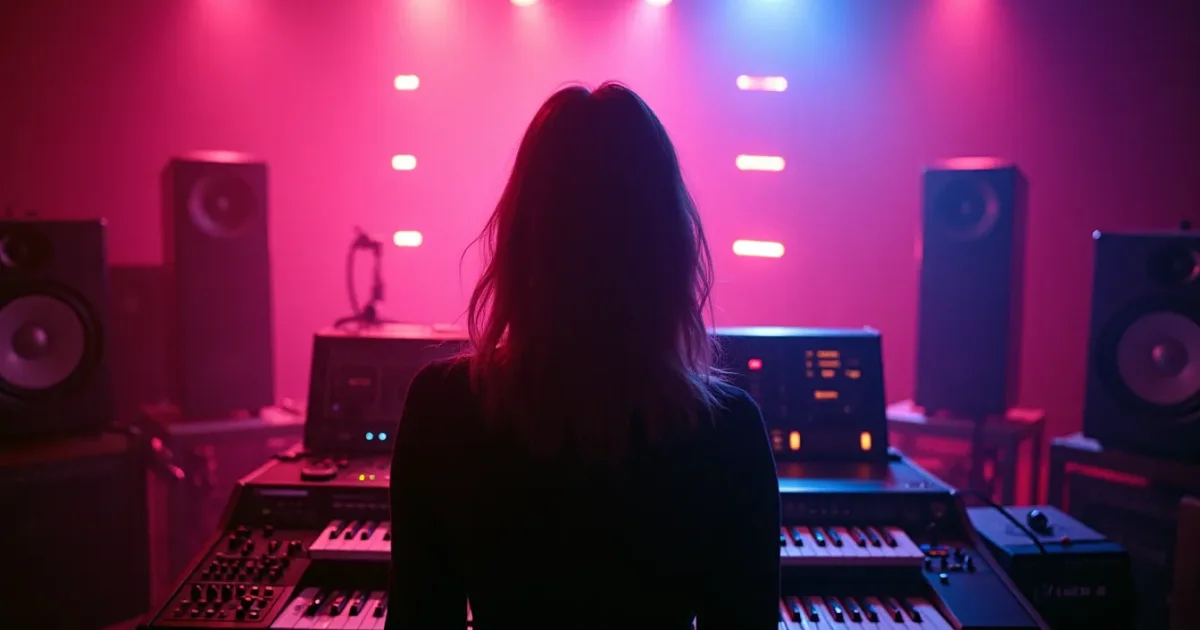
By 1984 Arabesque had broken up after nine albums. Cretu and Sandra had started dating, eventually marrying in 1988. When Cretu rebuilt “Maria Magdalena” from scratch for Sandra solo, he threw out the old arrangement and wrote new synthesizer parts - lead on Roland Jupiter-8, choirs on Yamaha DX7, drums on LinnDrum. Recording took place at Cretu's own studio Data Alpha, near Munich.
What makes it special
Structurally, “Maria Magdalena” is almost the textbook italo-disco form: eight-bar intro, verse-chorus, sixteen-bar bridge, final chorus with modulation. But Cretu departs from the Italian formula in one fundamental place. In classic italo-disco, the chorus sits in the relative major of the minor verse. In Cretu's song, the verse is in A minor and the chorus is in C Mixolydian - built around the VII degree. This makes the hook feel strangely unresolved - the ear waits for a return to A minor and only gets it at the intro of the next verse.
“I wanted the chorus to sound like an unanswered question. A chorus that sounds like an answer satisfies the listener - and the listener forgets the song in a week. An unresolved chorus keeps spinning in the head on its own”, Cretu told Musikexpress in 2001.
Vocally, this was Sandra's first solo work without Arabesque's supporting harmonies. Cretu made her record 23 takes of the phrase “I'll never be your Maria Magdalena”, choosing not the cleanest take but the most tense one - with a slightly catching breath before each chorus.
The numbers speak for themselves
In Germany, the record held number one for seven weeks from March to April 1985. Total European sales - about 2.5 million copies by year's end. For comparison, “You're My Heart, You're My Soul” by Modern Talking, released in the same months, moved around 1.8 million.
- Germany: #1, 7 weeks, 7× platinum
- Switzerland: #1, 5 weeks
- Netherlands: #1, 4 weeks
- Austria: #1, 6 weeks
- France: #3 - in a country where German pop usually doesn't make the cut
- US: #19 Dance Club Play
The vinyl 12-inch maxi-single with extended version was sold separately - the 7-minute extended mix with stretched bridge became the standard of club DJ sets through 1985-1986. DJs spun it longer than “I Feel Love”, which in 1985 was a serious metric.
Cretu and Enigma
The success of “Maria Magdalena” let Cretu close his Data Alpha studio in 1988 and open A.R.T. Studios in Ibiza instead - financed by Sandra earnings. Two years later, in that studio, he recorded “MCMXC a.D.” (1990) - the first album of Enigma. Sandra's voice on “Sadeness (Part I)” is the same voice as on “Maria Magdalena”, just processed more heavily.
Played back-to-back, “Maria Magdalena” and “Sadeness” reveal a continuity of vocal delivery: the same half-whispered, half-sung phrasing, the same long held notes in the chorus. Cretu simply swapped the 1985 synth-pop arsenal for ambient samples of Gregorian chant.
Why the track is still alive
“Maria Magdalena” doesn't age for two reasons. First - the clean arrangement: no “dated” guitar parts, no signature 80s drums up front. Everything is built on synthesizers that sound the same in 1985 and in 2024. Second - the unresolved harmony of the chorus. As long as the listener searches for the tonic, the track gets replayed. That works the same for a 1985 teenager and a 2024 TikTok user.
In 2022 the track entered the HBO soundtrack of Euphoria (season 2, episode 5) - an unprecedented placement for 1985 German synth-pop. For deeper looks at other hits of the same period, see the breakdowns of “Self Control” and “Dolce Vita” by Ryan Paris.
What remains
“Maria Magdalena” is one of the rare cases where a solo debut outgrows its author. Sandra released more than twenty singles after this track, but none reached its heights. Cretu built the Enigma career and A.R.T. Studios on this hit. Virgin Germany used the revenue to promote another ten German pop artists. And all of it is the consequence of one single, recorded in three weeks at a studio near Munich. For 1985, that wasn't the worst investment the German record industry ever made.