
In July 1977, when “I Feel Love” shipped as a single from the album I Remember Yesterday, British magazine Melody Maker published a one-sentence review: “This is the dance music of the new decade”. At that moment the record hadn't yet hit the charts. A month later it was at number one on the UK Singles Chart, where it stayed for four weeks. In the US it reached number six on the Billboard Hot 100 - and for the first time, a fully electronic disco track sat at the top on both sides of the Atlantic.
A studio in Munich
“I Feel Love” was recorded at Musicland Studios - a basement facility underneath the Arabella-Hochhaus hotel in Munich. From 1969 onwards, Musicland was leased by Giorgio Moroder and his production partner Pete Bellotte. At the same time, Deep Purple were tracking Burn (1974), Led Zeppelin recorded parts of Presence (1976), and Queen worked out of the same rooms - but it was the Moroder-Bellotte-Summer axis that turned Musicland into the epicentre of European disco.
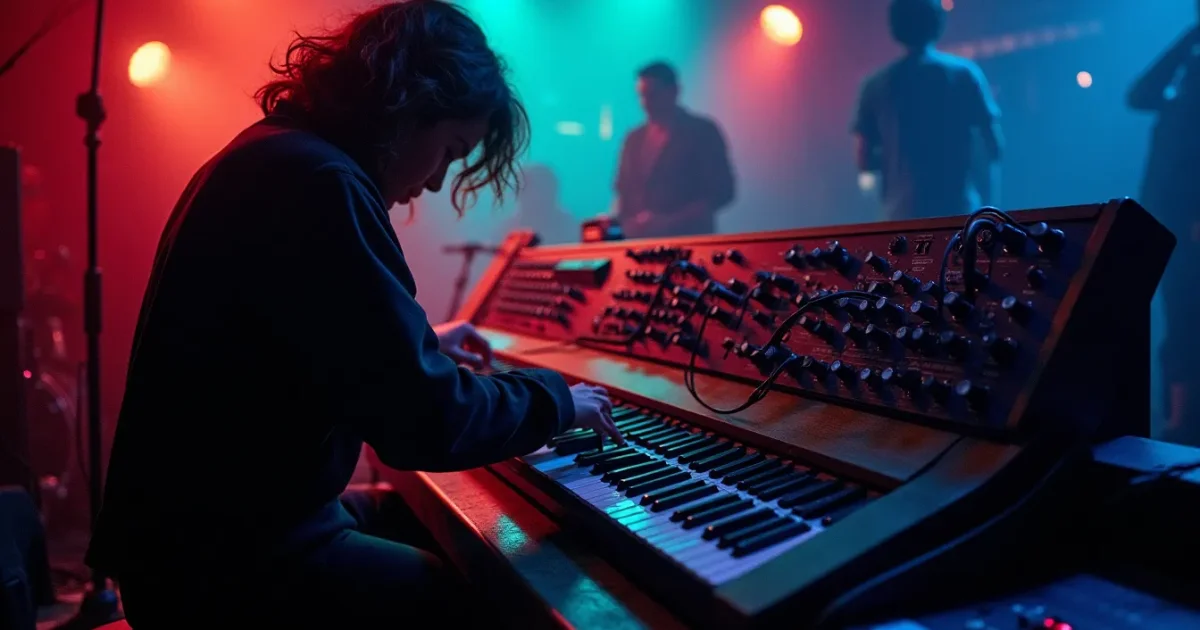
The engineering chair went to Reinhold Mack (the in-house engineer, the same man who ran Queen's The Game sessions) and specialist guest Robby Wedel, brought in specifically for modular electronics. Wedel hauled his own Moog Modular System 55 - a wardrobe-sized cabinet that filled most of the control room. This wasn't “a studio with a synthesizer” - it was a studio built around one specific instrument.
How they did it
Technically, “I Feel Love” is almost pure experiment. Live instruments in the track are reduced to the minimum: no bass guitar, no keys, no horns. The entire rhythm foundation is a Moog sequencer programming a 16-note bassline per bar. Percussion - synthesized hi-hat and clap from the same Moog, plus one lone track of real handclaps in the bridge.
“We recorded bar by bar. One bar, one bass note - you'd dial it until it sounded right, then move on”, Wedel told Sound on Sound in 2019. The backing track took around 36 hours of recording time.
Donna Summer's vocal was tracked last - Moroder took two passes, holding a single note with varying intensity. The final mix took six days. The total single budget, per Moroder, was around 6,000 Deutschmarks. In 2024 money that's under €12,000.
“I've heard the sound of the future”
In August 1977, Brian Eno heard “I Feel Love” at Berlin's Hansa Studios, where he was working on David Bowie's album “Heroes”. The legend - retold by Bowie himself in a 1995 Mojo interview - goes that Eno burst out of the control room holding the record and said:
“I've just heard the sound of the future. The next fifteen years are going to sound like this”.
Eno only got the timeframe wrong - “this” is still audible today. The bassline of “I Feel Love” is quoted by Madonna (“Ray of Light”, 1998), by Kylie Minogue (“Can't Get You Out of My Head”, 2001), by LCD Soundsystem (“All My Friends”, 2007). Patrick Cowley produced a fifteen-minute remix in 1982 that was reissued as a separate 12-inch and became mandatory in every gay club in San Francisco.
What the actual revolution was
Before “I Feel Love”, disco sounded orchestral - strings, horns, live bass, live percussion. Even the eurodance precursors and the Italian disco of the late 70s kept a live rhythm section as their foundation. Moroder made the opposite move: electronics took over absolutely everything except the voice. And it turned out this didn't impoverish the sound - it opened a new acoustic space.
That approach became the foundation of italo-disco. Mauro Farina in 1983-1984 quoted Moog's sequenced bass almost verbatim in his early work - Silver Pozzoli, Carrara, Valerie Dore. The entire Hi-NRG genre grew out of the “I Feel Love” formula. And the whole EDM line from Daft Punk to Calvin Harris runs technically on the same principle: live vocal over electronic bedding.
Why the track still sounds new
Unlike most 1977 disco hits, “I Feel Love” is not date-stamped: no characteristic strings, no wah-wah guitar, no Philadelphia-soul four-on-the-floor kick circa 1975. There's only a sequenced bass and a voice. Those two elements have no age. When Blondie sampled Moroder's bassline in 2008 on a remix of “One Way or Another”, it sounded current - because the source had no 1977 anchor.
In 2011, the Grammy Hall of Fame inducted “I Feel Love” into its archive of historically significant recordings. In 2021, Rolling Stone placed the track at number 132 on its list of the 500 greatest songs of all time. For a track recorded in 36 hours on a budget under €12,000, that's a remarkable result.
What to do with it today
If you're assembling a retro electronic track, try to reconstruct the logic of “I Feel Love” - not the sound, the logic. A 16-note bass sequence per bar, LFO-driven rate on the percussion, a single live element - the voice on top. It's the most honest exercise for understanding how italo-disco and its European relatives are built. A week of experiments like that, and you'll start hearing the genre's structure differently.
In 2015 Moroder released Déjà Vu, and on the title track with Sia he quoted his own 1977 bass. It's the only case in recorded history of a producer reusing his own pattern 38 years later and still sounding fresh. Which leaves one conclusion: the “sound of the future” Eno heard has no shelf life.