In May 1983, at the NAMM show in Chicago, Yamaha Corporation introduced the DX7 - a synthesizer that would sell over 200,000 units in four years and become the best-selling electronic instrument of its era. For perspective: the Roland Jupiter-8 shipped roughly 3,500 units across its entire lifespan; the Oberheim OB-Xa, about 1,500. The DX7 didn't just beat the competition on numbers - it rewrote the logic of how late-80s pop music sounded.
Where FM came from
FM synthesis - frequency modulation synthesis - was invented in 1967 by John Chowning, a professor at Stanford University. The idea: one sound wave can modulate the frequency of another, and from two sine waves you get a complex spectrum with rich overtones. In 1967, this was purely academic - no electronic instrument of the era had the digital precision to implement it.
Stanford filed the patent in 1973 and received it in 1975. In 1974, Yamaha bought exclusive rights - over 23 years, this patent would earn the university around $23 million, making it Stanford's most profitable licence ever. Yamaha's first commercial FM synths, the GS-1 and GS-2 (1981), cost $16,000 each and remained rare studio instruments. The DX7 did the same thing for $1,995.
Inside - six operators
The DX7 has six identical “operators” - each containing an oscillator and an envelope. These operators could be connected in 32 different topologies, which Yamaha called algorithms. In some, operators modulate each other (carrier/modulator pairs); in others, they work in parallel. This variety is precisely what made FM so expressive: from six simple sine waves, you could build an electric piano, a bell, brass instruments, and a bass that didn't sound like a Moog bass.
“Programming the DX7 is like playing chess blindfolded. You can't hear what you're doing until you're finished”, wrote Roger Powell, Todd Rundgren's keyboardist, in Keyboard magazine in 1984.
The synth had a two-line LCD and membrane buttons - no knobs. Hence the paradox: 200,000 buyers used the same 32 factory presets. Especially E.PIANO 1 - the crystalline electric piano heard on every other pop ballad of 1984-1989.
Where you hear it
Listing tracks with a DX7 on them is basically listing half the late-80s charts. But the landmarks are worth knowing by heart:
- Whitney Houston - “Greatest Love of All” (1985). The entire piano part is the E.PIANO 1 preset.
- a-ha - “Take On Me” (1985). That lead hook - CALLIOPE preset on a DX7 layered with a Roland Juno-60.
- Phil Collins - “One More Night” (1985). Electric piano on a DX7.
- Berlin - “Take My Breath Away” (1986). Producer Giorgio Moroder built the entire backing on a DX7 plus Lexicon 224.
- Spagna - “Call Me” (1987). An italo-disco hit whose lead synth is a DX7 with the BASS 1 preset.
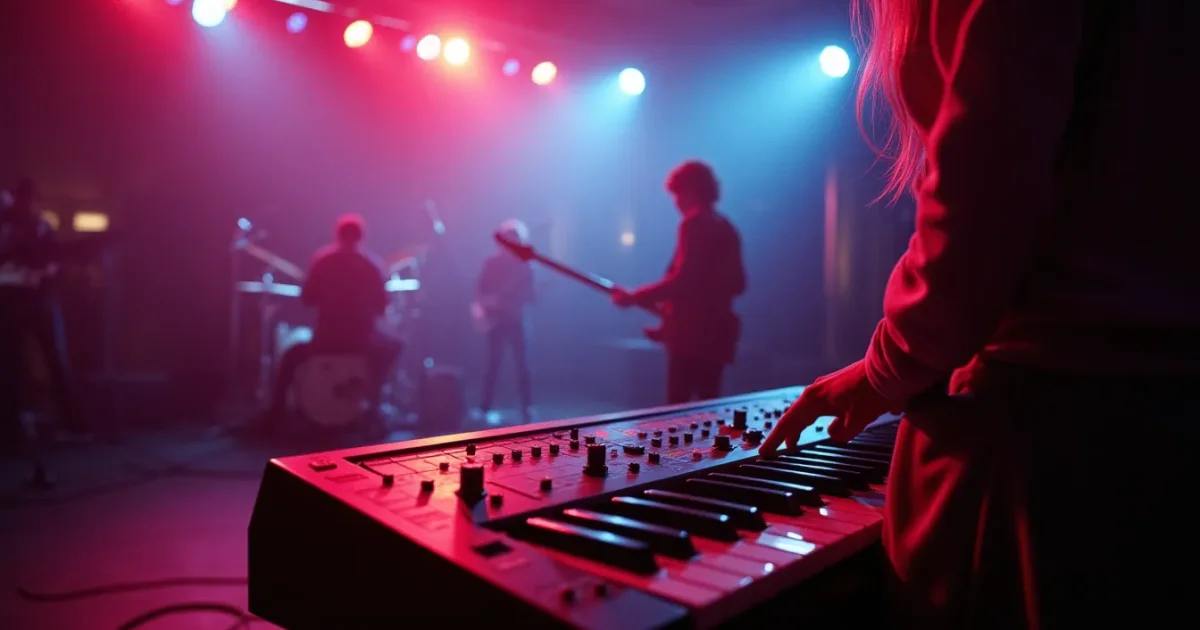
The DX7 arrived in italo-disco slightly later than the Jupiter-8 - around 1986, when the second-hand price dropped to $1,200. From that point on, you hear it in every other release from Baby Records, Il Discotto Productions and Memory Records.
Why FM and analog sound different
Analog synthesis is subtractive: start with a complex sound (a saw or square full of overtones) and filter out what you don't want. FM works the other way: start with a pure sine and modulate it into a complex spectrum. Hence the characteristic “glassy” tone you never get from a Moog or a Jupiter.
Analog has its own life: floating tuning, warm distortion, soft resonant peaks. FM delivers mathematical precision - accurate to the last overtone, but without breathing. That contrast is exactly what creates the mid-80s sound: Jupiter-8 for pads and bass, DX7 for bells and choir, Fairlight CMI for samples.
Legacy and modern emulations
The DX7 stayed in production until 1989, with the DX7II-FD (disk drive version) and DX7II-D as updates. In the 1990s, FM synthesis left the mainstream - only to return in the 2000s as a plugin, and as the sound of a nostalgia era. The 2010s and 2020s brought DX7 tones back to the surface, from The Weeknd to Dua Lipa.
Several good emulations exist today. Native Instruments FM8 is the fullest clone, released back in 2006. Dexed is a free emulation with an accurate model of the original algorithms - it even accepts SysEx patch banks from hardware DX7s. Arturia DX7 V (2019) adds modern effects and modulation on top of the classical FM engine. More on the harmonic language of the genre and on how a hit is built can be found in their own write-ups.
Why it still works
The DX7 is the 20th-century synth with the highest recognition factor of any electronic instrument. If you need a listener to instantly feel “1986”, switch on the E.PIANO 1 preset - done. Analogs give you character; FM gives you a chronological ID tag. Without the DX7, the italo-disco of the late 80s wouldn't sound the way we remember it - not Savage's choir, not Fancy's bells, not Spagna's bass.
The eight-bit path, disks and price are covered in the Ensoniq Mirage DSK-8 profile.
Two DCOs, aftertouch and the PG-800 are covered in the Roland JX-8P profile.