Late 1979, Sydney. Twenty-three-year-old Kim Ryrie and twenty-one-year-old Peter Vogel ship something that hadn't existed before: the Fairlight CMI, the first commercial digital sampler. Price - AU$25,000, roughly US$30,000, or about US$130,000 in 2024 money. Inside: a Motorola 6800 processor, 208 KB of RAM, two CRT monitors, a musical keyboard and a glowing light pen in place of a mouse. Outside: a hand-built wooden case of Australian pine. Over the next six years this machine would upend record production more profoundly than the entire previous decade of synthesizers.
How two Sydney students built a machine nobody had seen
Ryrie and Vogel met in 1975 in the electrical engineering program at Sydney University. The idea of “a computer that plays any sound” came from reading about Harold Bode's Computer Music Melodian, a laboratory synthesizer, plus a conviction that “the same thing could be made portable.” Three years went into writing an operating system from scratch in 6800 assembler. By 1979 they had a prototype that fit in a single case and was controlled by a light pen.
A quick detail: CMI stands for Computer Musical Instrument, and it was the first commercial GUI on a musical device - five years before the Macintosh.
Series I specs (1979-1982)
- Sampling: 8-bit, 24 kHz (rate adjustable from 2 to 30 kHz)
- Polyphony: 8 voices
- Memory: 208 KB RAM, storage on two 8-inch floppies
- Interface: two CRT monitors (300 and 320 lines), light pen, velocity-sensitive keyboard
- Processor: dual Motorola 6800 at 1 MHz
- Price: AU$25,000 base, AU$30,000 fully loaded
For comparison: a Roland Jupiter-8 in 1981 cost US$5,300, a Prophet-5 US$4,000. Fairlight was a machine for flagship studios, not home studios. Ryrie and Vogel sold 11 units in the first two years - nearly all to the UK and US.
Kate Bush, “Never for Ever”, 1980
The first major artist to buy a Fairlight was Kate Bush. Her brother Paddy heard a demo in London at Peter Gabriel's home in early 1980 and talked Kate into investing - AU$45,000 delivered with onsite training. Never for Ever (September 1980) became the first platinum album where Fairlight plays a leading role.
You can hear it immediately: the “Army Dreamers” intro is a looped sample of a military march that Bush recorded into the Fairlight herself. Breaking glass in “Babooshka”, the birdsong in “Delius”, the choir in “Breathing” - all Fairlight. Before Kate Bush, no one had used a sampler as the primary sound source on a commercial album.
“Fairlight changed everything. Before it, we hunted rare sounds on records, hired orchestras, recorded choirs. After - you could take any sound in the world, hold it in memory, and play it on the keyboard as if it were a synth preset”, - Kate Bush to Electronics & Music Maker, 1982.
Peter Gabriel, “Security”, 1982
Peter Gabriel bought a Fairlight in spring 1980 - one of the first units in Europe, serial number 7. On Peter Gabriel (1982, known as Security) he first demonstrated that a sampler could replace a full drum kit. The drum parts of “Shock the Monkey” and “I Have the Touch” are assembled from samples of real percussion - African drums, metal keys striking metal, vocal yelps - looped on Page R, the pattern sequencer built into Fairlight Series II.
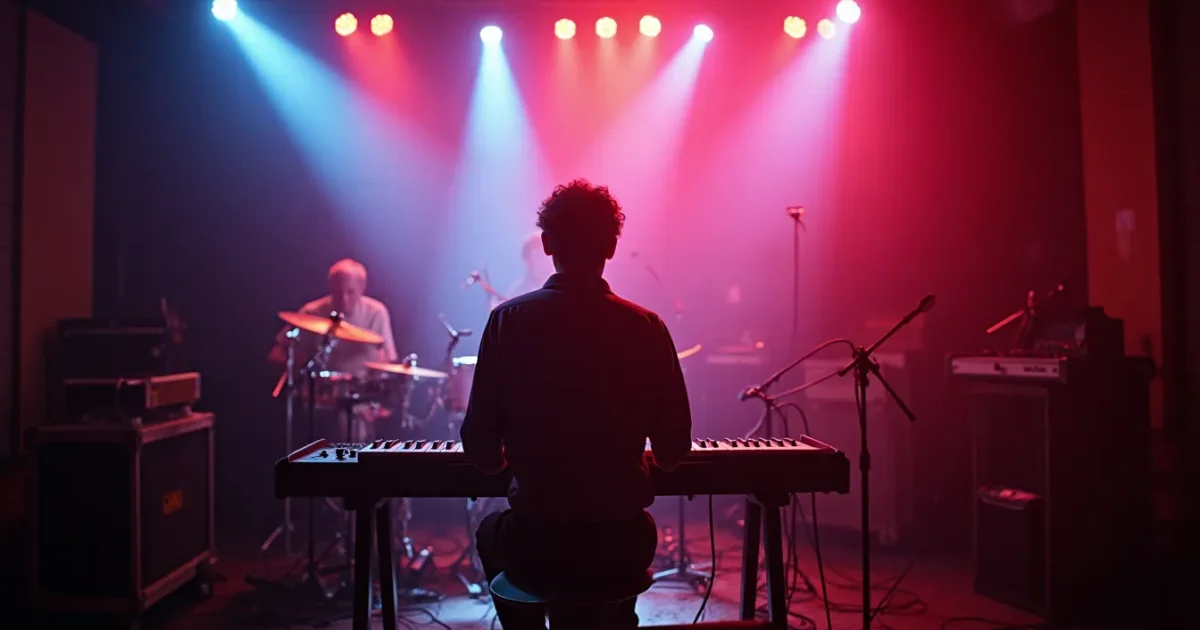
Gabriel is exactly the person who prompted Kate Bush to buy in, and later inspired Phil Collins and his own hit “Sledgehammer” (1986), where a 16-bit Fairlight Series III carries the entire percussion layer.
ORCH5 and Trevor Horn
In the factory sample library of Fairlight Series II there was preset ORCH5 - a four-second sample of a full symphony orchestra playing a single fortissimo note. The source was the finale of Stravinsky's “Rite of Spring” in Muti's 1978 recording with the Philadelphia Orchestra, digitised and trimmed to two seconds.
Trevor Horn used ORCH5 while producing Yes - “Owner of a Lonely Heart” (November 1983). That orchestral hit before the second verse is ORCH5. The single went #1 Billboard Hot 100 in January 1984, and from that moment ORCH5 started appearing everywhere: on Art of Noise, in late-80s hip-hop (“Planet Rock” by Afrika Bambaataa had used a similar sample already in 1982, but ORCH5 became the codename for “that orchestral hit”).
“I heard ORCH5 in at least a hundred late-80s records. It became part of the sonic language of the era, like the Roland TR-808 or the Juno-60”, - Trevor Horn in the documentary Modulations (1998).
Series III (1985) - 16 bits at US$75,000
In March 1985 Fairlight shipped Series III with 16-bit sampling at 44.1 kHz - the same quality as the Compact Disc, launched three years earlier by Sony and Philips. Polyphony grew to 16 voices, memory to 14 MB, storage to a 20 MB external hard drive. Price - US$75,000 (about US$220,000 in 2024).
Series III was bought by the major studios of the period: Trevor Horn's Battery Studios, Peter Gabriel's Real World, Electric Ladyland in New York, Sarm West in London. Series III recorded the first Art of Noise albums, Frankie Goes to Hollywood's “Welcome to the Pleasuredome”, much of Herbie Hancock's post-“Rockit” work. The same machine is audible on “Relax” by Frankie Goes to Hollywood and most ZTT releases from the second half of the 80s.
Why Fairlight lost to Akai
In 1986 the Japanese firm Akai shipped the S900 - a 12-bit sampler with 750 KB of memory, up to 40 kHz, at a price of US$2,495. For the same function that Fairlight charged $75,000, Akai charged $2,500. In three years the whole market shifted: by 1989 Fairlight had sold roughly 300 Series III units worldwide.
The company tried to push back: Series III Plus in 1987, CMI-2000 in 1988. But professional studios were already moving to the Akai S1000 (1988) and, later, Kurzweil K2000 (1991). Fairlight Instruments went bankrupt in 1988. Ryrie and Vogel pivoted into video production and distance learning.
What Fairlight did to the sound of the 80s
- Replaced live orchestral recordings with samples - studio budgets dropped tenfold
- Turned percussion from “recording live drummers” into “composing with sounds”
- Taught producers to think of sound as an object that can be transposed and looped
- Gave unlimited repeatability to unique voices and instruments
- Delivered the signature Trevor Horn / Art of Noise / ZTT sound - the blueprint of 1984-1988 synthpop
Collector value in 2024
On eBay in 2024 a working Fairlight CMI Series II with disks and documentation sells for £18,000-25,000 (Series III: £45,000 and up). That is more than any Prophet-5 and more than most Moog IIIc systems. Active collectors include Brian Eno (owns three), Daniel Lanois, Hans Zimmer. Peter Vogel relaunched a project in the 2010s called Peter Vogel Instruments and released an iPad emulator of Fairlight at US$99 with the original sample library and full Page R interface.
Deep dives on neighbouring 80s gear - Roland Jupiter-8, Yamaha DX7, Roland TR-909. Fairlight sits apart: it is the only machine of 1979-1985 that was neither a synthesizer nor a drum machine. It was a computer that could play any sound - including the one you had recorded five minutes earlier from your own voice.
The eight-bit path, disks and price are covered in the Ensoniq Mirage DSK-8 profile.