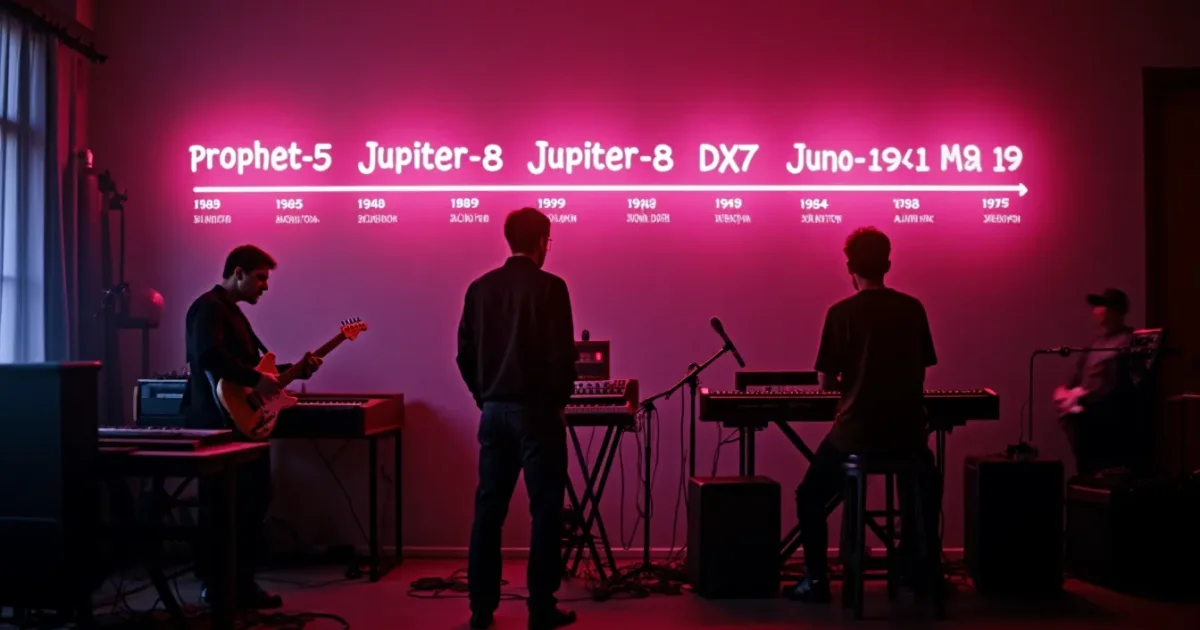
1978. Dave Smith and John Bowen unveil the Sequential Prophet-5 - the first polyphonic synthesizer with programmable memory, $3,950 at launch. Following it, in 1981, the Roland Jupiter-8 at $5,295. In 1983 the Yamaha DX7 - $1,995, FM synthesis, 200,000 units sold. Synthesizers of the 80s are ten years in which the price of a polyphonic instrument dropped threefold while the voice count doubled. A sound map by year and model - not a top-10, but a chronology.
Synths of the 80s: a map by year
The decade divides into three waves. The first - analog polyphonics (1978-1982): Prophet-5, Jupiter-8, Oberheim OB-Xa. The second - the digital revolution (1983-1985): DX7, Roland JX-8P, Korg DW-8000. The third - workstations and samplers (1986-1989): Korg M1, Roland D-50, Ensoniq Mirage. Each wave changed not only the sound but also who could afford a studio instrument.
Wave I: analog polyphonics 1978-1982
The Sequential Prophet-5 (1978) - five voices, programmable memory, $3,950 at launch ($4,595 at the 1981 price list). The first synthesizer where you could save a patch and recall it with one press. Users: Kraftwerk, Michael Jackson, Pink Floyd, Phil Collins. The Roland Jupiter-8 (1981) - eight voices, $5,295, arpeggiator, split keyboard. Duran Duran, the Human League, OMD, Italo Disco studios in Milan. The Oberheim OB-Xa (1980) - $6,195, two oscillators per voice, a "fatter" sound than the Jupiter. Van Halen "Jump," Prince, Styx. More in our deep dive into the Roland Jupiter-8 as an analog anthem.
Wave II: the digital revolution 1983-1985
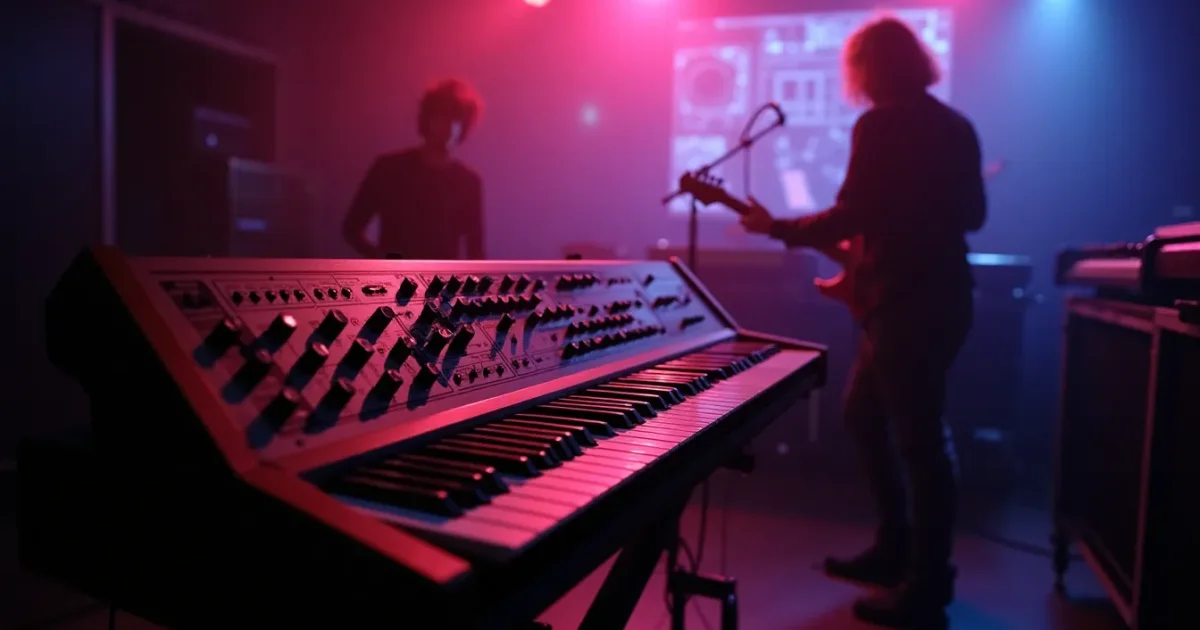
The Yamaha DX7 (1983) - FM synthesis, 16 voices, $1,995. more than 200,000 units sold during production. In 1986 the DX7 appeared in 40% of Billboard Hot 100 #1 singles. Preset E.PIANO 1 - the sound that became the decade's signature. Programming the DX7 was nearly impossible: 6 operators, 32 algorithms, a two-line LCD menu. Most musicians played presets. More in our deep dive into the Yamaha DX7 and the FM revolution.
The Roland JX-8P (1985) - analog but digitally controlled, 6 voices, $1,695. Roland's answer to the DX7: warmer, but without FM's flexibility. The Korg DW-8000 (1985) - a hybrid: 8 voices, PCM waveforms + analog filter, $1,495. Korg tried to deliver "analog warmth" at the DX7's price.
Detail: the Prophet-5 was the first synthesizer with patch memory, but only 40 slots. Musicians saved extra patches to cassette tape via a cassette dump interface - an audio signal that decoded back into a patch.
Wave III: workstations 1986-1989
The Roland D-50 (1987) - LA synthesis: PCM samples + analog processing, $1,895. The "Enya" sound, strings and pads that neither the DX7 nor the Jupiter could produce. The Korg M1 (1988) - the first true workstation: synth + sequencer + effects in one unit, $2,166. 250,000 units sold - more than the DX7 over the same period. Preset Piano 16 appeared on Madonna's "Vogue" and Robin S's "Show Me Love."
The Ensoniq Mirage (1984) - the first affordable sampler, $1,695, 8-bit, floppy disks. The Roland Juno-106 (February 1984) - $1,295, 6 voices, DCO instead of VCO, built-in chorus. The Juno-106 was cheap, reliable and sounded "warmer" than the DX7 - it is still used today. More in our deep dive into the Roland Juno-106 as the best poly-analog.
Prices and polyphony: a table
- Prophet-5 (1978) - 5 voices, $3,950
- Oberheim OB-Xa (1980) - 8 voices, $6,195
- Roland Jupiter-8 (1981) - 8 voices, $5,295
- Roland Juno-106 (1984) - 6 voices, $1,295
- Yamaha DX7 (1983) - 16 voices, $1,995
- Roland JX-8P (1985) - 6 voices, $1,895
- Roland D-50 (1987) - 16 voices, $1,895
- Korg M1 (1988) - 16 voices, $2,166
In ten years the price dropped from $5,295 (Jupiter-8) to $2,166 (Korg M1), while polyphony grew from 5 voices (Prophet-5) to 16 (DX7, D-50, M1). The synths that built Italo Disco mostly came from the first wave: Jupiter-8, Prophet-5, Roland Juno-60.
What remained
The DX7 was discontinued in 1989. The Prophet-5 in 1984. The Jupiter-8 in 1985. But these machines did not disappear: in 2020 Sequential reissued the Prophet-5, in 2021 Roland released a software emulation of the Jupiter-8. And originals on the secondhand market cost more than at launch: Jupiter-8 - $8,000-12,000, Prophet-5 - $6,000-8,000. Instruments that cost $5,000 in 1981 have appreciated 100% in forty years. Not every investment delivered that return.
The eight-bit path, disks and price are covered in the Ensoniq Mirage DSK-8 profile.
Two DCOs, aftertouch and the PG-800 are covered in the Roland JX-8P profile.