July 1981, Leeds → London: British duo Soft Cell releases on Some Bizzare / Phonogram the single “Tainted Love” - a synth-pop cover of a forgotten 1964 soul record. By October 1981 it's #1 in the UK, where it sits for two weeks. By February 1982 - #8 Billboard Hot 100 in the US. In July 1982 it sets a record that would stand until 2001: 43 consecutive weeks in the Billboard Hot 100 - the longest chart run of any single in the history of the US chart.
Where the song came from
The original “Tainted Love” was recorded in 1964 by American singer Gloria Jones (later Marc Bolan's partner in T.Rex). Producer - Ed Cobb, a member of the Four Preps. It was released on Champion Records, sold roughly 500 copies, and was forgotten. Jones re-recorded the track on T.Rex Records in 1976 - also to no effect.
In the late 1970s “Tainted Love” was dug up on the British Northern Soul club circuit - an underground movement in clubs like Wigan Casino and Blackpool Mecca, where DJs spun rare 60s American soul 45s. Jones's original became a staple. One of the DJs of that scene - Richard Searling - gave a copy in 1980 to David Ball, the keyboardist of what would become Soft Cell.
“Dave came home from Wigan Casino, put the record on the deck and said: "Marc, we have to do this one. Imagine it on synthesizers"”, Marc Almond recalled in his autobiography Tainted Life (1999).
How the Soft Cell version was made
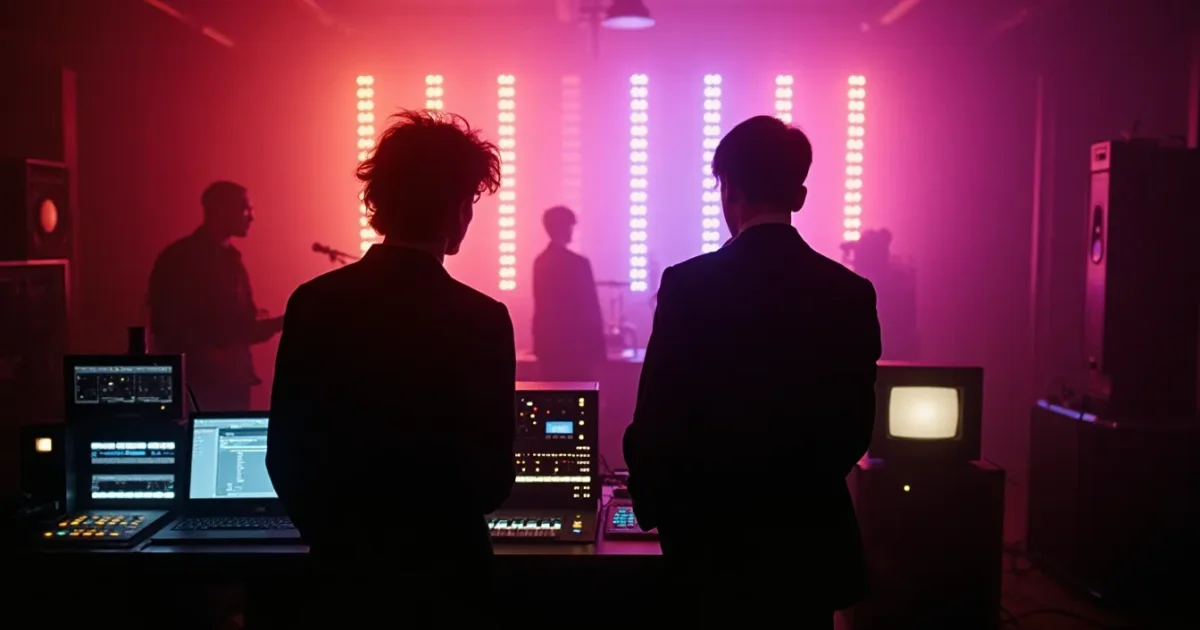
Recording took place in August 1981 at Advision Studios in London (the same room where New Order's “Blue Monday” would be tracked in 1983). The producer was Mike Thorne, previously associated with Sheena Easton and Wire. Budget - under £10,000, one of the most modest for a UK #1 single that year.
The instrumentation is minimal:
- Synclavier II - main synth, bassline and lead (Soft Cell used Advision's house machine - they couldn't afford one; it cost $25,000)
- Roland TR-808 - drum machine (arguably the first use of the 808 on a British UK #1 single)
- Sequential Circuits Pro-One - pads
No live instruments. No guitar. No bass. David Ball played the entire track in two days; Marc Almond recorded the vocal in three hours. Total recording - seven days. Thorne mixed for another four. Total studio time: 11 days.
The hook - “bink-bonk”
The signature “bink-bonk” in the intro (the sound the entire song is recognised by) is two short samples on the Synclavier. Ball discovered them by accident while fiddling with a preset called “Tuned Perc” - a percussion sample tuned to a specific pitch. One sample - F♯4, the other - A4. Both about 0.6 seconds long.
These two sounds became the most recognisable hook of British synth-pop in 1981. So much so that Depeche Mode sampled them in 1986 on “Stripped”, Pet Shop Boys quoted them in 1988 on “Domino Dancing”. The 2000s electroclash scene (Fischerspooner, Ladytron) cited them; the 2010s hipster-pop (MGMT, Empire of the Sun) re-cited them.
The numbers
- UK: #1, 2 weeks (September 1981); 1.5 million copies
- US: #8 Billboard Hot 100 (March 1982); 43 consecutive weeks in chart - 1982 record
- Germany: #2, 8 weeks in top ten
- Australia: #1, 6 weeks
- Canada: #4 RPM
- Japan: #33 Oricon
- South Africa: #1, 8 weeks
- Israel: #1, 4 weeks - the first synth-pop single at the top
The 43-week Billboard Hot 100 record stood until 2001, when it was broken by Ashanti's “Foolish” (53 weeks). For 1982, it was unprecedented - most singles spent 10-15 weeks in the chart.
The writing royalty and Ed Cobb
Publishing rights to “Tainted Love” belonged to Ed Cobb - producer of the 1964 original. By 1981, Cobb hadn't received significant royalties from the song for 17 years. When the Soft Cell version became an international hit, Cobb suddenly received a cheque for $400,000 (roughly $1.2 million in 2024 terms).
By 1990 Cobb's annual payments from “Tainted Love” stabilised at around $80,000-120,000. Cobb died in 1999, but the rights passed to his family - who still receive $60-80k per year from one song written in a week in 1964.
What it opened up for the genre
The Soft Cell version did three things of importance for the whole synth-pop scene of the early 80s. First - it legitimised the synth cover as a genre form. Before Soft Cell, covers of soul classics were done by rock bands; it became acceptable to take an R&B original and translate it for two synths. Second - it proved that a niche club record (a rare Northern Soul release) could become a mainstream hit if reinterpreted correctly. Third - it set the TR-808 sonic canon in British synth-pop. Before “Tainted Love”, the 808 was rare in the UK; after, it became a standard machine.
For italo-disco, “Tainted Love” is not a direct ancestor but a structural cousin: the same logic of “minimum instruments, maximum effect”. Two years later this approach would be developed by italo-disco. Breakdowns of the genre's synths and TR-808 live in dedicated pieces.
What remains
Soft Cell broke up in 1984 (after the second album The Art of Falling Apart), reunited in 2001 for a run of nostalgia shows, and have since returned periodically. Their seventh album, Happiness Not Included, came out in 2023 - but “Tainted Love” remains the only track every European audience remembers.
By 2024 Spotify shows over 870 million streams of the Soft Cell version - one of the most-streamed cover recordings in history. Gloria Jones's original has only 8 million streams. The cover outperforms the source by a factor of 100+. A rare case in pop history where a cover so decisively overgrew its origin.