

In November 1981 the 22-year-old Suzanne Vega walked into the morning diner Tom's Restaurant at Broadway and 112th Street in New York. She sat at a table, ordered coffee, and started writing in a notebook. These were observations - what customers were doing, what was playing on the tape deck, what the weather was doing outside. A year later those lines became the song “Tom's Diner”. Nine years after that, the song became the first piece of music used to test the MP3 codec (1991), and three years after that it turned into a global dance hit in the DNA “Tom's Diner” remix (1990). Today “Tom's Diner” is the most technically important song in the history of digital music.
How the song was written in a morning diner
Suzanne Vega was born in 1959 in Santa Monica and grew up in New York. By 1981 she had been writing folk songs in the tradition of Joni Mitchell and Leonard Cohen for five years. Tom's Restaurant was her favourite morning spot - cheap, quiet at 7am, and they let you sit for hours on a single coffee.
In a 2017 Guardian interview Vega described the moment: “I was sitting alone. People came in, I watched them. A woman was straightening her tights. A man was reading the paper. On the tape deck something about Kennedy Jr. was playing. It was raining. The bus stopped. All of this was so ordinary - and I suddenly realised I wanted to describe it exactly as it was. Without metaphors, without a story. Just observations”.
Vega wrote the song over the course of a week. The structure is unusual: 10 verses, no chorus, no bridge. Every verse begins “I am sitting in the morning at the diner on the corner”. Vega sings it a cappella - no accompaniment, one key, a melody of four notes: C-D-E-F. It's the most minimalist pop song of the 1980s: not a single instrument, not a single chord change.
Recording: 1987, eight years later
The song sat in the notebook for six years. In 1984 Vega released her debut album Suzanne Vega - “Tom's Diner” was not on it. In 1985-86 she performed at folk festivals and occasionally sang the song a cappella as an interlude. Audiences loved it, but the label (A&M Records) refused to put it on an album: “too strange”.
In 1987 Vega was recording her second album Solitude Standing. Producer Lenny Kaye (guitarist of the Patti Smith Group) insisted: “Tom's Diner” had to be there. The recording happened at BearTracks Studios in Suffern, New York, in a single take. Microphone: Neumann U87. Runtime: 2 minutes 8 seconds. No overdubs, no effects.
“I recorded it as a little aside on the album. I thought it was a „safe" song - nobody would listen. I couldn't have imagined it would become the most important song of my career.”
- Suzanne Vega, NPR interview, 2008

The MP3 codec: 1991, Fraunhofer
In 1991 German engineer Karlheinz Brandenburg was working at the Fraunhofer Institute on a new audio compression algorithm. That algorithm would later be named MP3 (MPEG-1 Audio Layer III). Brandenburg needed a test track - a song with wide dynamic range and subtle vocal colouration, but with no instruments, so the algorithm could focus on the pure voice.
In a 2014 Forbes interview Brandenburg said: “I switched on the car radio - „Tom's Diner" was playing. I thought: this is perfect. An a cappella voice, tonal nuance, quiet consonants - everything MP3 has to preserve without quality loss. I taped it and took it into the lab”.
From 1991 to 1993 Brandenburg and his team listened to “Tom's Diner” thousands of times, testing different compression parameters. Every time the algorithm “broke” (introduced artefacts), they heard it specifically on Vega's voice - because there were no instruments to mask the error.
Brandenburg: “By the end of the project I knew every second of „Tom's Diner" better than Suzanne Vega did. I could tell the difference between 64 kbps and 128 kbps by ear, just from how the word „corner" in the first verse sounded. It was my work song for two years”.
DNA “Tom's Diner” 1990: an unauthorised dance remix
In 1990 the British production duo DNA - Neal Slateford and Nick Batt - created a “Tom's Diner” remix. They took Vega's original 1987 a cappella and added a Moog Source bassline, 16th-note hi-hats on a Roland TR-707, and a LinnDrum LM-1 snare. Result: BPM 102, a minor-key dance track.
DNA did not obtain permission from Vega or A&M Records. They released the remix on an independent label in a limited pressing of 500 copies. The song quickly became an underground hit in British clubs. A&M found out and threatened a lawsuit.
Vega heard the remix in 1990 and, by her recollection, told the label: “I like it. Don't sue. Release it officially”. A&M re-released the DNA version on its own label with Vega's approval. It reached #5 UK Singles Chart and #5 Billboard Hot 100. It sold 4 million copies worldwide.
The oddest detail: Vega's songwriter royalty on the DNA remix was 30 times more than her earnings on the 1987 original. “Tom's Diner” became her main financial asset for the rest of her career. Vega: “It's a rare case where someone else's remix made the author of the original richer than the author did”.
- Key: A minor (Vega's vocal, unaccompanied)
- BPM (DNA version 1990): 102
- Length (1987 original): 2:08
- Length (DNA 1990 remix): 3:49
- Album: Solitude Standing (April 1987, A&M)
- Original sales: 300,000 copies by 1990
- DNA remix sales: 4 million copies worldwide
- Uses in commercials, films, MP3 tests: 200+ documented
Seinfeld, Friends and Tom's Restaurant
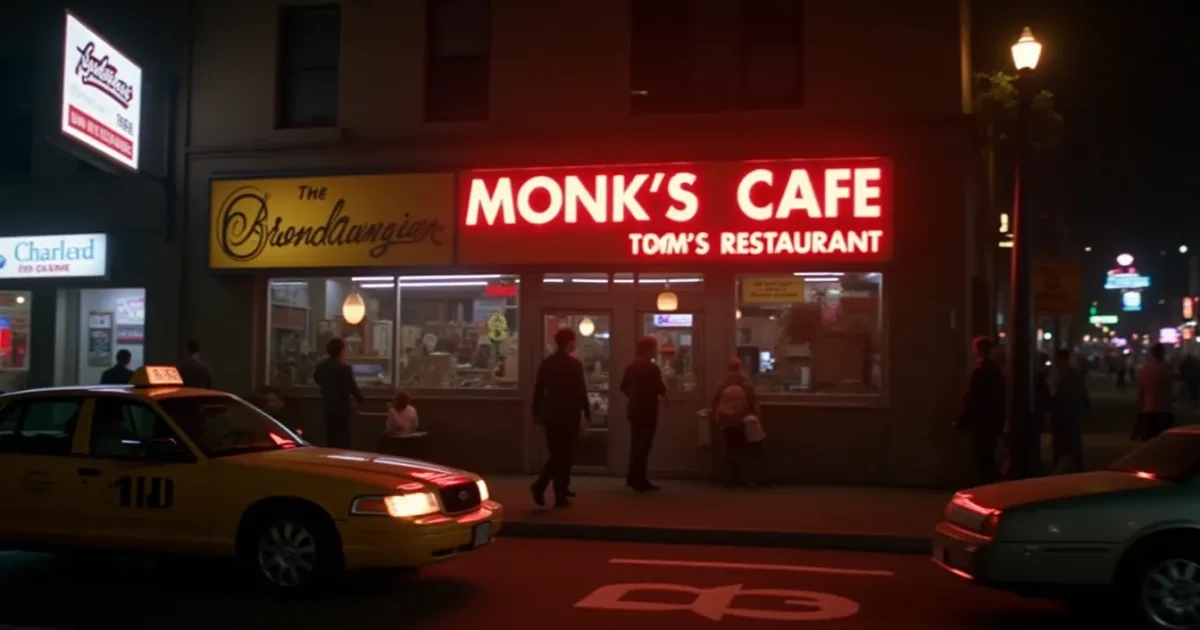
In parallel with MP3 and the DNA remix, Tom's Restaurant got a second cultural life. In 1989 NBC's new sitcom Seinfeld picked the Tom's facade as the show's visual signature. All 9 seasons of Seinfeld (1989-1998) open on a shot of Tom's Restaurant - but renamed on screen as “Monk's Cafe”.
A coincidence: Vega picked Tom's in 1981, Larry David and Jerry Seinfeld picked it in 1989 - independently. By 2024 Tom's Restaurant has three intersections with global culture: Vega's song, Seinfeld, and MP3 tests.
The restaurant still operates on the corner of 112th and Broadway (opposite Columbia University). The owner told the New York Times in 2020 that every week 50-100 tourists show up looking for “the place”. By 2015 Google Street View had the entrance tagged as “location from the song Tom's Diner”.
Vega keeps touring
After 1990 Suzanne Vega released eight more albums. None matched “Tom's Diner” and “Luka” (#3 Billboard 1987). But she remains an active folk performer, giving 30-40 concerts a year worldwide. At every show she plays “Tom's Diner” - with warm irony, telling the MP3-test story.
In 2015 Karlheinz Brandenburg appeared with Vega at TEDxBerlin-2015 - he described the MP3 tests, she sang “Tom's Diner” a cappella. It's one of the few public interactions between two people who changed digital music in very different ways.
Why “Tom's Diner” is so technically important
An a cappella voice is the hardest thing to compress. Instruments mask artefacts: if an MP3 codec slightly distorts a synth sine wave, the listener won't notice - other instruments “cover” the error. A voice is naked. Every “sss”, every “f”, every fine intonation is audible without cover.
That's exactly why Brandenburg picked “Tom's Diner”. If MP3 could compress her voice without loss to the human ear, it could compress anything. Today every time you listen to music in MP3, AAC, or Opus, you're hearing an algorithm that was polished on Suzanne Vega's voice.
What to listen to next
For the minimalist folk-pop aesthetic of the 80s: Suzanne Vega “Tom's Diner” → Tracy Chapman “Fast Car” (1988) → Indigo Girls “Closer to Fine” (1989). Three American folk singers, each of whom built a minimalist hit that outlived its decade.
For the “song that became a cultural standard outside music” parallel, try Yello “Oh Yeah” (1985) and Katrina and the Waves “Walking on Sunshine” (1985). All three - songs whose cultural reach exceeds their musical fame: “Oh Yeah” in film, “Walking on Sunshine” in advertising, “Tom's Diner” in technology.