

September 1989. Belgian project Technotronic, created by producer Jo Bogaert back in 1987, releases "Pump Up the Jam" - a single that will reach #2 on the Billboard Hot 100 and set the tempo for the entire following decade. The 90s disco does not begin on 1 January 1991, but right here: when the four-on-the-floor kick and synth bass from Frankfurt and Brussels studios hit dancefloors across Europe - and then, with a delay, Russia. Below is the mechanics: what got into rotation, where DJs sourced their records, and how the Russian 90s dancefloor differed from the European one.
What played on the dancefloor: Eurodance as the main format
By the early 1990s, Eurodance dominated European dancefloors - a genre fusing house, techno, hip-hop and pop structure. According to the English Wikipedia article on Eurodance, the genre "originated in the late 1980s in Western Europe" and was aimed at mass club audiences and radio. Tempo - 110 to 150 beats per minute, four-on-the-floor kick on every beat, male rap in the verses and female vocals in the choruses. This formula worked almost flawlessly for eight years.
The timeline of the major hits that defined what played on 90s dancefloors:
- 1989 - Technotronic "Pump Up the Jam" (vocals by Ya Kid K), Black Box "Ride On Time" (July, best-selling UK single of the year, house piano on a Korg M1)
- 1990 - Snap! "The Power" (#1 in the Netherlands, Spain, Switzerland, the UK). Snap! were assembled in Frankfurt by Michael Münzing and Luca Anzilotti (working under the pseudonyms Benito Benites and John "Virgo" Garrett III)
- 1992 - Snap! "Rhythm is a Dancer", Dr. Alban "It's My Life"
- 1993 - 2 Unlimited "No Limit" (a Belgian-Dutch project by producer Jean-Paul De Coster), Haddaway "What Is Love"
- 1994 - Rednex "Cotton Eye Joe", Real McCoy "Another Night", Scatman John "Scatman (Ski-Ba-Bop-Ba-Dop-Bop)"
- 1995 - Scatman John "Scatman's World", the last major hit of classic Eurodance: #1 on the Eurochart Hot 100 for three weeks in late August - early September
In May 1995, seven Eurodance songs sat in the Italian top-10 simultaneously. The genre's peak ran from 1992 to 1996; after 1995 producers began drifting toward happy hardcore and house, and by the end of the decade classic Eurodance had morphed into progressive house.
Meanwhile the rave scene was building in parallel: in July 1989, German DJs Westbam and Dr. Motte held the first Love Parade in Berlin - 150 people turned up. By the mid-90s the Love Parade was a march of half a million, and Eurodance hits blasted from float speakers just as they did from club systems. But it was the single format - three minutes with a hook up front - that determined what reached an ordinary 90s disco, not a rave.
More on the European side of this story in the article on Eurodance of the 90s and beyond and the breakdown of the pivotal year 1992.
Where a DJ in Russia got the music
A European DJ in 1992 bought vinyl at a specialist record shop or received promos from a label. In Russia, a different system operated. The main source of records for DJs and music fans was Gorbushka - a market in Moscow near the Gorbunov Palace of Culture, which grew out of a phonograph collectors' club founded in autumn 1987 by publisher Igor Tonkikh (the club's first chairman was Boris Simonov).
In the 1990s Gorbushka sold vinyl, reel-to-reel tapes and cassettes - branded records were expensive, pirate copies of rare albums and compilations cheaper. In 1992-1993 the first compact discs appeared on the market, beginning to displace cassettes. By mid-decade the stalls had expanded: alongside music they sold players, tape decks, posters and T-shirts with band images.
Detail: Gorbushka had its own music chart, as popular as FM radio charts. The repertoire was built on what people actually bought, not on what radio played.
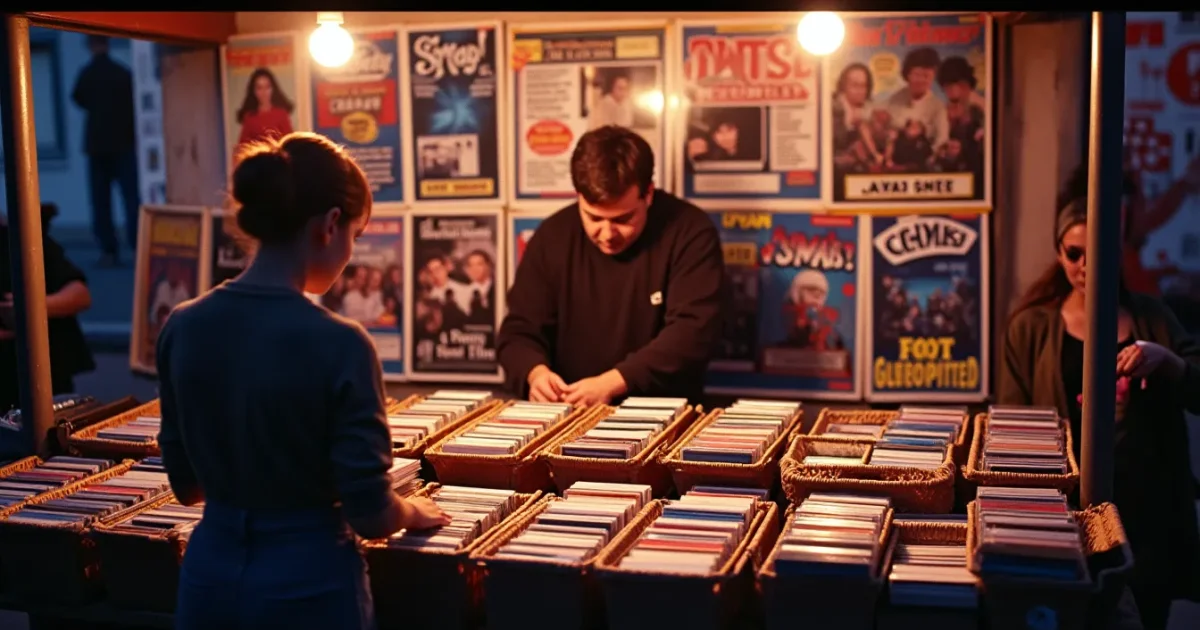
In 1997 Gorbushka entered the Guinness Book of Records for "fastest piracy": on the day Bill Gates announced the launch of Microsoft Office 97, pirate copies were on sale at the market four hours later, ten times cheaper than the original. The same logic applied to music - licensed discs were too expensive, and the wider audience had no internet yet. The market closed in January 2001, when a law banning the open-air sale of audio and video products came into force.
How the Russian dancefloor differed from the European one
The main difference was lag. A track that became a hit in Europe in 1992 reached Russian 90s disco rotation a year or two later, when cassettes and compilations filtered through to the provinces. A European DJ got vinyl the week of release; a DJ in Syzran got a cassette copy of a copy six months later.
The second difference was terminological. In Russia and Eastern Europe, "Eurodance" covered a broader range of dance pop than in the West: euro house, happy hardcore, hands up, italodance and adjacent genres all fell under the label. On release covers from 1992-1996 the word "Eurodance" barely appeared - producers and labels themselves used "dance", "club music" or "techno". The term settled retroactively, in the late 1990s, in compilations and record-shop catalogues.
The third was domestic production. Kar-Man (Sergey Lemokh and Bogdan Titomir) began performing in November 1989, and on 1 January 1990 the duo signed a three-year contract with the Gala studio. Their first album, "Vokrug sveta" ("Around the World"), came out in 1990. At Kar-Man concerts, their "dance machine" - a five-person dance troupe - took the stage to Technotronic's "Pump Up the Jam" and DNA feat. Suzanne Vega's "Tom's Diner": Western Eurodance was already working material for Russian dance routines. Kar-Man's 1994 album "Russkaya massirovannaya zvukovaya agressiya" is one of the few Russian-language albums entirely in the Eurodance style. Bogdan Titomir left the group in April 1991 for a solo career, and Lemokh re-recorded all of his former partner's vocal parts for the album "Karmania" (summer 1991). Lemokh later wrote songs for Lada Dance and Natalya Vetlitskaya - a producer model not unlike his Frankfurt colleagues, just in Moscow.
Other names defining what the Russian 90s disco played: Ruki Vverh!, Kombinaciya, Lada Dance, Mal'chishnik (founded spring 1991, one of the first rap groups in the USSR; their debut album "Pogovorim o sekse", 1992, sold over a million copies), Bad Balance, Na-Na, Ivanushki International. In the 1990s the top-selling albums moved about 1.5 million copies across Russia - but with piracy factored in, real listening figures were many times higher.

Shadow vocalists: who actually sang
Eurodance was a producer's genre: projects were assembled around a single, and the face in the video did not always match the voice on the record. According to the Russian Wikipedia article on Eurodance, the "shadow" vocalists who lent their voices to many hits include Nana Hedin, Giovanna Bersola (Jenny B), Sandra Chambers (Sandy) and Ennerly Gordon (Ann Lee). The producer built a "visual" image of the project for promotion and filming, keeping the real singers in the shade - a scheme that worked on the Russian dancefloor the same way it did on the European one.
Why exactly this got into rotation
Three factors determined what reached the 90s disco - foreign and Russian alike. First: a four-on-the-floor kick at 110-150 BPM - a tempo at which it is physically comfortable to dance, neither too fast nor too slow. Second: a verse-chorus structure with a recognisable hook in the first ten seconds - a DJ dropped the needle and immediately knew whether the floor would take it. Third: compilations. At Gorbushka and in kiosks they sold cassette and CD compilations - "Dance Machine" (a French series of same-named TV concerts running for several years), Italian compilations - and it was these that shaped a provincial DJ's repertoire, not label promo mailings.
Vinyl, cassette, CD: what changed on the dancefloor
The format determined not only the sound but the DJ's behaviour. Vinyl gave control - you could smoothly mix tracks, loop a break, beat-juggle. But vinyl was expensive and wore out. Cassettes were cheaper, but rewinding and finding the right track killed the set's momentum: the DJ played a cassette end-to-end and went outside to smoke while it ran. The compact disc, which appeared at Gorbushka in 1992-1993, gave instant access to any track - but the first CD players cost several months' wages and were not available to every DJ.
By the mid-90s, all three formats coexisted on the 90s disco. Large clubs in Moscow and St. Petersburg worked with vinyl and CD; provincial community centres used cassettes dubbed from those same CDs. The technical gap between the capital and the periphery was no smaller than the musical one: what was already club-sound standard in Europe existed in the Russian provinces as a cassette copy played through Radiotehnika speakers.
When Eurodance started losing pace after 1995, new rhythms arrived on the 90s dancefloor - but that is a different story, tied to the shift from analog turntables to CD players and the first MP3s. On how Eurodance related to its predecessors, read the breakdown of the transition from disco to Eurodance; on what was later done with those tracks, see the selection of Eurodance covers of the 90s.
Kar-Man's album "Russkaya massirovannaya zvukovaya agressiya" came out in 1994 - the same year Scatman John held #1 on the Eurochart and seven Eurodance songs sat in the Italian top-10. Russian Eurodance and European Eurodance existed simultaneously - one just came from a cassette copied at Gorbushka, the other from an official vinyl pressing.