
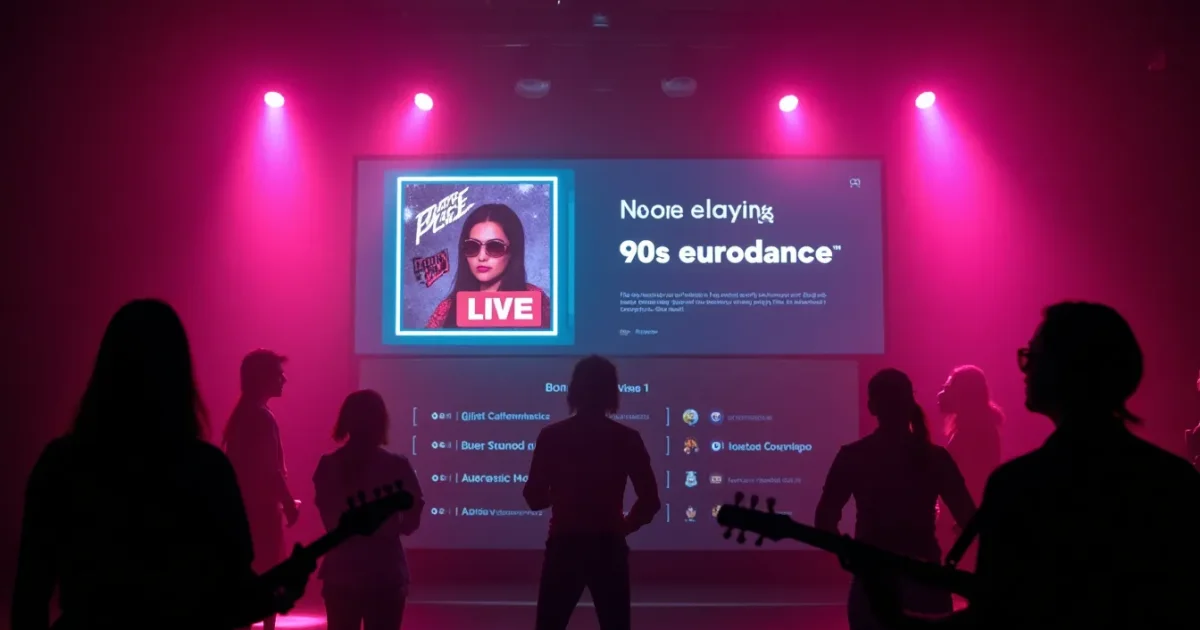
50 published tracks, and the server keeps 30 of them in memory as "recently played." That arithmetic is what the decade:90s channel is built from: while you listen to 90s music non-stop, the broadcaster strikes the last 30 songs off the queue and keeps them at least thirty positions away. The result is a stream where repeats are spaced far enough apart that you stop noticing them - even though the pool is only fifty tracks deep.
The decade itself is stitched to the catalog hard: decade:90s is everything published with an original release year from 1990 through 1999. But "year" here is not the date the track was added to the catalog; it is the original release year, and that distinction is load-bearing. The year column on every track reads 2024-2026 (when the record entered the site), and filtering on it would leave only decade:20s. So the channel cuts on original_year instead: a 2025 remix of a 1993 eurodance track sits in decade:90s, not decade:20s - because the original came out in 1993.
Stream versus playlist - where the line is
The difference between "stream" and "playlist" is not in the buttons but in who holds the position. In a playlist the position is yours: you queue the first track, then the next, you can scrub, shuffle, go back. In a stream the server holds the position: you join an air already in progress and catch the track at the second it sits at right now. That is why on decade:90s you cannot "play next" - the prev/next and shuffle buttons in the player are disabled, and a LIVE badge burns on the card.
The rest follows from that. You cannot scrub inside the air - the progress bar is locked, because your scrub would desynchronise you from the other listeners. You cannot pick a specific song - you get whatever is playing now, the way broadcast radio works. The trade-off is that you do not have to pick anything: press play and listen for hours while the server minds the order and keeps the repeats away.
- Playlist: the position is yours. You control order, tempo, scrubbing. Suits when you know what you want.
- Stream (broadcast): the position lives on the server. You join the shared air. Suits when you want "press play and stop thinking."
- Personal stream (favorites): a hybrid - the position is yours, but the server picks the next track from your likes, excluding the last 50.
90s music non-stop: how the channel is assembled
Decade:90s is a broadcast channel, which means synchronous. A single row in the radio_broadcasts table holds a pointer to the current track for all listeners at once: the id, the start time, the duration. Every 20 seconds the browser hits /api/radio/sync, gets those numbers back and seeks to the computed position. As long as the track has not changed, the server answers 304 Not Modified - 19 of every 20 requests, almost no traffic. Five hundred milliseconds before the track ends the client re-asks forcefully, the server catches the rollover and hands out the next record.
The audio itself is MP3, re-encoded through libmp3lame at 44,100 hertz and 160 kbit/s by default (the bitrate is clamped to a 96-224 kbit/s corridor by configuration). Each track has two files: a stream copy for playback and a full-size source for download. The full mechanics of sync, buffering and drift are unpacked in the continuous stream breakdown - I am not repeating them here, I am showing what makes this channel specifically the 90s channel.
Why the rotation does not repeat
The secret is the history window. Every time the channel moves to a new track, the broadcaster logs the just-played id into the radio_broadcast_history table. At the next rollover it takes the last 30 played ids and passes them in the exclude parameter to the next-track picker. The picker walks the shuffled pool and returns the first record that is not among those thirty. With a 50-track pool that means the same song will not come back to the air until at least 30 others have played.
The pool is not recomputed on every request - that would kill the database on a large catalog. Instead the id list is cached for 30 minutes and shuffled once in PHP, not through ORDER BY RAND() in SQL (which does not scale on big tables). When the cache expires the pool is rebuilt and reshuffled - the order inside the window refreshes, but the 30-track "already played" window keeps the repeat still far off.
Detail: if a track has no duration stored, the server substitutes 180,000 milliseconds - three minutes as a safe default. It is a rare import-without-metadata case, but it explains why a progress bar sometimes "catches up" to the end slightly ahead of the actual sound.
Decade versus genre, top and fresh
To see what sets decade:90s apart from its neighbours, it helps to look at how the other pools are cut. A genre channel pulls tracks by tag from the genres table: "Russian Pop" collects 141 records, "Eurodance" 97, "Electro House" 62. A decade channel ignores tags entirely - only the original year. So decade:90s overlaps with the genre channels but does not coincide with them: its 50 tracks hold eurodance, Russian pop and things that do not get a channel of their own in the genre grid.
The "Top" channel works a third way - by play_count. It serves up to 300 most-played tracks, and the first 100 are duplicated in the pool so hits come up more often than the long tail. "Fresh" cuts by publication date: a 180-day window, a 60-track cap, and a fallback to the 20 freshest if nothing has been published in half a year, so the channel does not vanish from the storefront. Both top and fresh draw from all years and genres; decade:90s draws only from its decade.
- decade:00s - 69 tracks, the largest decade pool in the catalog.
- decade:90s - 50 tracks, second largest.
- decade:80s - 7 tracks: the channel exists, but the pool is thin and repeats come faster.
- decade:70s - 2 tracks and decade:20s - 4: they drop under noindex,follow and are absent from the grid.
The 5-track threshold separates "a real air" from "one or two songs under a label." Decade:90s, with fifty, sits well on the safe side of that line, and the 30-track history window works at full strength here. On decade:80s, with seven records, an exclude of 30 is physically unworkable - the server simply cannot find 30 non-repeating ids, and a repeat arrives quickly.
What lands in decade:90s
The 50-track pool is not a random sample but the entire published catalog with original_year between 1990 and 1999. By genre tagging the bulk falls to eurodance and Russian 90s pop - the two currents that defined the dancefloor in that decade. Who exactly stood behind the European eurodance of the period is unpacked separately in the survey of international 90s eurodance, and 1992 as the year the genre's formula crystallised - in the 1992 breakdown.
It is worth understanding that decade:90s is not "eurodance only." Anything published with an original year in range enters the pool - Soviet-song reworks in a 90s key, late italo-disco, Russian synth-pop from the start of the decade. The channel filters on year, not genre, so the air inside a decade comes out more mixed than a single genre channel.
Technically the stream rides on MP3 - a codec with nearly thirty years of history. MPEG-1 Audio Layer III was developed by a Fraunhofer Institute group under Karlheinz Brandenburg; the algorithm was calibrated on Suzanne Vega's "Tom's Diner," which is why Vega is half-jokingly called the "mother of MP3." On 23 April 2017 the last patents expired and manufacturer licensing fees stopped. At 128 kbit/s a file shrinks roughly elevenfold against uncompressed CD-Audio (1,411.2 kbit/s); the 160 kbit/s the stream uses lands in the zone where degradation is inaudible on ordinary speakers. In 2004 listening tests the LAME encoder produced the closest-to-original sound exactly at medium bitrates from 128 kbit/s up.
The channel's edges, worth knowing
A broadcast channel means: you walk in and immediately hear a track from the middle. That is not a bug but a property of synchronous air, and it takes getting used to if you came for a specific song. If you need a specific song, it lives in the catalog by direct link; decade:90s exists for the other mode - "press play and listen for hours."
The second limit is the mobile network. HTML5 audio buffering eats 1-3 seconds between load and sound, and on a poor connection a sync request can hang to a 10-second timeout. On broadcast the player finishes the buffered chunk and waits for the network to return; on a personal channel three errors in a row stop the stream. For decade:90s that means the air holds up better on the road than "favorites" does - the current track's buffer covers short connection drops.
There are system limits shared by every broadcast channel. Open decade:90s in a second tab and the first stops quietly - two streams do not hammer the API at once, and that is controlled through localStorage without a server round-trip. The sync endpoint is guarded by a rate limit: under request flooding from one IP the server answers 429 with a Retry-After header, and the client backs off exponentially. The /radio/decade:90s page ships schema.org markup - RadioBroadcastService as the broadcasting service and MusicPlaylist as a description of the air's content, without listing 50 tracks by hand.
So decade:90s is fifty tracks from 1990-1999, a synchronous pointer on the server, and a 30-position history window that keeps repeats at a distance. The LIVE badge on the card is not decoration but an honest signature of how the channel is built: you join an air that runs independently of you and catch it at the second it sits at right now.