

1 February 1980: the single “Call Me” by Blondie is released on the American Gigolo soundtrack by Polydor Records. Producer - Giorgio Moroder. Music by Moroder, lyric by Debbie Harry in one evening in Los Angeles. By the end of March - #1 Billboard Hot 100 (six consecutive weeks). #1 UK (April 1980, one week). #1 in Canada, Australia, the Netherlands, Belgium, New Zealand. Billboard named “Call Me” its #1 single of 1980 - ahead of “Another One Bites the Dust” by Queen and “Rock with You” by Michael Jackson. Total global sales by end 1981 - 6 million copies. It's Blondie's biggest US hit (bigger than “Heart of Glass”, bigger than “Rapture”) and one of the five best-selling singles of the decade.
How Moroder called Blondie
In October 1979 Giorgio Moroder was working on the soundtrack for Paul Schrader's American Gigolo. The film's lead - Julian (Richard Gere), a high-end male escort in Los Angeles. Moroder wrote the main theme and an opening song. He needed a female vocal - star-level, recognisable, with a club presence.
The first offer went to Stevie Nicks of Fleetwood Mac. Nicks declined - she was under an active Atlantic Records contract that prohibited solo releases on other labels. Second pick: Donna Summer, Moroder's long-time partner. Summer also declined: she was moving toward jazz and Christian material and considered American Gigolo a too-provocative premise.
Third candidate - Blondie. Moroder personally called Debbie Harry at her New York apartment on Third Avenue on 12 December 1979. Harry agreed for a fee of US$35,000 plus 5% royalties on soundtrack sales.
A detail: Moroder delivered the already-finished instrumental recording to Harry. Vocal melody, chords, arrangement - everything was ready. All she had to do was write a lyric and sing. That was unusual: usually a vocal writer creates lyric alongside the composer, in parallel.
A lyric in one evening
Debbie Harry flew to Los Angeles on 3 January 1980. Given a cassette with the instrumental, she wrote the lyric that evening, over four hours, sitting in her Chateau Marmont hotel room. Her opening line - “Colour me your colour, baby” - came to her in the shower.
The lyric - about a woman calling a lover. Double meaning: could be a sexual liaison, could be one of the protagonist's clients in American Gigolo. Harry deliberately left the interpretation open. The line “Call me, call me any, anytime” became the main hook.
“I wrote the lyric in an evening because Moroder's music spoke for itself. I only needed to give it a voice. The words came easily. Giorgio later said I'd done his work - I wrote the lyric already in the rhythm, already knowing where each line should fall”, - Debbie Harry in her memoir Face It (2019).
Tracking at Rusk Sound Studios
Recording ran 8-12 January 1980 at Rusk Sound Studios on Holloway Drive in Los Angeles. Budget: US$120,000 (a large budget for a soundtrack single). Tracking took 5 days.
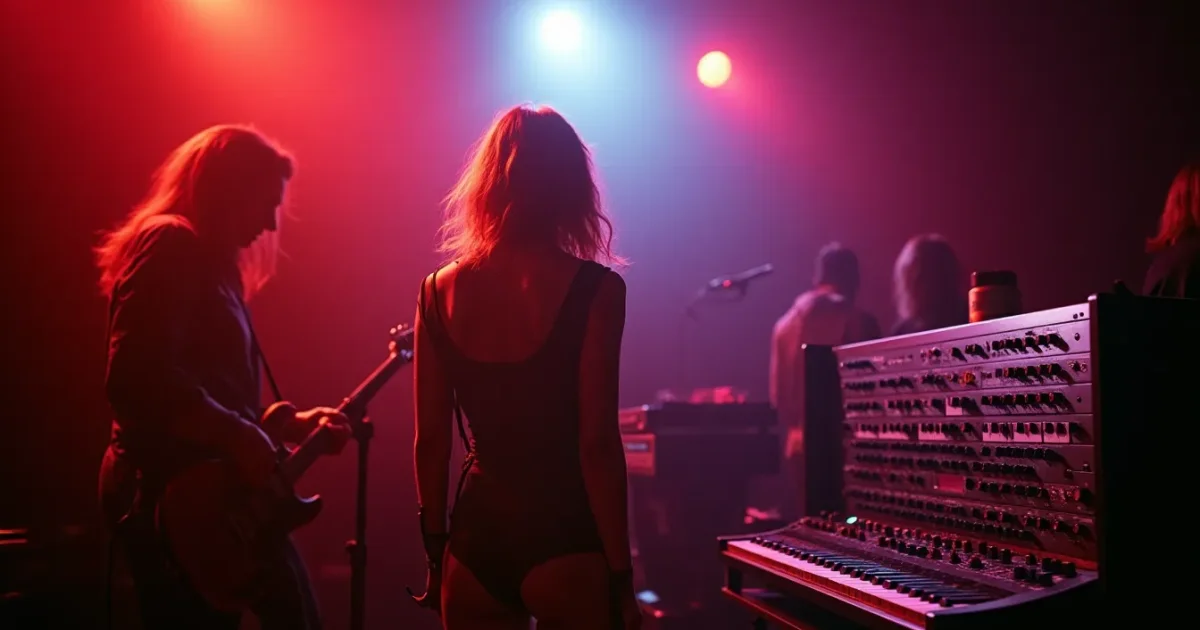
- Moog Modular System 55 - bass sequence (Moroder's signature sound from “I Feel Love”)
- Roland MC-8 Microcomposer - program sequencer, sync-locked to the Moog
- Sequential Prophet-5 - lead in the chorus
- ARP 2600 - pads and arpeggios
- Oberheim OB-X - additional pad
- Kapton Kuston - live drums (session drummer Harold Mason)
- MCI JH-636 32-channel console
Debbie Harry tracked vocals on 9 January, 22 takes in one day. Moroder left her alone in the studio, went to a nearby restaurant for lunch. When he returned three hours later, Harry said: “Done.” Moroder listened to all 22 takes, chose take 12 - the one where her voice was “dry”, without emotional excess.
The Moroder signature formula
“Call Me” is built on the same structural elements Moroder used on “I Feel Love” Donna Summer (1977):
- Moog sequence - a 16-step bass in Em, running the whole track without interruption
- Synchronisation - MC-8 Microcomposer linked to the Moog via CV/Gate, giving perfect rhythmic accuracy
- Tempo 132 BPM - the upper boundary of Munich disco
- String pad - Prophet-5 with slow attack, like a “cloud” over the sequence
- Dry, almost-speaking vocal - warm voice against cold electronics
The only difference from the Munich formula - live Bernard Edwards bass. Moroder added it to make the track sound “fuller” for US radio, which in 1980 preferred warm bass to digital.
Numbers
- US: #1 Billboard Hot 100, six weeks (19 April - 31 May 1980); platinum
- UK: #1 UK Singles Chart, one week (April 1980); silver
- Canada: #1 RPM, four weeks
- Australia: #1, two weeks
- New Zealand: #1, five weeks
- Netherlands: #1, three weeks
- Germany: #3
- France: #5
- Billboard Year-End 1980: #1 single of the year
- Total global sales by end 1981: 6 million copies
Spotify 2024 - over 890 million streams - higher than “Heart of Glass”. YouTube video - 200 million views.
Why “Call Me” matters more than “Heart of Glass”
Historically, “Heart of Glass” (1979) is considered Blondie's defining song - that first punk-band-does-disco moment. Commercially, though, “Call Me” outperformed “Heart of Glass”:
- “Heart of Glass”: 4M copies; #1 UK 4 weeks, #1 US 1 week
- “Call Me”: 6M copies; #1 US 6 weeks, #1 Billboard Year-End 1980
“Call Me” also laid the groundwork for “Blondie on soundtracks”: it was followed by “One Way or Another” in Coach (1989), “Atomic” in Trainspotting (1996), “Dreaming” in Rock of Ages (2012). That made Blondie one of the most frequently used bands in 80s and later cinema.
What “Call Me” gave Moroder
For Moroder “Call Me” was the biggest American commercial hit of his producer career - bigger than Summer's “Love to Love You Baby”, bigger than “Flashdance... What a Feeling”. It secured his status as “American top-tier producer”, which three years later led to Flashdance (second Oscar) and three years after that to “Top Gun” (third Oscar).
Without “Call Me”'s commercial success in 1980, Moroder would have remained a European producer in the US market. With “Call Me”, he became a Hollywood power player.
Place in pop-music history
“Call Me” is a fusion of two schools: New York new wave (Blondie) and Munich disco electronics (Moroder). Before 1980 these two schools existed separately. After “Call Me” it became clear: genre boundaries can dissolve if the right producer works with the right vocalist. It paved the way for later cross-genre collaborations: Trevor Horn + Yes (1983), Nile Rodgers + Bowie (1983), Quincy Jones + Michael Jackson (1982).
Related: “Heart of Glass” Blondie, “I Feel Love” Donna Summer, Moroder's Munich Sound. Blondie never matched “Call Me” - the follow-up “The Tide Is High” (1980) did hit #1 UK, but it was already a reggae remake, not Moroder electronics. Debbie Harry and Moroder did not work together again after 1980. But that one phone call from Moroder to the Third Avenue apartment in December 1979 gave Blondie their biggest career hit and Moroder the US market.